Core Conclusion
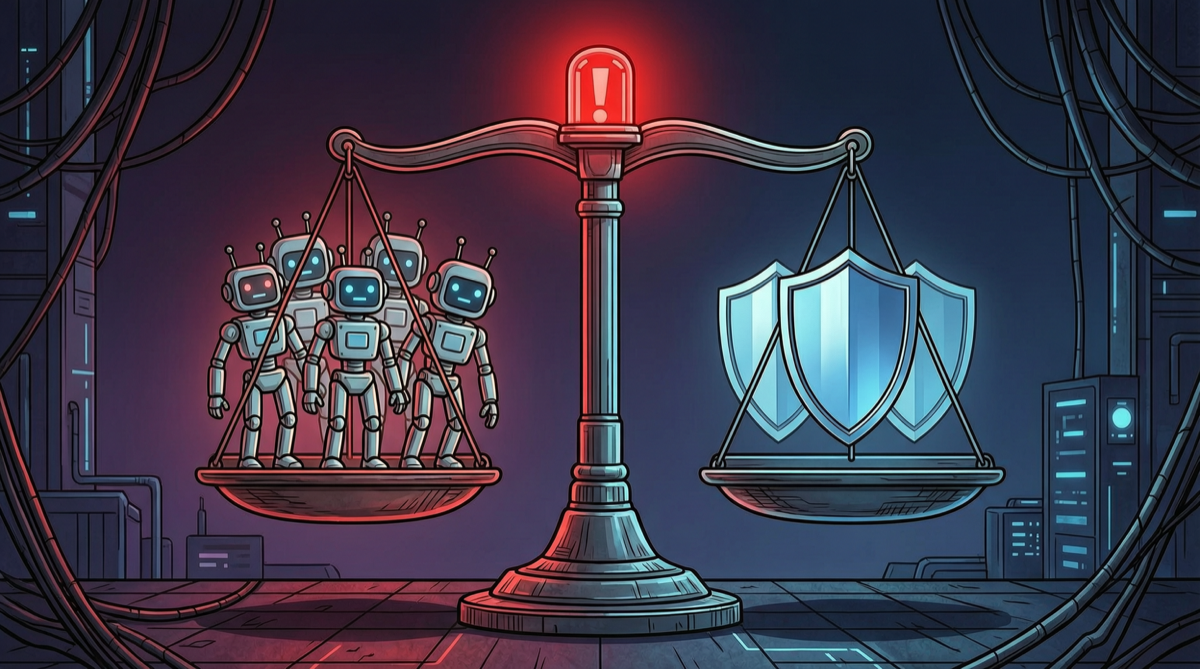
The deployment speed of AI Agents has far outpaced the development of governance capabilities. Latest data from May 2026 reveals an unsettling reality: 74% of enterprises are running AI Agents in production environments, but only 21% have mature governance mechanisms. This means more than half of enterprises are letting autonomous AI systems make real business decisions without effective oversight.
What Happened
Data Overview
| Metric | Value | Meaning |
|---|---|---|
| Enterprises deploying Agents | 74% | Most enterprises have entered Agent operational phase |
| Enterprises with mature governance | 21% | Only one-fifth have established complete governance frameworks |
| Governance gap | 53% | More than half of enterprises are in a “naked” state |
| Daily real decisions by Agents | Millions | Procurement approvals, code merges, customer replies, etc. |
Specific Manifestations of the Governance Gap
1. Lack of Permission Management
Most enterprise Agents have system permissions that exceed their task needs:
- Reading production databases
- Sending customer emails
- Merging code to main branches
- Calling payment APIs
But there is a lack of fine-grained permission isolation and the principle of least privilege.
2. Decision Audit Gaps
When Agents make wrong decisions (such as incorrectly approving refunds, merging buggy code), most enterprises cannot answer:
- What information was this decision based on?
- Which prompt or configuration led to this behavior?
- Who should be held responsible?
3. Insufficient Unauthorized Behavior Detection
Agents may:
- Access internal documents beyond their task scope
- Send sensitive data to external APIs
- Create unauthorized sub-Agents
Most enterprises lack the capability to monitor these behaviors in real-time.
Why It Matters
1. This Is Not a Theoretical Risk — It’s Happening Now
Unlike autonomous driving or medical AI, the special characteristic of the Agent governance crisis is:
- Already deployed: Not a future risk, but a current problem
- Highly concealed: Agent wrong decisions are often only discovered after the fact
- Broad impact: A single rogue Agent can trigger cascading reactions (calling other APIs, creating new Agents)
2. Regulation Is Approaching
- The EU AI Act has classified autonomous decision-making systems as high-risk categories
- Multiple US states are drafting Agent governance legislation
- Financial industry regulators have begun focusing on Agent applications in trading and risk management
3. Potential Consequences for Enterprises
| Risk Type | Possible Consequences | Case Reference |
|---|---|---|
| Data breach | Agent sending sensitive data to external models | Multiple reports exist |
| Financial loss | Incorrect approvals/transactions/pricing | E-commerce platform Agent error discounts |
| Compliance violation | Violating data protection regulations | GDPR/CCPA fines |
| Reputation damage | Agent generating inappropriate content | Multiple brand incidents |
What You Can Do
Governance Framework Self-Check List
Enterprises can evaluate their Agent governance maturity across the following dimensions:
Level 1 — Basic Controls
- All Agents have clear identity identifiers
- Agent activity logs exist
- Basic human approval processes exist
Level 2 — Intermediate Controls
- Permission isolation (least privilege principle)
- Abnormal behavior alerts
- Agent decision traceability
Level 3 — Mature Controls
- Automated policy enforcement (Agents cannot bypass security policies)
- Real-time decision auditing
- Cross-Agent behavior correlation analysis
- Regular governance review and updates
Action Priorities
- Immediate action: Inventory all deployed Agents and their permissions
- Within one week: Establish basic activity logging and auditing mechanisms
- Within one month: Implement permission isolation and anomaly detection
- Within one quarter: Establish a complete governance framework and review process
Tool Recommendation Directions
- Agent observability platforms (such as LangSmith, Smithery, etc.)
- Policy engines (define what Agents can and cannot do)
- Audit logging systems (record all Agent behaviors and decisions)