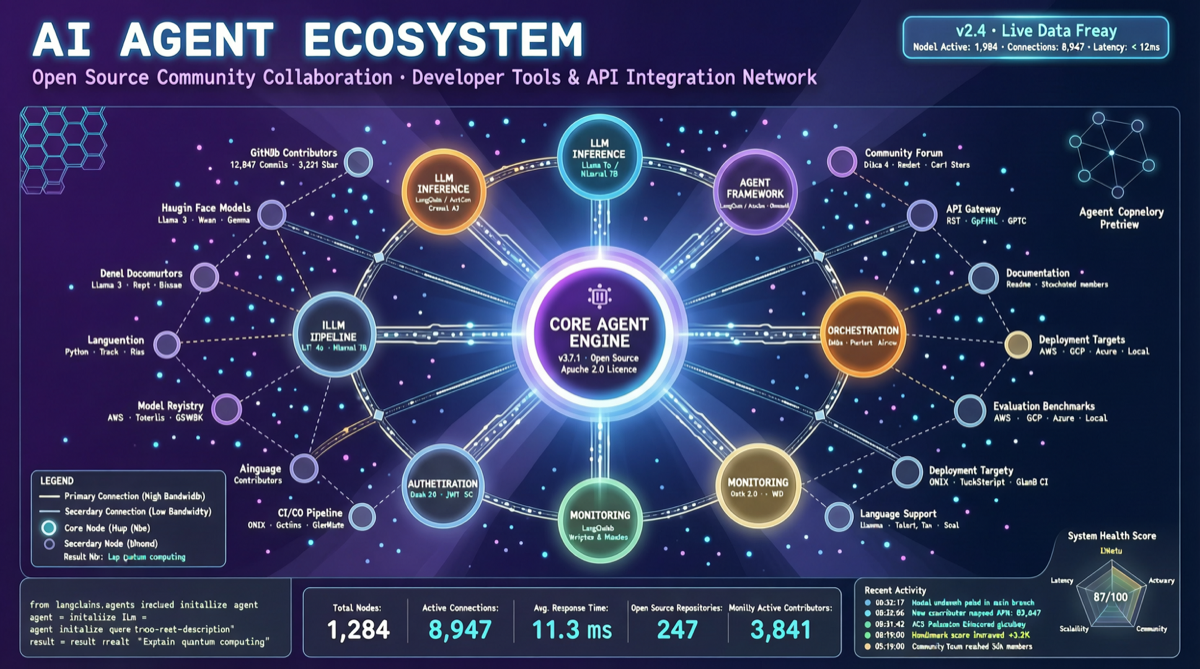
From Model to Ecosystem
While many are still debating whether DeepSeek V4’s performance has “declined,” DeepSeek has quietly done something more significant: opened an Agent Integrations repository specifically for collecting community integration solutions for Agents and Coding Agents.
This move signals more than any benchmark score—DeepSeek is shifting from “providing a good model” to “building an Agent ecosystem.”
What the Agent Integrations Repository Means
DeepSeek’s official @deepseek_ai account created this dedicated repository on GitHub with the purpose of:
- Collecting community feedback: Letting developers share how they integrate V4 into various Agent frameworks
- Establishing best practices: Consolidating tool calling, context management, and multi-Agent collaboration solutions for different scenarios
- Lowering integration barriers: Newcomers can reference existing integration patterns instead of starting from scratch
This parallels the development paths of frameworks like OpenClaw and Hermes Agent—a model’s value no longer depends on benchmark scores, but on how many Agent systems it’s integrated into.
V4’s Agent Capability Positioning
From community practice, DeepSeek V4 has several characteristics in Agent scenarios:
- Tool calling capability: V4’s tool call performance is stable, demonstrating reliable results in practical tasks like invoice processing
- Cost-effectiveness advantage: With May’s limited-time pricing discounts, V4’s cost advantage in heavy Agent scenarios is significant
- Open-source friendly: V4’s open-source nature allows the community to freely fine-tune and experiment with integrations
Developer testing shows that in invoice tasks, DeepSeek V4 Flash, GPT-5.5, and GLM-5.1 all correctly complete tasks, while some models fabricate data. This reliability is critical for Agent scenarios—Agents need predictable outputs, not occasional brilliance.
The Competitive Landscape of Chinese Agent Ecosystem
DeepSeek’s Agent Integrations repository is just one slice of the Chinese AI Agent ecosystem. The current landscape shows multi-layered competition:
Model Layer:
- GLM-5.1, Kimi K2.6, Qwen3.6 Max, DeepSeek V4 each have different Agent scenario performance
- Xiaomi MiMo-V2.5-Pro targets Code Agent with 1T parameters
- SenseNova U1 attempts a unified understanding-generation architecture
Framework Layer:
- Hermes Agent: Open-source Agent framework emphasizing Skill management and OS Pattern
- OpenClaw: Local Agent framework supporting Computer Use
- XiaoLongMao/LanMaoWeFu: Web interface tools supporting both OpenClaw and Hermes
Integration Layer:
- DeepSeek Agent Integrations repository
- Various community-built Agent orchestration and deployment solutions
Why Agent Ecosystem Matters More Than Models
The first half of large model competition was about “single-model capability.” The second half will be about “ecosystem integration.” The reasons are clear:
- Users don’t buy models, they buy solutions: Enterprises need Agent systems that solve real problems, not API call counts
- Integration cost is the biggest barrier: Even a strong model loses value if it’s hard to integrate into existing workflows
- Network effects: The more Agent frameworks support a model, the more community integration solutions are contributed, the thicker the ecosystem moat
DeepSeek opening its Agent Integrations repository is essentially accelerating this network effect.
The Deeper Meaning Behind Pricing Strategy
DeepSeek V4’s price discount runs through all of May. This isn’t just promotion—it’s ecosystem strategy:
- Lower trial costs: Let developers try V4 in Agent scenarios at minimal cost
- Capture user mindshare: During the window of intensive Chinese model releases, lock in users with cost-effectiveness
- Data flywheel: More developers using = more integration solutions contributed = better ecosystem = more users
Conclusion
Whether DeepSeek V4 falls short on certain benchmarks matters less now. What truly matters is: it’s becoming a reliable base model in the Agent ecosystem.
When a model’s Agent Integrations repository starts accumulating community contributions, when its tool calling is proven reliable in real scenarios, when its cost-effectiveness makes heavy Agent users able to afford it—that model has found its place.
The AI Agent era isn’t defined by the strongest model, but by the most widely integrated model. DeepSeek clearly understands this.