Bottom Line First
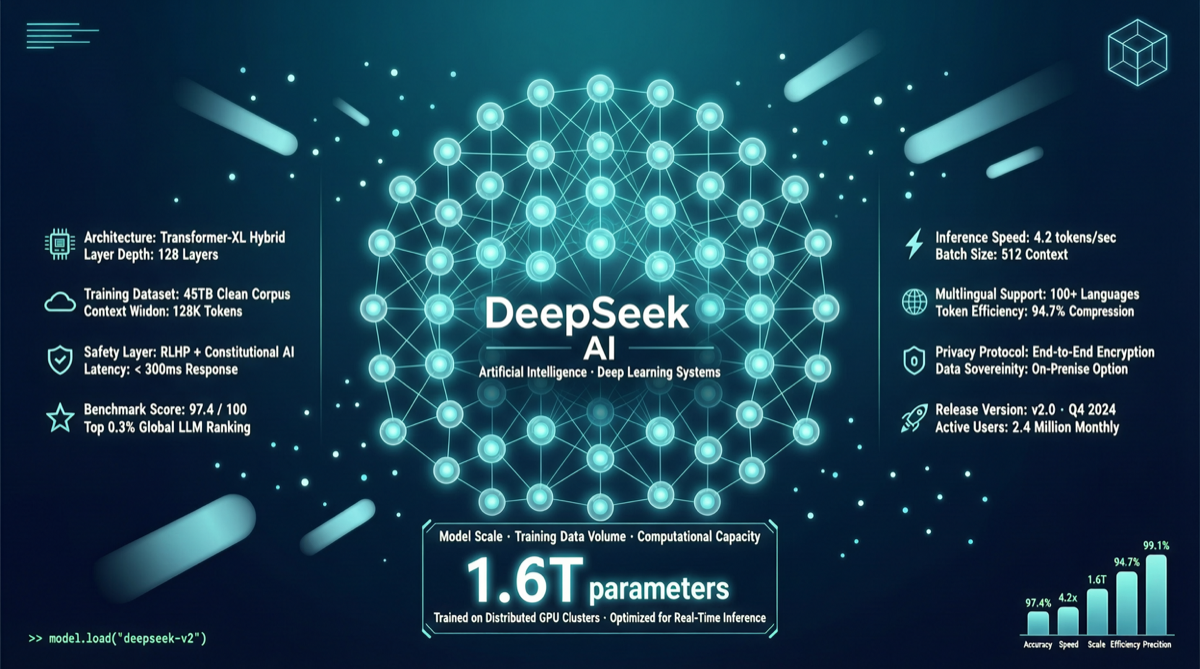
DeepSeek-V4 is not an incremental upgrade—it’s a direct challenge to the existing market pricing paradigm. The specs alone are staggering: 1.6 trillion parameters, only 37B activated, 1M context window, Apache 2.0 open-source. But what truly changes the game is the $3.48/M output tokens API pricing, slashing frontier closed-source model costs to 1/7.
Spec Overview
| Metric | DeepSeek-V4 | GPT-5.5 | Claude Opus 4.7 |
|---|---|---|---|
| Total Parameters | 1.6T | Undisclosed | Undisclosed |
| Activated Parameters | ~37B | Undisclosed | Undisclosed |
| Context Window | 1,000,000 | 128,000 | 200,000 |
| Open Source | Apache 2.0 | Closed | Closed |
| Input Price | $0.35/M | $2.50/M | $15.00/M |
| Output Price | $3.48/M | $30.00/M | $25.00/M |
| Inference Speed | 35x faster (vs. previous gen) | Undisclosed | Undisclosed |
| Energy Reduction | 40% (vs. previous gen) | Undisclosed | Undisclosed |
| Multimodal | Native text/image/video/audio | Yes | Yes |
Source: DeepSeek official technical report, model pricing pages (April 2026)
Why This Number Matters
The price gap is not marginal—it’s an order of magnitude. When DeepSeek-V4 Pro is priced at just 14% of Opus 4.7 and 11.6% of GPT-5.5, the logic of enterprise tech decisions fundamentally shifts.
The past justification for choosing closed-source APIs was “open source isn’t capable enough”—but current benchmark data shows DeepSeek-V4’s gap with Opus 4.7 on coding tasks is less than 0.2 points. For most production scenarios, this 0.2-point gap is nowhere near enough to justify a 7-9x price premium.
Architecture Breakdown: Why MoE Can Be Both Big and Fast
DeepSeek-V4’s 1.6 trillion parameters use MoE (Mixture of Experts) architecture. Key points:
- Sparse Activation: Each inference activates only ~37B parameters, 2.3% of total. This means actual inference cost is far lower than full-parameter models.
- 16 Expert Routing: The model contains multiple specialized “expert” sub-networks, automatically routing to the most relevant expert combinations based on input.
- 1M Token Lossless Context: Unlike many models with “effective context decay,” DeepSeek-V4 claims to maintain full attention mechanisms at the million-token level.
Implications for production deployment: You can run DeepSeek-V4 inference on a single 8×H100 server, while closed-source equivalents require remote API calls.
Early User Feedback
After late April launch, early users report:
- Response Speed: DeepSeek-V4 Pro delivers results in ~10 seconds for comparable tasks, vs. ~20 seconds for GPT-5.5
- Search + Reasoning: For queries requiring strong search and self-review, both produce consistent answers
- API Integration: Now supports integration with Claude Code desktop, expanding use cases
Landscape Assessment
DeepSeek-V4’s release marks the convergence of three trends:
- Open source models have crossed the “good enough” threshold: 90% capability + 1/7 price = optimal solution for most enterprise scenarios
- MoE architecture maturity: Sparse activation enables trillion-parameter models at reasonable deployment costs
- API price war is irreversible: Closed-source vendors must respond or lose the mid-tier market
Action Recommendations
| Your Scenario | Recommendation |
|---|---|
| Heavy closed-source API usage with high costs | Replace non-critical path calls with DeepSeek-V4 Pro first, expect 60-80% API cost savings |
| Need local deployment, data stays in-house | DeepSeek-V4 Apache 2.0 open weights can be downloaded and deployed directly |
| Need extreme coding capability (0.2-point gap matters to you) | Keep Opus 4.7 / GPT-5.5 for core coding scenarios |
| Budget-constrained, need high-volume calls | DeepSeek-V4 Pro discount extended to May 31—current optimal trial window |
DeepSeek discount offer valid through May 31, 2026.