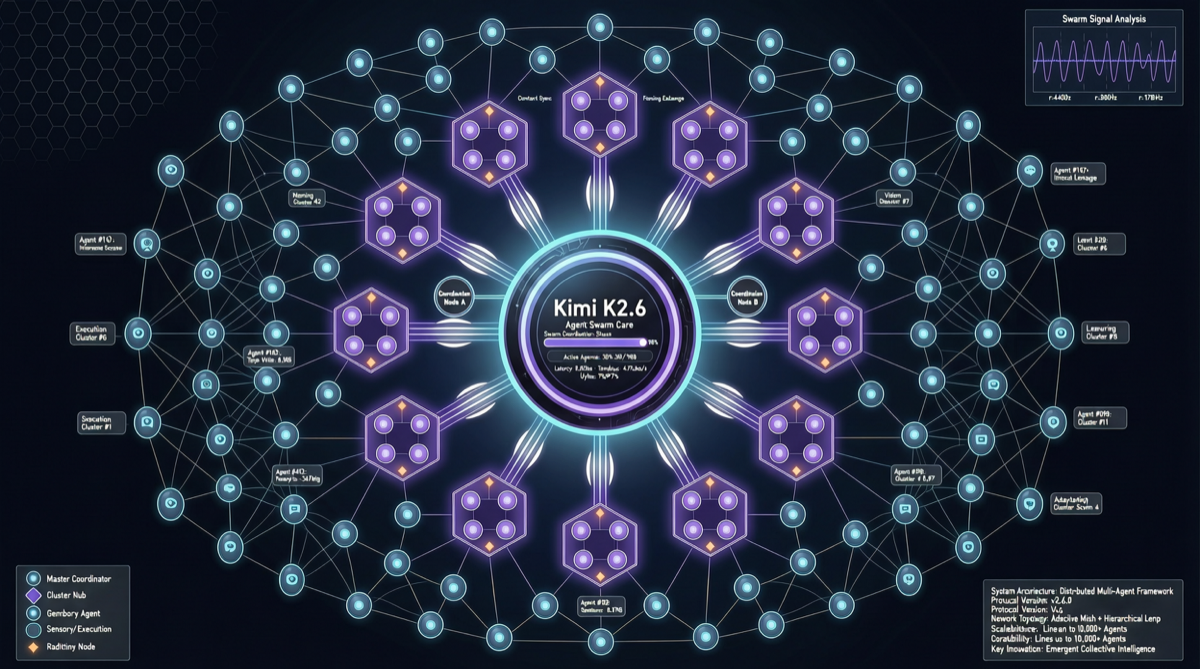
Moonshot AI has launched Agent Swarm on top of the Kimi K2.6 foundation model — not a routine API upgrade, but an orchestration system designed for ultra-scale complex tasks. The core numbers speak for themselves: 300 parallel sub-agents, 4,000 steps per run, 100+ files output at once.
Core Architecture Breakthroughs
Scale: The Leap from 100 to 300
| Dimension | K2.5 | K2.6 Swarm | Improvement |
|---|---|---|---|
| Parallel sub-agents | 100 | 300 | 3x |
| Single-run steps | 1,500 | 4,000 | 2.67x |
| Max output files | ~30 | 100+ | 3x+ |
| Typical task type | Single-project coding | Literature review / dataset / full-stack app | Qualitative leap |
Behind these numbers lies a systematic engineering reconstruction. 300 sub-agents is not simply splitting tasks — it requires solving task scheduling, dependency management, conflict resolution, and result aggregation, all challenges of distributed systems.
Output Is Files, Not Conversations
The most distinctive feature of K2.6 Swarm is output-as-product: a single run can deliver:
- 100K-word literature reviews: Automatic retrieval, reading, synthesis of hundreds of papers into structured review documents
- 20K-row datasets: Multi-source data scraping, cleaning, format conversion, and final delivery
- Full-stack application scaffolding: Frontend + backend API + database schema + deployment config, 100+ files generated at once
This changes the agent usage paradigm — from "conversational exploration" to "product delivery."
Capability Breakdown
Coding Benchmarks
Kimi K2.6's base model metrics already demonstrate competitiveness:
| Benchmark | K2.6 Score | Industry Comparison |
|---|---|---|
| HLE w/ tools | 54.0 | Open-source SOTA |
| SWE-Bench Pro | 58.6 | Approaching Claude Opus 4 |
| BrowseComp | 83.2 | Beyond GPT-5.5 |
| Math Vision w/ Python | 93.2 | Best in class |
Agent Swarm Typical Scenarios
Scenario 1: Long-Horizon Code Refactoring
300 sub-agents can simultaneously handle refactoring tasks across different modules, with the main agent coordinating merges. 4,000 steps are sufficient for full-scale analysis and modification of large codebases.
Scenario 2: Academic Research Automation
Input research question → Swarm automatically dispatches sub-agents for literature retrieval, summarization, viewpoint extraction, cross-validation → Output a multi-thousand-word review with citation溯源.
Scenario 3: Data Analysis Pipeline
From data discovery, cleaning, feature engineering to model training and visualization, each stage handled by specialized sub-agents, aggregated into a complete analysis report.
API Pricing and Market Positioning
Kimi K2.6 API is now live with aggressive pricing:
| Billing Item | Price |
|---|---|
| Input (cache hit) | $0.16 / M tokens |
| Input (cache miss) | $0.95 / M tokens |
| Output | $4.00 / M tokens |
Compared to peer models, this price range is highly competitive — especially in large-scale agent scenarios where cache hits at $0.16/M can significantly reduce Swarm multi-round interaction costs.
Landscape Assessment
The emergence of Kimi K2.6 Agent Swarm sends a clear signal: the second half of agent competition is about scale, not single-point capabilities.
- DeepSeek V4 takes the "parameter scale" route (1.6T MoE)
- Qwen 3.6 takes the "open-source + cost-effectiveness" route
- Kimi K2.6 Swarm takes the "agent orchestration scale" route
These three routes evolve in parallel, but ultimately converge on one question: who can make agents reliably complete the most complex real-world tasks?
Action Recommendations
- Researchers: Try Agent Swarm's literature review capability immediately — 300 sub-agents processing academic retrieval in parallel was previously impossible at this scale
- Developers: Integrate K2.6 into code refactoring workflows — 4,000 steps means you can cover full refactoring of medium-sized projects
- Enterprises: Evaluate K2.6's $0.16/M (cache hit) pricing against current agent workflow token consumption — potential 5-10x cost optimization
- Competitor watchers: Pay attention to whether OpenClaw, Hermes, and other agent frameworks will natively adapt to K2.6 Swarm's multi-agent interface