The Event
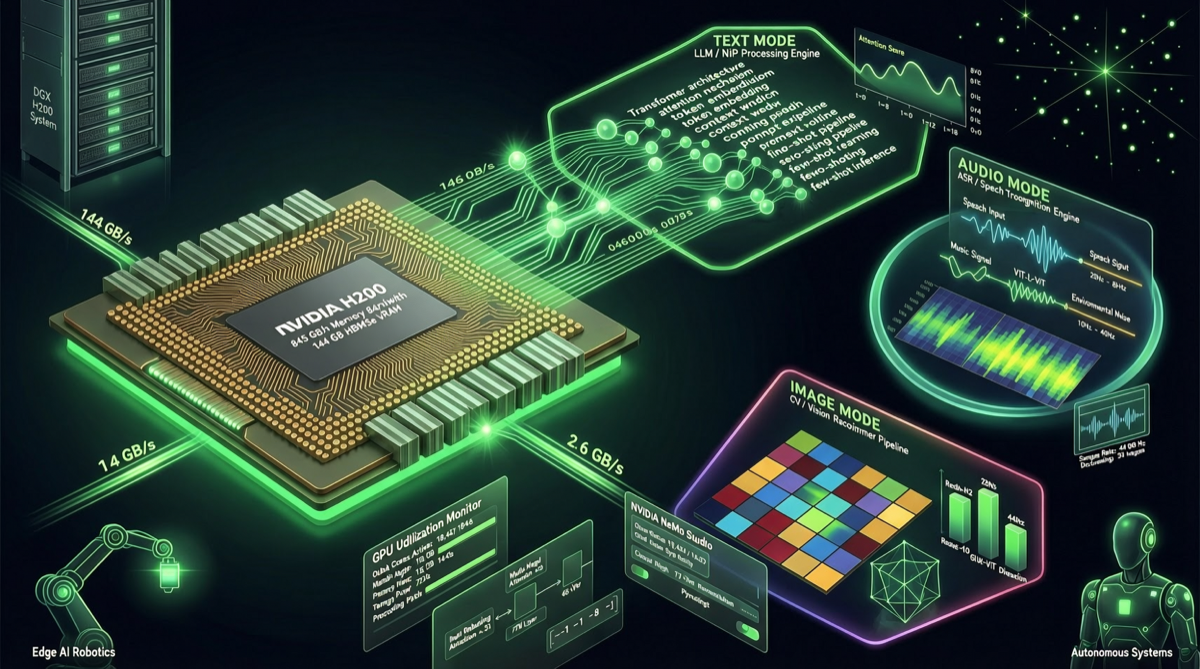
NVIDIA officially released the next-generation open omni-model Nemotron 3 Nano Omni on April 29. The model emphasizes efficiency and precision, with deep optimization for FP8 inference on Hopper and Blackwell architectures, while remaining compatible with consumer-grade GPUs like the RTX 5090 and the Jetson Thor robotics platform.
More importantly, the new model achieves up to 9x efficiency improvement in Agent application scenarios, marking a shift in the focus of large model competition from “capability ceiling” to “application efficiency.”
Why It Matters
A Paradigm Shift in Competition
Over the past year, large model competition was essentially a race for capability ceiling: whose benchmark scores are higher, whose context window is longer, whose code generation is stronger.
Entering 2026, the competitive logic has fundamentally changed: who can complete real tasks at the lowest cost, highest efficiency, and with the fewest resources has become the new winning criterion.
The release of Nemotron 3 Nano Omni is a landmark event in this paradigm shift. NVIDIA is no longer purely pursuing model scale expansion, but focusing on output efficiency per unit of compute.
Revolutionary Hardware Compatibility
Nemotron 3 Nano Omni’s hardware compatibility strategy is deeply significant:
- Consumer-grade GPUs (RTX 5090): Individual developers and small teams can run high-quality omni-models without purchasing enterprise-grade GPUs
- Jetson Thor robotics platform: Bridges the complete pipeline from cloud inference to edge deployment, paving the way for AI robotics and IoT scenarios
- Deep optimization for Hopper/Blackwell architectures: Fully leverages NVIDIA hardware compute power in enterprise scenarios
This “full-stack coverage” strategy means that whether it’s an individual developer’s local Agent, a quality inspection system on a factory floor, or multi-Agent orchestration in a data center, everyone can find a suitable deployment option.
Technical Highlights
Omni-Modal Capability
The core breakthrough of Nano Omni lies in its omni-modal nature — a single model can handle text, image, audio, and other input types. This directly solves a pain point in Agent development: multi-modal tasks typically require chaining multiple specialized models, leading to high latency, high costs, and complex debugging.
Nano Omni’s omni-modal capability allows Agents to complete with a single model:
- User input analysis (text/voice/image)
- Multi-modal understanding and reasoning
- Multi-modal output generation
FP8 Inference Optimization
Deeply optimized FP8 inference is the core technical enabler behind the 9x efficiency improvement. Compared to traditional FP16 inference:
- VRAM usage reduced by approximately 50%: The same GPU can run larger models or handle longer contexts
- Inference speed improved 2-3x: FP8 compute throughput is significantly higher than FP16
- Controlled precision loss: NVIDIA’s specific quantization strategy keeps precision loss within acceptable bounds
Agent-Native Design
Nano Omni’s design goals directly target AI Agent application development. The model features targeted optimizations in:
- Tool-calling capability: Enhanced native support for MCP protocol and function calling
- Multi-step reasoning: Optimized Chain-of-Thought reasoning paths, reducing Agent “wrong turns” in complex tasks
- State persistence: Improved context management mechanisms, enabling Agents to better maintain task state across multi-turn interactions
Industry Impact
The “Pickaxe Seller” Strategy for Open Source Models
NVIDIA’s release of the Nemotron 3 series continues its “pickaxe seller” strategic positioning. Regardless of which model ultimately wins the market, they all need to run on NVIDIA hardware. By open-sourcing high-performance reference models, NVIDIA is effectively:
- Demonstrating hardware capability ceilings: Showing developers how fast and well models can run on NVIDIA chips
- Setting technical benchmarks: Establishing reference points for efficiency and precision across the industry
- Driving ecosystem prosperity: Open-source models lower the development barrier, attracting more developers into the Agent ecosystem
Accelerating Edge AI
Nano Omni’s support for consumer-grade GPUs and Jetson platforms will significantly accelerate the popularization of Edge AI. Previously, deploying AI Agents required cloud GPU servers; now, a workstation equipped with an RTX 5090 or even a Jetson embedded device can handle the job.
This means:
- Privacy-sensitive scenarios (healthcare, finance) can deploy locally without sending data to the cloud
- Offline scenarios (factories, mines, field operations) can run complete AI Agents
- Latency-sensitive scenarios (real-time control, autonomous driving) can achieve millisecond-level response
Signal & Validation
- Official NVIDIA release, high credibility
- The 9x efficiency improvement figure is based on NVIDIA’s own benchmarks and needs independent verification
- The open-source strategy lowers the technical barrier, but FP8 optimization is highly dependent on the NVIDIA hardware ecosystem
- Omni-modal capability needs to be evaluated in actual Agent scenarios
Action Items
- Assess Edge AI needs: If your business has local deployment or low-latency requirements, Nano Omni deserves serious evaluation
- Test FP8 inference: Run benchmarks on your target hardware to verify the efficiency improvement figures
- Follow the open-source community: Nano Omni’s open-source nature means the community will quickly produce adaptation solutions and best practices
- Plan multi-Agent architecture: Lower inference costs mean you can deploy more specialized Agents rather than relying on a single general-purpose model