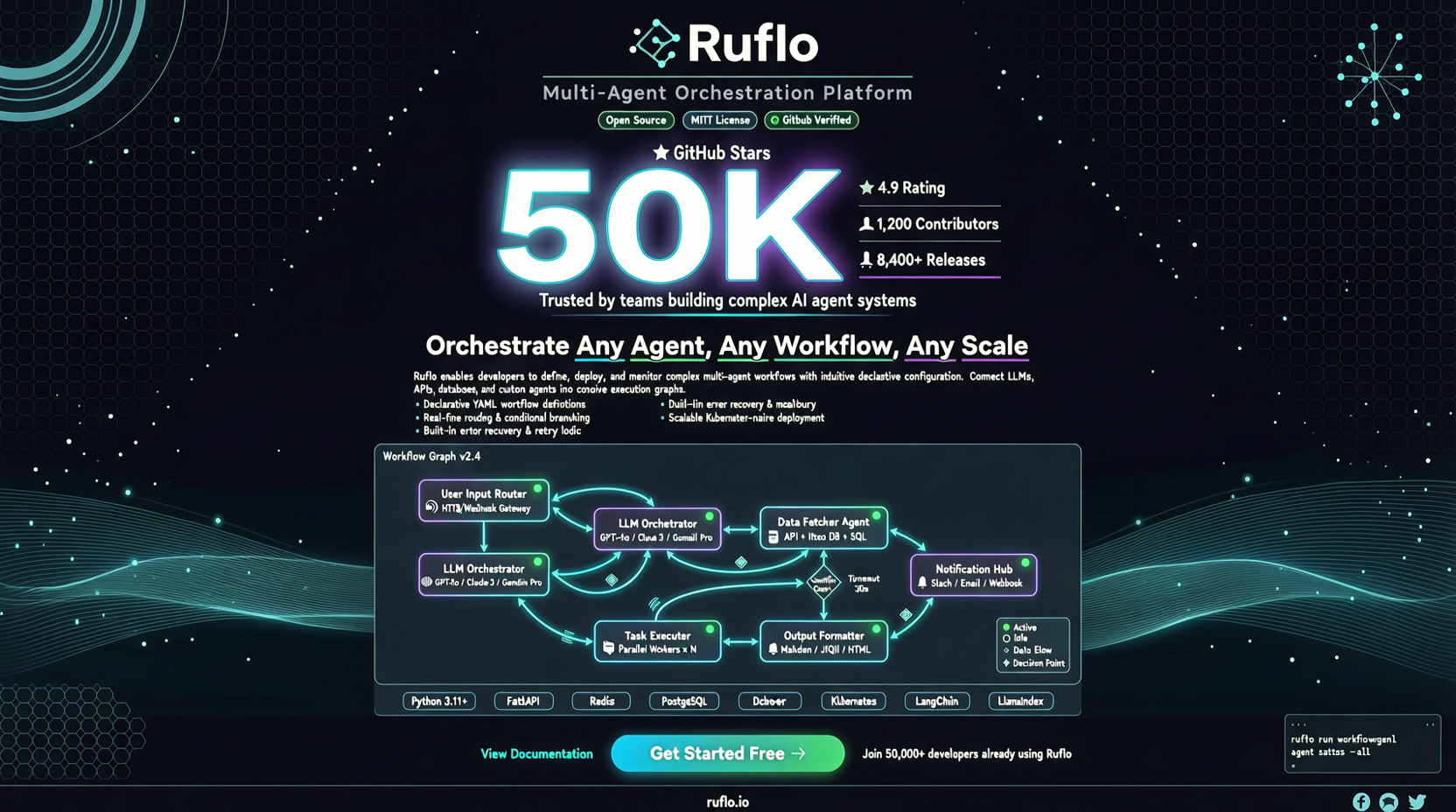
50,000 stars. 6,407 commits. 1,475 tags. 236 branches.
Put together, these numbers might make you think this is a project maintained by a team of hundreds over several years. But in reality, Ruflo has only one core contributor—ruvnet (Reuven).
Of course, Claude has also contributed to a significant number of commits.
Ruflo positions itself as the "leading Claude Agent orchestration platform." Its core capabilities include: deploying multi-agent swarms, coordinating autonomous workflows, and building conversational AI systems. It has just recently completed a full integration between Codex and Ruflo.
What Exactly Does Multi-Agent Collaboration Mean?
A single agent is already incredibly capable—writing code, researching, running tests. But when task complexity crosses a certain threshold, a single agent starts to struggle.
Ruflo solves exactly this problem: breaking down a large task into multiple subtasks, assigning each subtask to a specialized agent, and enabling them to coordinate with each other, share context, and sync progress.
Imagine this scenario: you need to produce a competitive analysis report.
Single-Agent Mode: One agent does everything from start to finish—searching for data, reading documentation, making comparisons, writing the report, and generating charts. It constantly needs to switch between different "skill modes," and its context window quickly gets overcrowded.
Multi-Agent Mode (How Ruflo Does It): A Market Researcher Agent collects competitor data, an Analyzer Agent handles comparative analysis, a Writer Agent drafts the report, and a Designer Agent generates the charts. The four agents work in parallel, sharing information and synchronizing progress through Ruflo's orchestration layer.
The latter approach is more efficient, more fault-tolerant, and allows each agent to be highly specialized.
Ruflo's Architectural Features
Looking at the repository structure, Ruflo features several key designs:
.agents directory Stores the definitions and configurations for each agent. Each agent has its own independent skill set, behavioral constraints, and context management.
.claude and .claude-plugin directories These serve as the native integration layer for Claude. Ruflo's agent definitions can run directly as plugins for Claude Code.
bin directory Contains the complete agentic-flow integration for Ruflo v3.5.0—the first major stable release, which includes comprehensive execution-layer fixes.
Recent commits show that Ruflo has just completed the Codex ↔ Ruflo integration—implementing actual codex exec calls, renaming Ruflo Agents from the WASM format to a native agent format, and supporting deployment via the Claude Managed Agent API.
Comparison with Other Orchestration Tools
The agent orchestration space is no longer a niche. With LangGraph, AutoGen, CrewAI, and the orchestration layers in the MCP ecosystem—how does Ruflo differ from them?
LangGraph is a graph-based agent orchestration framework within the LangChain ecosystem. It's relatively low-level and requires code to define graphs. AutoGen is Microsoft's multi-agent conversational framework, leaning more toward research prototypes. CrewAI is a Python-native multi-agent orchestration tool with concise role definitions, but its ecosystem relies heavily on LangChain.
What makes Ruflo unique is that it is Claude-native. Agent definitions run directly as .claude-plugin files, installed via Claude Code's plugin system, and deployed through the Claude Managed Agent API. It bypasses LangChain's abstraction layer entirely, interfacing directly with Claude's native capabilities.
This also means that if you're already in the Claude Code ecosystem, Ruflo's integration cost is virtually zero. However, if you're using OpenAI or other models, Ruflo isn't your first choice.
Enterprise-Grade Features
Ruflo's README highlights several "enterprise-grade" features:
Self-learning swarm intelligence. Agent swarms learn each other's collaboration patterns during operation to optimize task allocation.
RAG integration. Built-in retrieval-augmented generation capabilities allow agents to pull context directly from enterprise knowledge bases.
Native Claude Code / Codex integration. The latest commits confirm the true implementation of codex exec, meaning Ruflo can dispatch OpenAI Codex to execute specific tasks.
Practical Adoption Threshold
The 6,407 commits and 1,475 tags indicate an extremely rapid iteration cycle. But this brings a question: stability.
The 236 branches mean many experimental features are still in development. The 415 open issues and 132 open PRs also show a high volume of community feedback, but the maintainers (one person + Claude) may struggle to keep up.
If you plan to use it in production, it's recommended to start with the stable v3.5.0 release rather than chasing the latest commit on the main branch.
The Bottom Line
Ruflo is currently the most comprehensive multi-agent orchestration solution within the Claude ecosystem. Its potential is incredibly high, but its maturity still needs to be proven over time.
Primary Sources:
- ruvnet/ruflo GitHub Repository
- Ruflo v3.5.0 Release Notes