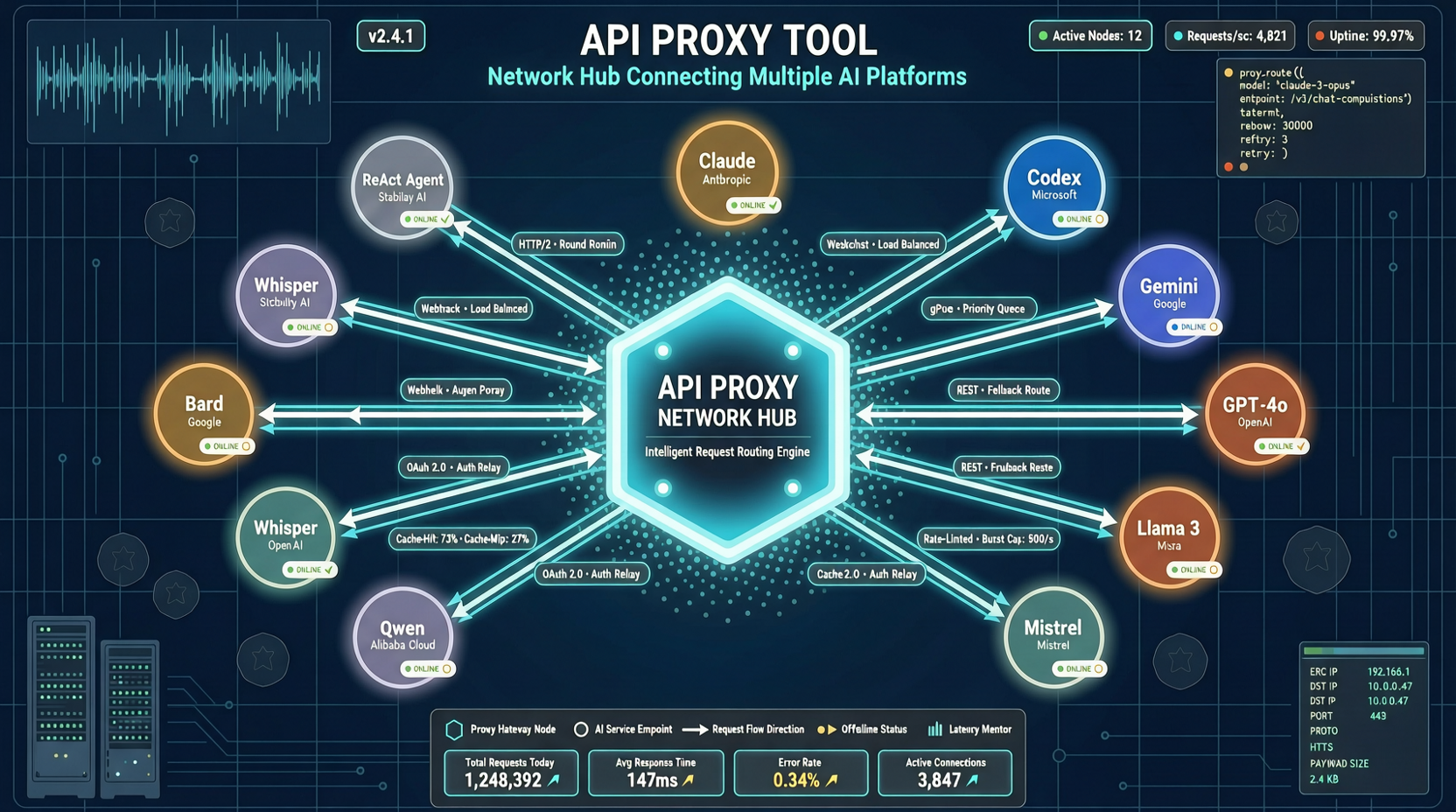
CCX does something simple: a unified proxy layer for Claude, Codex, and Gemini APIs.
A Go backend + a frontend, 1.1K stars, 201 release versions, 1,092 commits — this release frequency for an API proxy is unusually diligent.
What problem it solves
If you use all three — Claude, Codex, Gemini — you'll find each API has its own format, its own limits, its own billing.
CCX sits in the middle: you send a unified request format, it translates to the corresponding API format, and returns unified results. Plus:
- Request routing: automatically selects available API
- Rate limiting: manages each provider's rate limits
- Cost tracking: unified view of API usage across providers
- Caching: repeated requests don't cost repeatedly
Why it's worth attention
Three reasons:
First, release frequency. 201 versions means the author is continuously iterating and fixing. For a utility project, this activity level proves real users are giving feedback and driving improvements. Not a project with lots of stars but no maintenance.
Second, timely documentation. Recent commits include "add client integration guide" (Chinese docs) and "gpt-image-2 common filters" updates — the author keeps up with each provider's API changes. OpenAI, Anthropic, and Google update their APIs frequently; a proxy layer that doesn't keep up quickly becomes useless.
Third, Go rewrite. The project was likely originally in another language, then restructured to Go. Go's single-binary deployment, low memory footprint, good concurrency — sensible choices for a long-running proxy service.
Real use cases
CCX's most valuable scenario isn't individual developers — individuals can just use each API directly without a proxy layer.
Where it's genuinely useful:
- Team environments: unified API entry point, easier permission control, auditing, cost allocation
- Multi-model routing: automatically select the best model per task type (coding with Claude, translation with Gemini)
- Cost control: centralized API call management, avoiding repeated request waste
For individual users, unless you're running multiple AI coding assistants simultaneously and are cost-sensitive, CCX may not be essential.
A concern
CCX's core value rests on the premise that "each provider's API is incompatible." If OpenAI, Anthropic, and Google launch a unified API standard (or compatibility layer) in the future, CCX's value drops significantly.
But until then, it at least saves you some hassle.
Sources: