The Verge’s headline was blunt: "Would you let robots spend your money? Google is betting on it."
Would you let robots spend your money? Google is betting you will.
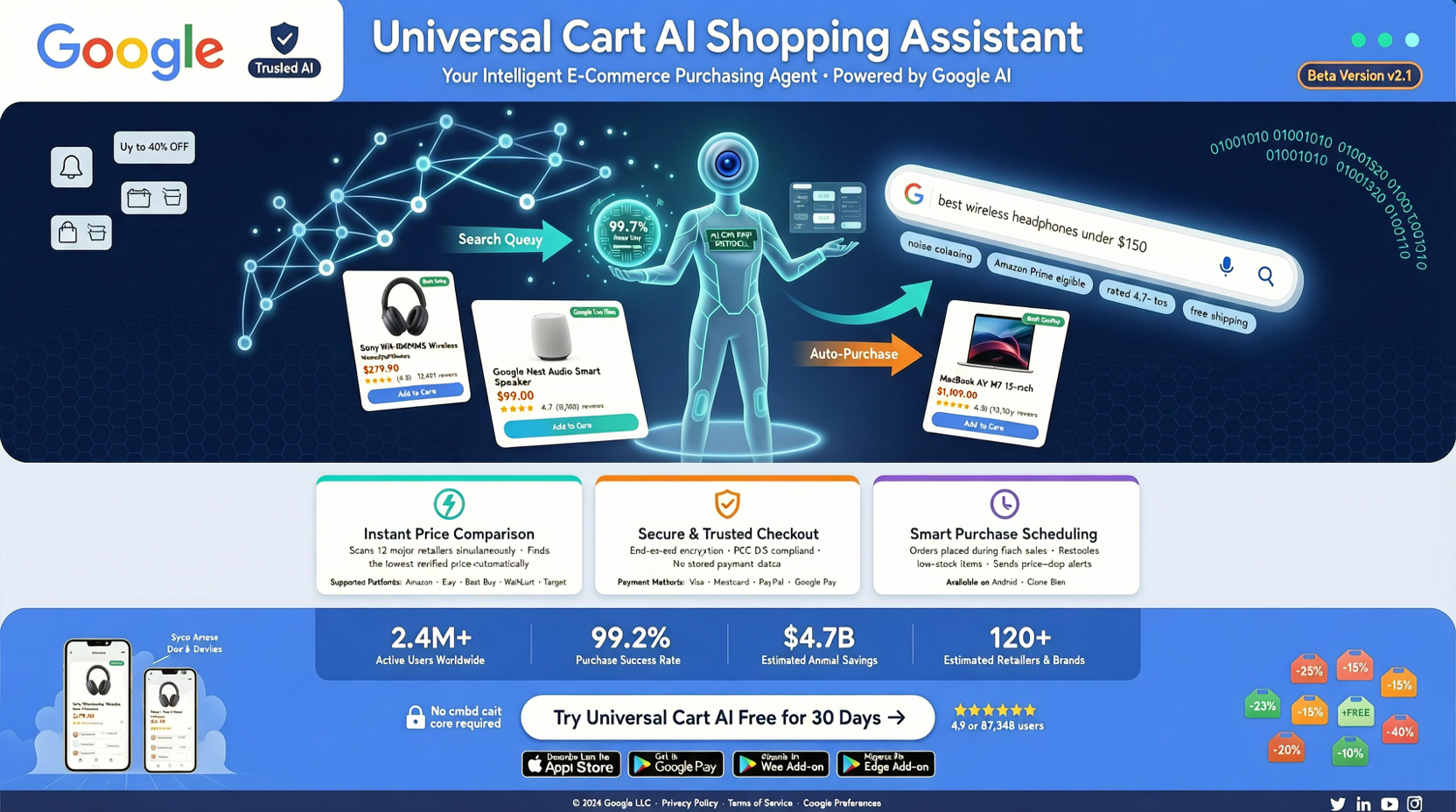
At Google I/O 2026, Google launched something called the Universal Cart—not just a shopping cart, but a Gemini-powered, cross-platform, cross-retailer AI shopping assistant.
What Can This Thing Actually Do?
In short, Universal Cart aims to be your all-in-one shopping concierge:
- Cross-platform item collection: Spot something you want to buy in Google Search, a Gemini chat, a YouTube video, or a Gmail email—and drop it into your cart instantly
- Price tracking: Automatically monitors price changes and notifies you when items go on sale
- Stock monitoring: Alerts you when out-of-stock items restock
- Smart recommendations: Vidhya Srinivasan, Google’s VP of Ads & Commerce, gave an example: while building your first PC, if you select a motherboard and CPU with incompatible sockets, the cart will proactively flag the incompatibility and alert you
- Discount aggregation: Integrates with retailers’ loyalty programs and Google Pay credit cards to automatically recommend money-saving options
More importantly, it’s not just an extension of Google Search. As Srinivasan put it: “My cart appears in every Google product I use.” The cart icon shows up right next to your profile avatar.
Why Is Google Building This?
Because shopping is one of the most natural—and commercially valuable—real-world applications for AI Agents.
Think about it: an AI assistant that understands your needs, compares prices, and spots compatibility issues—that’s exactly the ideal use case for Agent AI. And Google stands to gain massive commercial upside:
- E-commerce ad revenue: Universal Cart is fundamentally a shopping gateway. Google can charge retailers for product placements and click-throughs
- Payment ecosystem expansion: By integrating deeply with Google Pay, Google gains greater influence over the transaction flow
- Data moat: Your shopping preferences, price sensitivity, and purchasing habits—all reside within Google’s infrastructure
Srinivasan made an especially telling remark during her briefing. Describing today’s online shopping experience, she said: “I have dozens of browser tabs open, syncing across accounts… it barely works.” Universal Cart exists to solve precisely that pain point—consolidating fragmented shopping behavior into one unified place.
But the Challenges Are Obvious
Trust.
Letting AI manage your shopping cart means trusting it to:
- Recommend genuinely cost-saving deals—or merely promote advertisers’ inventory?
- Accurately diagnose hardware incompatibilities like “this motherboard won’t work with that CPU”?
- Collect and use your shopping data—how, and for what purposes?
Google also highlighted another I/O announcement in the same breath: “Gemini + Volvo’s in-car cameras”, where Gemini interprets traffic signs using Volvo’s external vehicle cameras. Paired with Universal Cart, this signals Google’s AI evolution—from answering your questions, to making decisions for you.
But “helping you read a parking sign” and “deciding what to buy for you” are two entirely different things. A misread sign might mean parking in the wrong spot; a bad purchase recommendation could mean spending real money unwisely.
Competitors Retreat While Google Charges Ahead
The Verge’s report noted an intriguing context: some competitors are pulling back from AI shopping—while Google is accelerating full speed ahead.
What does that imply? That monetizing AI-powered shopping is hard—but Google believes it holds unique advantages: its search entry point, Gmail’s massive user base, YouTube’s content ecosystem, and Google Pay’s payment infrastructure. Combined, no other company can replicate this stack.
It’s safe to predict that once Universal Cart launches, Amazon, Apple, and others will follow suit. AI-driven shopping experiences are shifting from “futuristic concept” to “today’s competitive battleground.”
So—back to the original question: Would you let AI spend your money?
Google’s answer is “Yes.”
What’s yours?