Who is Daniel Miessler? Cybersecurity researcher, podcast host, author of the Unsupervised Learning newsletter, wrote several books on AI and security. He's not the type who drops a demo on GitHub and walks away.
His Personal_AI_Infrastructure (PAI) project: 14.2K stars, 2K forks, 617 commits, latest release is v5.0.0. The last major update was 3 weeks ago — regenerating all 4 hand-drawn chalkboard-style architecture diagrams.
This isn't "yet another AI agent framework." It's more like a deployment guide for a personal AI workstation.
What problem PAI solves
Simple: most people's AI usage is too scattered.
ChatGPT in one browser tab, Claude in another, Ollama running locally, an app on the phone — no shared context, no unified memory, privacy depends on each company's goodwill.
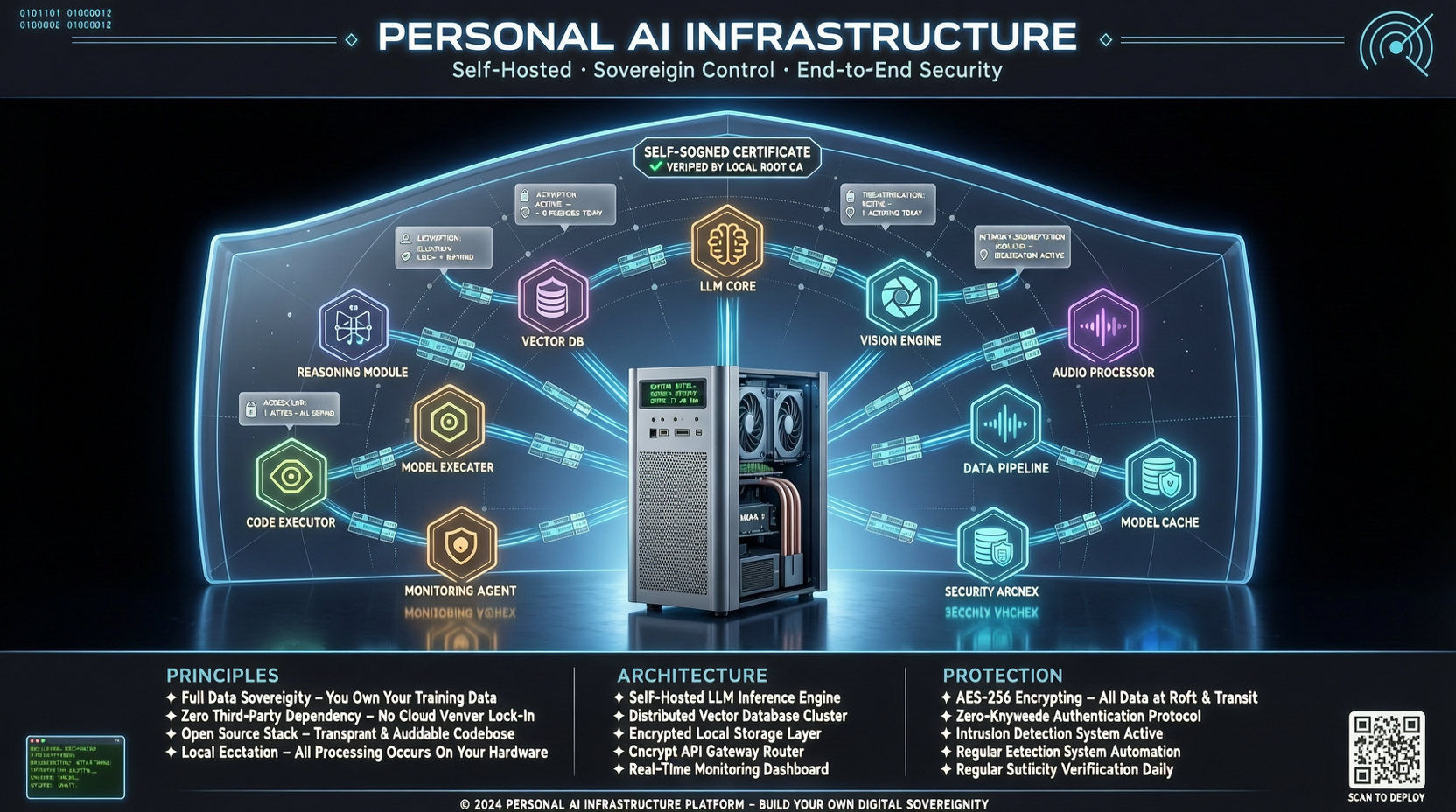
PAI's approach: integrate all your AI tools into one self-hosted infrastructure. Including:
- Local model deployment (Ollama, vLLM, etc.)
- Unified API gateway
- Personal knowledge base and memory system
- Security layer (data stays local, model isolation)
- Monitoring and dashboards
The v5.0.0 release added 40 individual skill packs, each corresponding to a specific capability. This isn't padding — each pack has clear purpose boundaries and configuration requirements.
Security-first
Miessler's security background shows clearly in this project. PAI has a .pai-protected.json file defining security pattern categories — the latest update added 4 new categories.
Most personal AI projects don't care about security, or don't know how to. PAI treats it as a first-class citizen: which data can leave localhost, which model calls need auditing, which tool calls need human confirmation — all defined.
Who it's for
Good for:
- Individual users who care about data privacy
- Technical people wanting to integrate multiple AI tools into one workflow
- Security professionals (the security design will resonate)
Not for:
- People who just want to casually use ChatGPT
- People who don't want to maintain infrastructure
- People without basic Linux/Docker experience
PAI isn't an out-of-the-box product. It's more like an architecture blueprint that requires technical ability to deploy and customize.
A detail worth noting
The project has .claude/ and .agents/skills/ directories. This means PAI is designed with AI coding assistants (Claude Code, Cursor, etc.) in mind — not just humans using AI, but AI using AI.
This is relatively rare in the personal AI infrastructure space. Most projects only consider human-model interaction, not "my AI agent needs to collaborate with other AI agents I've deployed."
Sources: