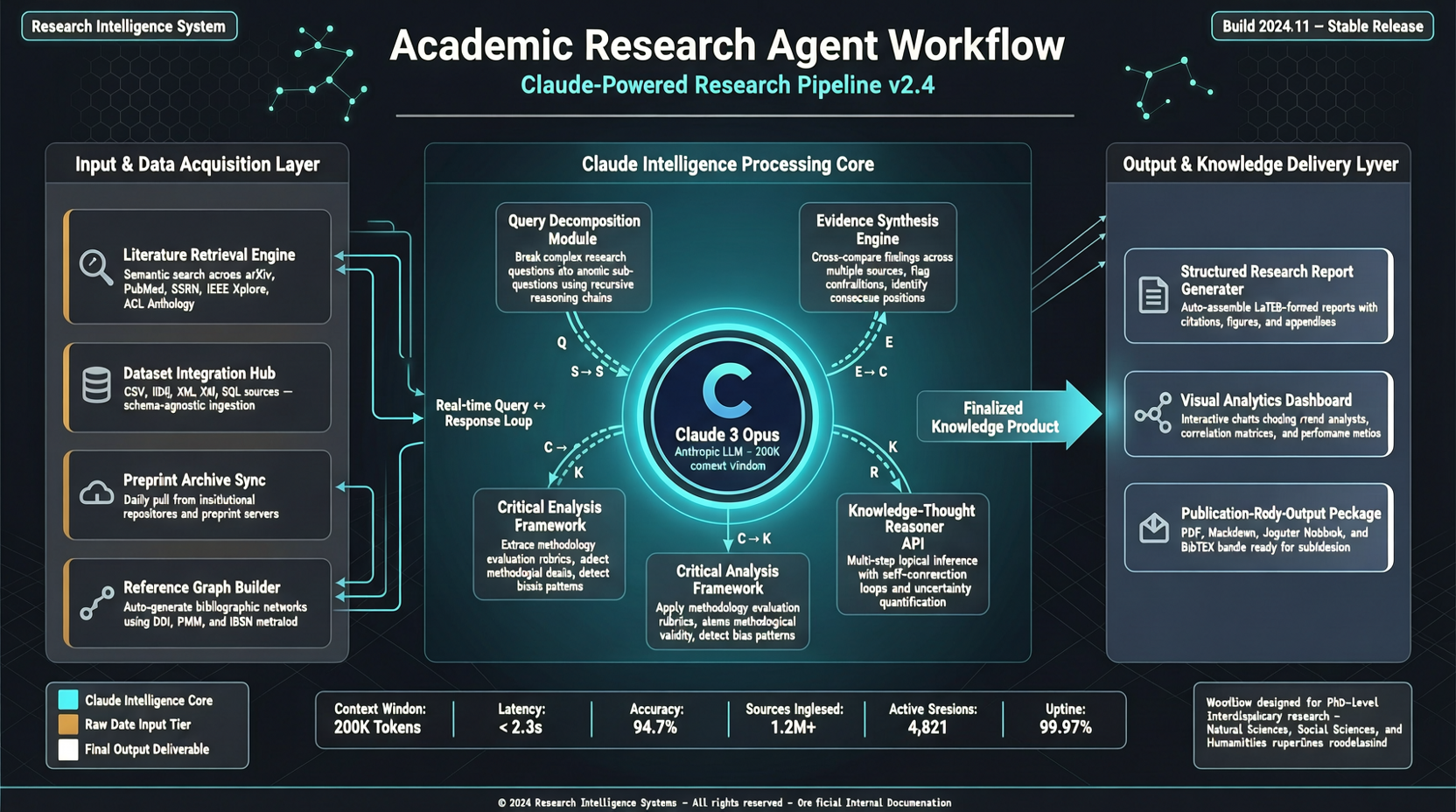
Let's start with a real-world scenario.
You're a graduate student, and your advisor gives you a new research direction. Your first steps are usually: read papers, take notes, identify gaps, write a proposal, run experiments, draft the paper, revise, revise again, submit, get rejected, resubmit...
In this process, the stages that truly require "academic creativity"—identifying problems, designing experiments, analyzing results—might only account for 30%. The remaining 70% is all about formatting adjustments, literature organization, language polishing, and endless revisions.
The academic-research-skills project targets exactly that 70%.
What It Is
This is an academic research skill pack designed for Claude Code, breaking down the complete paper writing process into five orchestratable stages:
Research → Write → Review → Revise → Finalize
Each stage has a dedicated agent skill to execute it. You can choose to let Claude Code run the entire workflow automatically, or step in for manual review at any stage.
The project already has over 10,000 stars on GitHub, gaining 1,300+ new stars daily. In the niche of academic tools, this number is quite staggering.
The Real Interest Isn't "AI Can Write Papers"
To be honest, the idea of "AI helping me write a paper" isn't particularly novel in 2026. What truly makes this project worth watching is its workflow design philosophy.
Instead of trying to solve everything with a single prompt, it breaks academic research into multiple stages, each with clear inputs, outputs, and quality standards. This staged design offers several advantages:
First, it's auditable. The output of each stage can be independently checked. If the literature review is poorly done, you won't discover it only after finishing the draft—it gets caught during the Review stage.
Second, it's collaborative. Researchers can step in at any stage without needing to run the whole process from scratch. For example, you can let the AI handle the literature review and first draft, then step in yourself to analyze experimental data, and finally let the AI handle the review and polishing.
Third, it's reusable. This workflow isn't customized for a single paper; it can be applied to any research field.
Practical Use: An Example
Suppose you want to write a review paper on "The Application of Large Language Models in Medical Diagnosis":
- Research Stage: The AI automatically searches for relevant literature, generates a literature review framework, and highlights key findings and contradictions.
- Write Stage: Based on the framework, it generates a first draft, including the introduction, methodology, results analysis, and discussion.
- Review Stage: A dedicated analyzer checks the paper for logical coherence, citation accuracy, and academic standards.
- Revise Stage: It modifies the draft based on the Review feedback and generates a revised version.
- Finalize Stage: It handles formatting adjustments, reference formatting, and generates the metadata required for submission.
Throughout this entire process, you only need to provide the research direction in the first stage, and then perform a check at each key milestone.
The Gray Area of Academic Integrity
This project inevitably touches on a sensitive topic: Where is the boundary for AI-assisted academic writing?
The project itself does not encourage academic misconduct. Its design is more like a "research assistant"—helping you with time-consuming but low-creativity tasks like literature organization, formatting, and language polishing. The core academic ideas, experimental design, and data analysis still need to be completed by the researcher.
However, in reality, this boundary is often blurred. This is also why arXiv recently introduced new rules requiring authors to explicitly disclose the extent of AI involvement.
My view is: The tool itself is neutral; the key lies in how you use it. Using AI to organize literature and adjust formatting is completely different from using AI to do your thinking for you.
The value of academic-research-skills lies in making the process transparent—you know exactly what the AI did at each stage, rather than using a black box to generate a paper you can't fully explain.
The Signal This Sends to Academia
The AI transformation of academic research is no longer a question of "whether to adopt it," but "how to use it well."
The popularity of academic-research-skills demonstrates one thing: Researchers don't lack AI tools; they lack effective AI workflows. Integrating AI into existing research workflows is far more effective than forcing researchers to learn an entirely new set of tools.
In the future, the core competitiveness in academic research may no longer be "who can publish more papers," but "who can better leverage AI tools to produce higher-quality research."
This shift has only just begun.