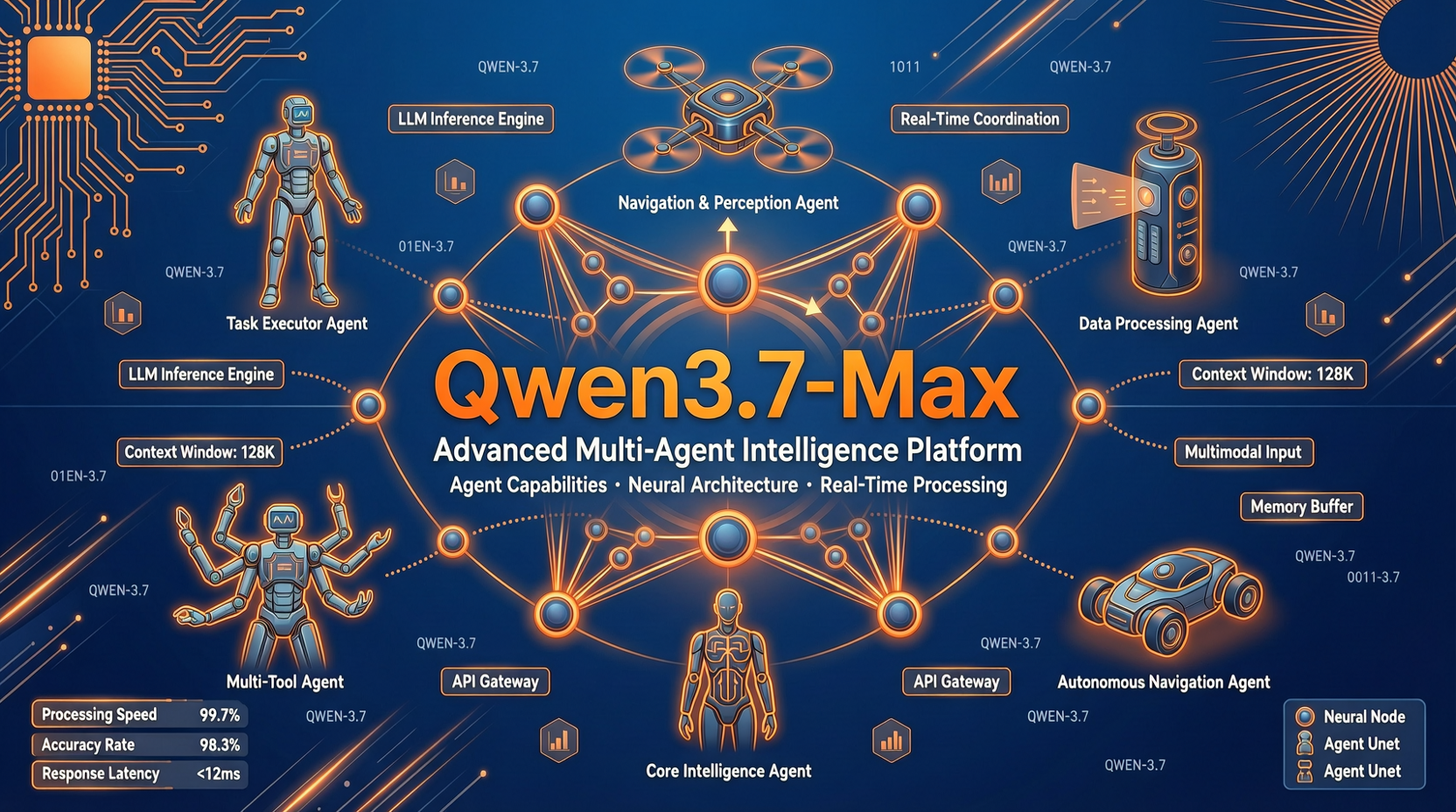
Hacker News front page. Number one. 313 points, 115 comments. The headline: "Qwen3.7-Max: The Agent Frontier."
Not "new model released." Not "record-breaking parameters." Just Agent. Alibaba is putting its cards on the table.
Agent Isn't a Feature — It's the Whole Game
For the past year, model launches have been about bigger context windows, faster inference, and lower prices. All important, but they solve single-turn conversation problems.
Qwen3.7-Max flips the script. It's not competing with GPT-5.5 on SWE-bench scores. It's answering a more engineering-focused question: can a model work continuously on a real task for ten minutes, call a dozen tools, self-correct, and deliver a result?
Sounds less exciting than a benchmark leaderboard, but it's the difference between a chatbot and a tool that actually ships work.
Why Now
The timing is telling. Anthropic acquired Stainless last week — the company behind SDK and MCP server tooling. OpenAI's GPT-5.5 is pushing tool-calling capabilities. Google just released Gemini 3.5 Flash, explicitly labeled as "Agent-optimized."
The entire industry went all-in on agents in the same week. That's not coincidence. That's consensus.
At the start of 2026, agents were an optional feature. Now they're "build it or get left behind" infrastructure. Qwen3.7-Max just put the trend center stage.
Qwen's Strategy Shift
Looking at Qwen's moves over the past six months, a pattern emerges:
- Before: parameter counts, leaderboard rankings — the "prove capability" approach
- Now: scenarios, integrations — the "engineering readiness" approach
Pragmatic move. Top of a leaderboard doesn't automatically become users. But a model that reliably runs MCP toolchains and plugs into existing workflows? That does.
Alibaba has the cloud ecosystem, DingTalk, and the Tongyi Qianwen application layer. If Qwen3.7-Max can make agent flows work across these surfaces, its user acquisition cost is an order of magnitude lower than pure API vendors.
The HN Thread
Best comment in the thread compares Qwen and Claude Code: "Qwen is going open-source + cloud, Anthropic is going closed-source + integrated. Both paths are converging on agents, but the end user experience will be completely different."
Another one cuts to the core: "What's the actual evaluation standard for agent capability? There isn't a recognized benchmark yet."
That's the pain point. MMLU measures knowledge, SWE-bench measures code fixing. But agents need planning, tool use, error recovery, and multi-step reasoning combined. No single benchmark covers that.
My Take
Qwen3.7-Max isn't the biggest model or the one with the most explosive benchmarks. But it's the first major release this month to put "Agent" in the title instead of burying it at the bottom of a feature list.
If this positioning lands, Qwen moves from "yet another open-source model" to "part of the agent infrastructure stack."
Of course, anyone can say the word. A model that actually runs MCP toolchains and handles long-horizon tasks reliably? That doesn't exist yet. Whether Qwen3.7-Max becomes the first depends on real-world integration results.
I'm putting it through some real agent workflows — code review, API integration testing, doc generation. Results in two weeks.
Primary sources: