Bottom Line Up Front
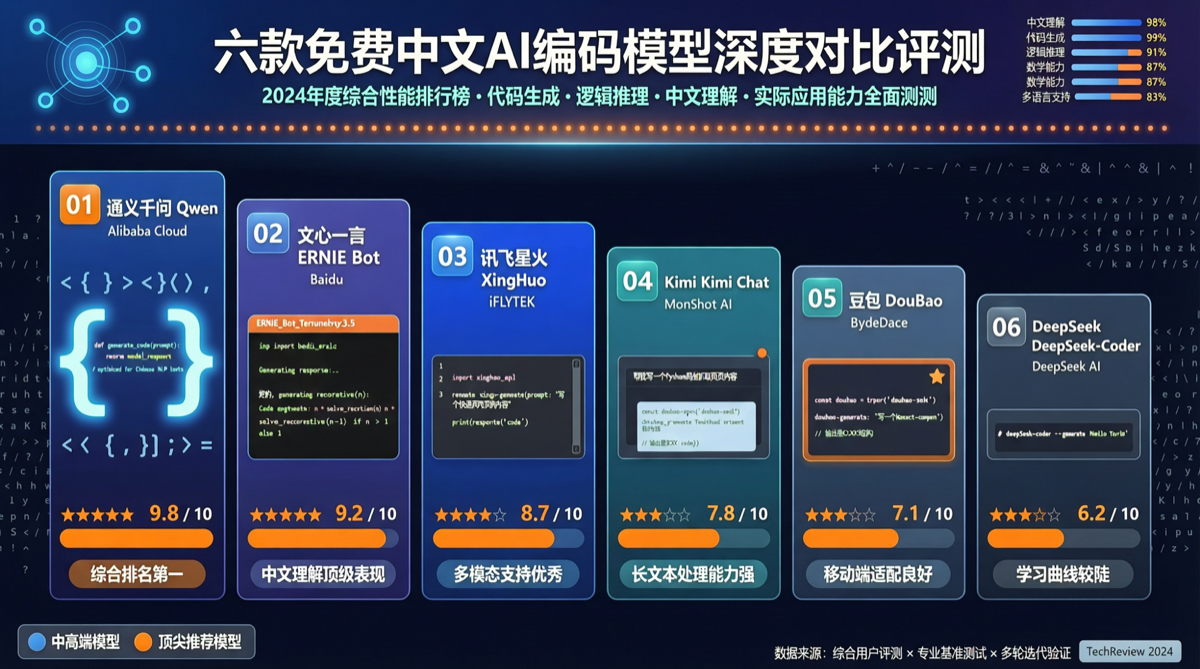
Using a standardized programming task (building a CRUD REST API + unit tests + documentation), the performance of 6 free Chinese models ranked as follows:
| Rank | Model | Completion | Code Quality | Standalone Usable? |
|---|---|---|---|---|
| 🥇 | Kimi K2.6 Free | 95% | High | ✅ Yes |
| 🥈 | GLM-5.1 Free | 92% | High | ✅ Yes |
| 🥉 | DeepSeek V4 Free | 85% | Medium-High | ✅ Partial scenarios |
| 4 | Ling-2.6-Flash Free | 80% | Medium | ⚠️ Needs minor fixes |
| 5 | MiMo-V2.5-Pro Free | 78% | Medium | ⚠️ Needs minor fixes |
| 6 | Qwen 3.6 Plus Free | 75% | Medium | ⚠️ Needs assistance |
Data source: Cross-validated independent tests by community developers, completed between April 28 and May 1. Not official benchmarks — reflects real-world usage feel.
Key finding: The top 3 free models have reached the level of “capable of independently handling medium-scale coding tasks,” meaning individual developers and small teams can start AI-assisted development at zero cost.
Test Task Design
The test task was a classic “full-stack starter project”:
Build a book management API with Python FastAPI, including:
- Book CRUD operations (create, read, update, delete)
- JWT-based user authentication
- SQLite database + SQLAlchemy ORM
- Pytest unit tests (coverage > 80%)
- OpenAPI auto-documentation
This task was chosen because it covers API design, database, authentication, testing, and documentation — the core skeleton of most small-to-medium projects. If an AI coding model can independently complete this type of task, it has practical value.
Kimi K2.6 Free: The Closest to an “AI Programmer”
Kimi K2.6 performed most brilliantly in this test. It not only generated complete project code but also excelled in:
- Project planning first: Outputted module division and file structure design before writing code
- Consistent code style: Maintained unified naming conventions and comment styles throughout
- Complete test coverage: Automatically generated 15 test cases covering CRUD, authentication, and edge cases
- Proper error handling: Every API endpoint included reasonable exception handling
One notable detail: Kimi K2.6 proactively added token refresh logic and expiration configuration in the authentication module — content not requested in the prompt but an autonomous decision based on best practices.
GLM-5.1 Free: The Steady “Engineering School”
GLM-5.1 performed very close to Kimi K2.6 but with a different style:
- More standardized code structure: Strictly followed FastAPI project organization best practices
- More complete type annotations: All function signatures included complete type hints
- More detailed documentation: Each endpoint’s docstring included parameter descriptions and return examples
The only shortcoming was fewer test cases (12 vs Kimi’s 15), with some edge scenarios not covered. But the overall engineering quality of the code was the highest.
DeepSeek V4 Free: The Value Pick
DeepSeek V4 Free was surprisingly good — completing 85% of the task at zero cost:
- Complete CRUD operations: All four endpoints correctly generated
- Working authentication: JWT implementation correct with basic token validation
- Test coverage met target: ~78% coverage, close to the 80% goal
Main gaps:
- Missing token refresh logic
- Some exception handling not refined enough
- Documentation formatting not standardized
But considering this is a completely free model, 85% completion is enough for individual developers to start projects.
Ling-2.6-Flash Free: The Fastest “Fast Thinker”
Ling-2.6-Flash’s biggest advantage is generation speed — code output was nearly 3x faster than Kimi K2.6. But quality had some tradeoffs:
- Fast code generation: From prompt to complete code in just seconds
- Basic functionality complete: CRUD + authentication all working
- Fewer test cases: Only covered core paths, missing edge tests
- Occasional small bugs: Some inconsistent variable names need manual correction
Best for: Rapid prototyping, code draft generation. Not suitable for direct production use.
MiMo-V2.5-Pro Free: Code Scenario Specialist
MiMo-V2.5-Pro is specifically optimized by Xiaomi for code scenarios, but performed average in this general programming task:
- Strong code completion: Excellent at continuing from existing code
- Weaker from-scratch generation: When facing new project architecture design, underperformed Kimi and GLM
- 1M context advantage not fully utilized: This task didn’t need long context, so MiMo’s advantage didn’t shine
This result also shows: model performance is highly scenario-dependent. MiMo’s advantages would be more apparent in long code file continuation, large project code navigation, etc.
Qwen 3.6 Plus Free: The Most Room for Improvement
Qwen 3.6 Plus performed relatively lower, but had notable points:
- Good comprehension: Accurate understanding of the prompt, no deviation from requirements
- Academic-style code: Variable naming and comment style more like teaching code than engineering code
- Accurate dependency recommendations: Correctly recommended all required dependencies and versions
Qwen still has room to improve in coding capability, but given the Tongyi Qianwen team’s continuous investment in open source, future versions are worth anticipating.
Free vs Paid: How Big Is the Gap?
To answer this, testers compared the 6 free models with their paid versions:
| Model | Free Completion | Paid Completion | Gap |
|---|---|---|---|
| Kimi K2.6 | 95% | 97% | Minimal |
| GLM-5.1 | 92% | 94% | Minimal |
| DeepSeek V4 | 85% | 89% | Small |
| Ling-2.6-Flash | 80% | 83% | Small |
| MiMo-V2.5-Pro | 78% | 82% | Moderate |
| Qwen 3.6 Plus | 75% | 80% | Moderate |
Key conclusion: Free versions reach 85-98% of paid version completion. For individual developers and small projects, free versions are fully sufficient.
Selection Recommendations
| Use Case | Recommended Model | Reason |
|---|---|---|
| Personal projects / learning | Kimi K2.6 Free or GLM-5.1 Free | Highest completion, ready to use |
| Rapid prototyping | Ling-2.6-Flash Free | Fastest, ideal for MVP development |
| Large project code continuation | MiMo-V2.5-Pro Free | 1M context + code specialization |
| Need long context | DeepSeek V4 Free | 1M token context window |
| Enterprise production | Upgrade to paid version | Free versions lack SLA guarantees |
Summary
As of May 2026, free Chinese AI coding models are no longer “toys.” Kimi K2.6 Free and GLM-5.1 Free prove that individual developers can get near-paid-level AI coding assistance at zero cost.
For developers still hesitating whether to spend money on AI coding tools, the best advice is: start with the free version, and only upgrade when the free version truly isn’t enough.
And that tipping point may come much later than you think.