Bottom Line First
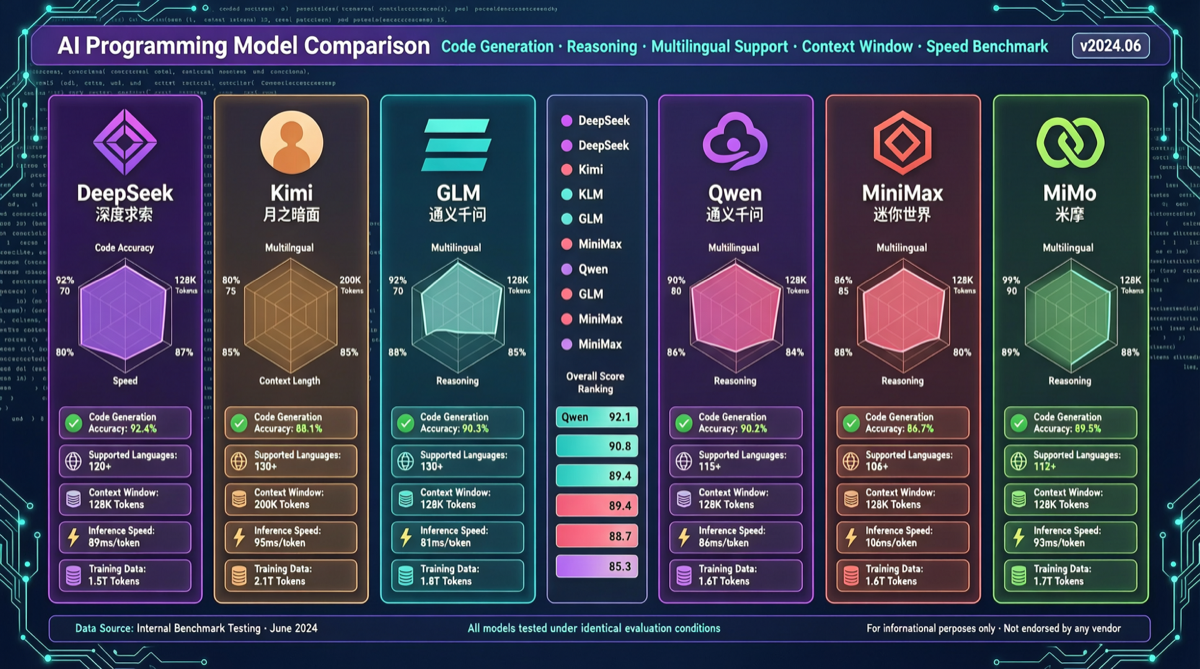
While most people are still watching GPT and Claude, six Chinese AI models have already developed killer positioning in programming capabilities. A recent cross-model coding test shows that Chinese models are no longer just “GPT alternatives” — they’re carving differentiated paths across reasoning style, code architecture, and execution efficiency.
Key Findings:
| Model | Strongest Dimension | Style | Best For |
|---|---|---|---|
| DeepSeek | Complex Reasoning | Reasoning engine, step-by-step breakdown | Algorithms, architecture design |
| Kimi K2.6 | Code Teaching | Teacher-like, explains every decision | Learning, Code Review |
| Zhipu GLM 5.1 | Code Architecture | Cleanest developer-style structure | Engineering projects, team collaboration |
| Qwen 3.6 | Execution Efficiency | Efficient and concise, straight to the point | Rapid prototyping, script generation |
| MiniMax | Creative Coding | Unconventional solutions | Creative projects, UI/UX |
| Xiaomi MiMo | Multimodal Coding | Voice + vision + code full-stack | IoT, edge deployment |
Test Background
The test ran identical coding prompts across all six models, comparing output quality, code structure, reasoning process, and actual execution results. This is not a benchmark score comparison — it’s a real-world “same problem, six solutions” comparison.
Testing Dimensions
- Code Correctness: Does it compile? Is the logic sound?
- Reasoning Transparency: Does it clearly explain its thinking?
- Code Standardization: Naming, structure, comments meeting engineering standards
- Execution Efficiency: Token consumption vs. output quality ratio
- Style Differences: How different models approach the same problem
Model-by-Model Breakdown
DeepSeek: The Reasoning Engine
DeepSeek exhibits strong “chain-of-thought” characteristics in testing. Facing complex problems, it:
- First breaks the problem into sub-tasks
- Analyzes constraints for each sub-task individually
- Gradually builds the solution
- Finally integrates and validates
This style is particularly suited for programming scenarios requiring deep reasoning — algorithm design, system architecture, performance optimization. In testing, DeepSeek was most robust on coding tasks requiring multi-step reasoning.
“DeepSeek is like an experienced algorithm engineer — thinks before coding.”
Kimi K2.6: The Teacher
Kimi’s standout feature is “explainability.” It doesn’t just write correct code — it also:
- Explains why one data structure was chosen over another
- Describes how edge cases are handled
- Points out potential optimization space
- Uses analogies to help understand complex concepts
For scenarios needing code review or team learning, Kimi’s output is practically ready-to-use teaching material. GPT 5.4 level coding capability, at one-seventh the price of Opus 4.7.
Zhipu GLM 5.1: The Architect
GLM’s output performed best in structural standardization:
- Function naming follows industry conventions
- Module division is clear
- Error handling is complete
- Comment placement is appropriate
For engineering projects requiring team collaboration, GLM-produced code is easiest for other developers to take over and maintain. This explains why some developers say they “used GLM for coding until Kimi K2.6 came out.”
Qwen 3.6: The Efficiency Player
Qwen’s differentiated advantage is “less talk, more work”:
- Lowest token consumption
- Output goes straight to the point
- Best inference performance on consumer-grade hardware
- Strongest multimodal capabilities (vision + text) among same-size models
For budget-conscious users, those prioritizing privacy, or needing local deployment, Qwen is almost the default choice.
MiniMax: The Creative Player
MiniMax demonstrated a distinctly different problem-solving approach in testing. When other models gave standard answers, MiniMax tended to:
- Try unconventional algorithms
- Provide extra suggestions on UI/UX
- Incorporate multimedia interaction elements
This is consistent with its accumulation in creative content generation.
Xiaomi MiMo: The All-Rounder
As the newest entrant, MiMo’s characteristic is “good at a bit of everything”:
- Voice-conversation coding
- Vision-assisted programming
- Open-source dialect ASR support
- Edge deployment friendly
While individual capabilities may not be the strongest, its multimodal integration gives it unique advantages in IoT and edge scenarios.
Pricing Comparison: Chinese Models Are Reshaping Pricing
| Model | Price vs. Opus 4.7 | Context Window | Open Source |
|---|---|---|---|
| Kimi K2.6 | ~14% | 200K | ✅ |
| GLM 5.1 | ~19% | 128K | ✅ |
| DeepSeek V4 | ~5% | 1M | ✅ |
| Qwen 3.6 | ~8% | 256K | ✅ |
Key Signal: Chinese models are not just approaching closed-source AI in capability — they’re also putting pressure on the entire AI market’s pricing model. DeepSeek V4’s ultra-low pricing strategy is forcing the industry to rethink API pricing.
Landscape Assessment
- Differentiated competition is settled: Chinese models are no longer chasing “surpassing GPT in everything” — each has found niche advantages
- Open source is becoming default: Five of the six models offer open source or open-weight versions
- Inference speed remains a bottleneck: Most users report Chinese models are still slower than closed-source models
- Multimodal is the next battleground: MiMo’s entry signals multimodal coding is becoming a new competitive dimension
Actionable Recommendations
| Your Need | Recommended Model |
|---|---|
| Complex algorithms/architecture | DeepSeek V4 |
| Learning programming/Code Review | Kimi K2.6 |
| Engineering projects/team collaboration | GLM 5.1 |
| Rapid prototyping/local deployment | Qwen 3.6 |
| Creative projects/UI design | MiniMax |
| IoT/edge multimodal | MiMo |
Core Recommendation: Stop sticking to one model. Switch models based on task type — this is currently the best strategy for optimal coding experience and cost control.