Every month-end, watching your Claude Code quota deplete, Cursor subscription auto-renew, while the code still isn't done — this is the collective pain point of AI coding tool users in 2026.
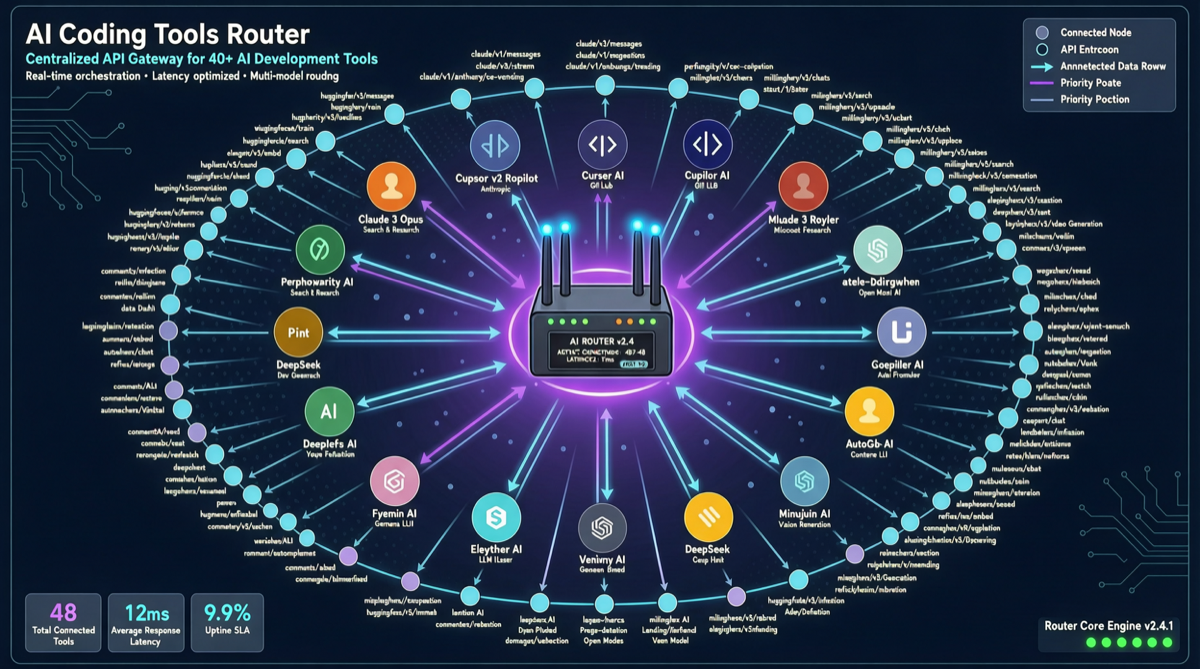
9router's approach is straightforward: spin up a proxy service on your local machine, connect all AI coding tools in front, and all available AI backends behind. One gateway, unified dispatch.
GitHub: decolua/9router
5.8K stars, 1.1k forks, 549 commits, 272 open issues, 119 PRs. The latest commit was 51 minutes ago — this project's activity level isn't "someone is maintaining it", it's "a group of people are iterating like crazy."
What problem it solves
The fragmentation dilemma of AI coding tools:
- Claude Code is good but has quotas
- Cursor's Copilot++ requires monthly subscription
- Codex has its own separate quota
- Each provider's pricing, rate limits, and availability differ
- Want to use multiple tools simultaneously? Configure backends individually for each — managing it is like herding cats
9router runs a proxy service locally, collecting API requests from your coding tools and routing them to backend AI providers based on policy.
40+ backend support. Covering OpenAI, Anthropic, Google, DeepSeek, Kimi and numerous domestic and free providers. You can mix free quotas and paid APIs in your backend list and let 9router decide which to use.
Two core features
Auto-fallback: When a backend goes down or hits its quota, 9router automatically switches to the next one. Your coding session won't be interrupted.
RTK Token compression: Claims 20-40% token reduction. The principle is compressing requests before sending to backends and decompressing after receiving. For token-billed scenarios, this directly saves money.
Getting started
From the README, the project supports Docker deployment and direct installation. Configuration is done via YAML defining backend lists and routing policies — manageable for anyone with technical background.
Documentation is fairly complete, with i18n support (including Chinese README), and issue response speed is good — 41 tags indicate a dense release rhythm.
Concerns to note
- Sustainability of free quotas: Routing to free backends presumes they stay "free forever." Many free quotas are promotional and can tighten at any time.
- Token compression quality: No public benchmark for the compression algorithm's adaptation to code scenarios. Over-compression could affect code generation accuracy — fatal for a coding tool.
- Security risk: As a local proxy, it handles all your API requests and responses. Encryption and privacy protection mechanisms need verification.
Worth trying?
If your daily coding heavily relies on AI tools and you have multiple coding plans or API keys, 9router is worth 20 minutes to set up. Its core value isn't "unlimited free" — that's hype — but unifying fragmented AI coding resources with auto-fallback so you don't manually switch backends.
For individual users with one tool and one API key, the significance is limited.
But for teams or developers running multiple AI coding workflows simultaneously, this could save significant management overhead.