Core Conclusion
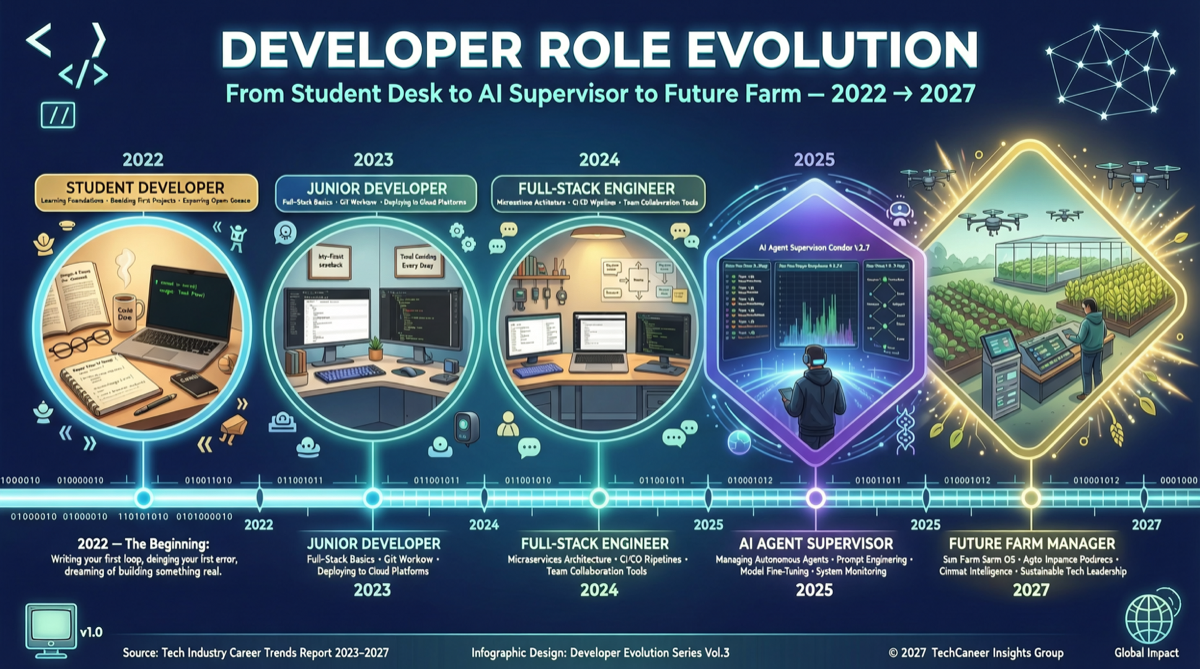
A tweet on X/Twitter that received 14,593 likes, 223 comments, and 699,789 views summarized five years of developer career evolution in just a few lines:
2022 — Student
2023 — Developer
2024 — Prompt Engineer
2025 — Vibe Coder
2026 — AI Agent Babysitter
2027 — Farmer
This isn't just a joke. It captures in minimalist fashion a real structural shift: developers' core value is moving from "writing code" to "managing and guiding AI agents."
What Each Step of the Evolution Means
2022 to 2023: From Student to Developer
After ChatGPT's release, the barrier to learning programming dropped dramatically. "Student" represented the stage of still mastering basic skills, while "Developer" meant AI assistance significantly accelerated the path to becoming a "qualified developer."
2023 to 2024: From Developer to Prompt Engineer
When AI programming assistants like Copilot became widespread, developers' key skill shifted from "knowing how to write code" to "knowing how to ask questions." Prompt Engineering became the new core competency.
2024 to 2025: From Prompt Engineer to Vibe Coder
Andrej Karpathy's "Vibe Coding" concept exploded in 2025. Developers no longer needed to understand code line by line — they described requirements in natural language and let AI generate complete applications. Coding became a "feels right" process.
2025 to 2026: From Vibe Coder to AI Agent Babysitter
This is the most pivotal step in the current evolution.
"AI Agent Babysitter" isn't a derogatory term — it accurately describes the relationship between developers and AI agents in 2026:
- No longer manual coding: Agents can handle tasks end-to-end
- But not fully hands-off either: Agents need guidance, supervision, correction, and feedback
- Core skill shift: From "writing code" to "defining task boundaries, reviewing output quality, handling edge cases"
Just like a babysitter watching a child — you don't need to do everything yourself, but you need to ensure things go in the right direction.
Industry Signals
The viral spread of this tweet itself sends an important signal: the developer community's anxiety and identification with their own role changes has reached a critical mass.
14,593 likes and 699,789 views means thousands of developers saw this tweet and said: "Yes, this is exactly my current state."
Real-Case Corroboration
Amazon's announcement today of company-wide Claude Code access triggered exactly this kind of response in the developer community:
"After using Claude Code, bot deployment went from 3 days to 4 hours."
This is the quintessential transition from "Vibe Coder" (doing the vibe coding yourself) to "AI Agent Babysitter" (letting the agent work, while you supervise).
The 2027 Farmer Metaphor
The tweet ends with "2027 — Farmer," seemingly a joke but carrying deeper meaning:
If AI agents can automatically complete most programming work, what are developers doing? The answer might be "farming" at a higher dimension — planting project ideas, cultivating agent workflows, harvesting automated results.
This aligns perfectly with YC Summer 2026 RFS's core signal: YC explicitly stated that starting in 2026, they want companies that "do things for people," not tools that "help people do things."
Landscape Assessment
Skill Migration Path
| Era | Core Skills | Learning Focus |
|---|---|---|
| 2022-2023 | Programming language basics | Syntax, algorithms, data structures |
| 2024 | Prompt Engineering | Questioning techniques, context management |
| 2025 | Vibe Coding | Requirements description, rapid iteration |
| 2026 | Agent Orchestration | Task decomposition, quality review, exception handling |
| 2027+ | System Design & Strategy | Architecture design, agent orchestration, business insights |
Employment Market Impact
- Entry-level programming positions: Demand will continue declining as agents cover most basic coding work
- Agent orchestrators: Will become an emerging high-demand role
- AI safety/governance experts: The more powerful agents become, the greater the need for supervision and governance
- Domain experts + AI: The combination of non-technical industry experts with AI tools will create new competitiveness
Action Recommendations
For employed developers:
- Don't resist agent tools — the earlier you adapt, the smoother the transition
- Invest in agent orchestration, task decomposition, and quality review skills
- Develop system thinking and architecture capabilities — these are hard for agents to replace in the near term
For students:
- Don't just learn syntax — learn how to collaborate with AI to solve problems
- Follow the agent ecosystem (Hermes Agent, OpenClaw, Claude Code, etc.)
- Develop cross-disciplinary capabilities: technology + domain knowledge + communication
For enterprise managers:
- Redefine "developer" job descriptions and performance metrics
- Establish agent usage guidelines and training systems
- Focus on team capability structure transformation, not just tool upgrades
Final Thoughts
"AI Agent Babysitter" isn't an endpoint — it's a transitional phase. It represents the qualitative shift in human-machine collaboration from "tool usage" to "partner management."
In this phase, the most valuable developers aren't the fastest writers, but those most skilled at guiding AI to produce high-quality results.