Ant Group is moving faster than expected.
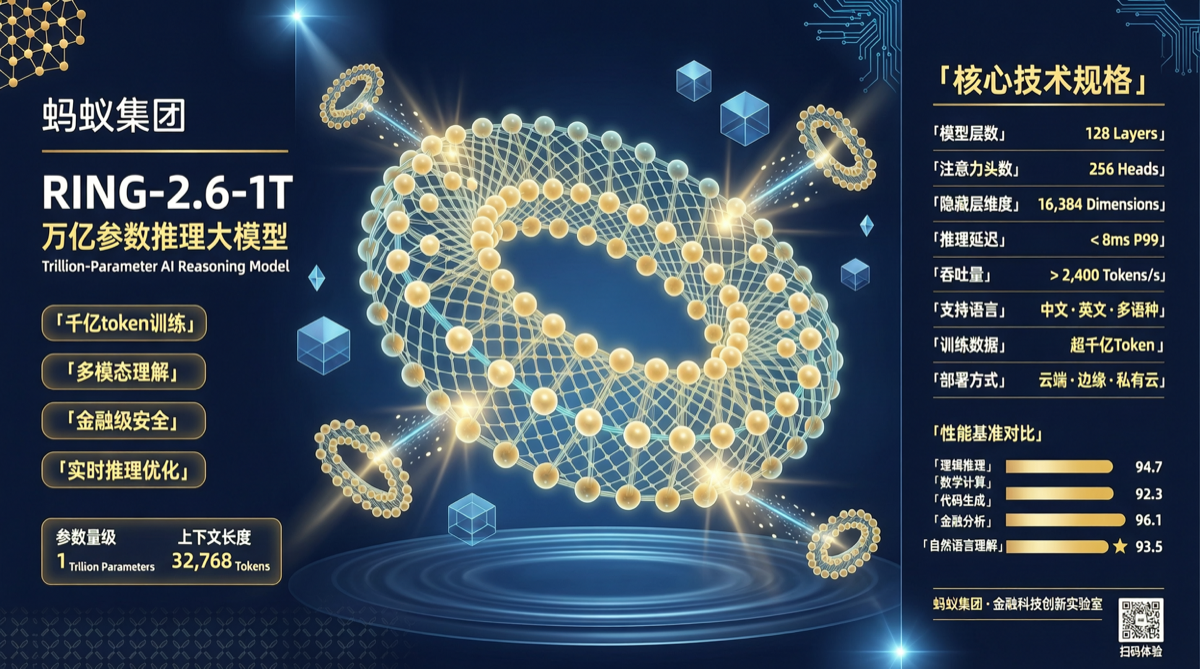
Less than a month after the previous Ring-1T release, the Bailing team jumped straight to Ring-2.6-1T. Trillion parameters, 63 billion active — and they added an interesting mechanism: dynamic thinking intensity.
What Is Dynamic Thinking Intensity
Simply put, the model can flexibly balance cognitive depth, token cost, and execution speed.
Ring-2.6-1T offers high and xhigh modes. high mode is faster with lower token consumption, suitable for everyday Q&A and general tasks. xhigh mode maxes out cognitive depth, ideal for complex reasoning, code generation, and deep analysis scenarios.
This design is pragmatic. Not every task needs the model to "think deeply" — a simple factual query in xhigh mode is pure token waste. But if you're doing financial risk analysis, xhigh is essential.
Parameter Scale
1T total params, 63B active. This is a classic MoE (Mixture of Experts) architecture — enormous total parameters, but only a small fraction activated per inference.
63B active params means its hardware requirements are relatively manageable. Compared to GPT-4-level hundred-billion dense models, Ring-2.6-1T can be deployed to more nodes at the same inference cost.
Why Ant Is Building a Reasoning Model
Ant's use cases differ from typical internet companies. Financial risk control, anti-fraud, credit approval, compliance review — these scenarios demand extremely high model precision and explainability.
General-purpose models often fall short here. You need a model that can max out complex logical reasoning without pulling token costs to unacceptable levels. Ring-2.6-1T's dynamic thinking intensity mechanism is essentially designed for this.
Free on OpenRouter for One Week
Ring-2.6-1T is live on OpenRouter, free for a week. This is Ant's consistent strategy — first build exposure on third-party platforms, accumulate user feedback, then push its own API service.
The free window is a trial window. If your use case happens to need deep reasoning, this week is the time to run some test cases with Ring-2.6-1T.
One Observation Point
When Ring-1T launched, some argued Ant was "chasing parameter scale" — the 1T number itself isn't meaningful, what matters is actual performance. This time, Ring-2.6-1T adds the dynamic thinking intensity mechanism, showing Ant's focus has shifted from "how big are the parameters" to "how comfortable can we make it for users to use."
That's a positive change. But the real evaluation criterion is just one: can it beat Kimi K2.6 and GLM-5 in real-world scenarios?
User feedback on OpenRouter next week will give the answer.
→ Further reading: GLM-5 Price Cut | Kimi K2.6 Free API
Primary sources: