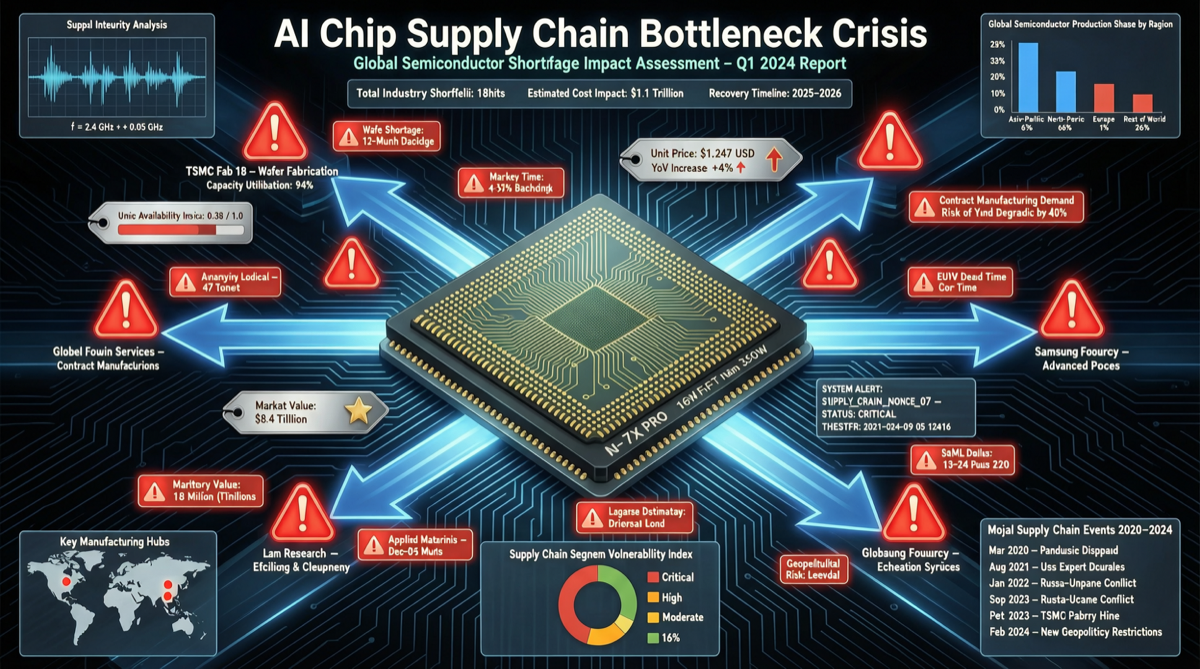
Conclusion: The “Triple Squeeze” on the AI Computing Supply Chain Is Taking Shape
In May 2026, a critical signal emerged from the semiconductor industry: Broadcom DSP (Digital Signal Processor) chip prices have risen by 15–20%, pushing the average selling price (ASP) above $1,000 per unit, with delivery lead times extended to 50–70 weeks.
This is not an isolated event. Concurrent industry data shows:
- GPU lead times: Remain stable at 6–9 months
- Access to high-end chips: Smaller companies continue to face significant challenges
- Chipmakers’ pricing power: Continues to strengthen
The AI computing supply chain is now experiencing a “triple squeeze”: price hikes + delivery delays + unequal allocation.
Data Breakdown
Broadcom DSP Price Increase
| Metric | Previously | Now | Change |
|---|---|---|---|
| Price | ~$830–870 | >$1,000 | +15–20% |
| Lead Time | 30–40 weeks | 50–70 weeks | +50–75% |
| Affected Products | 1.6T DSP | Full lineup of high-end DSPs | Across-the-board increase |
Broadcom’s DSP chips are core components for high-speed network interconnects—used for GPU-to-GPU communication within data centers. The DSP price hike directly increases AI cluster construction costs and degrades network performance.
Supply Chain Overview
| Bottleneck Segment | Current Status | Impact |
|---|---|---|
| GPU Supply | Lead time: 6–9 months | Delays in deploying AI training clusters |
| DSP Supply | Lead time: 50–70 weeks | Hinders data center network upgrades |
| Advanced Packaging | Capacity tight | Shortage of CoWoS and other advanced packaging technologies |
| High-end HBM | Prices rising | Indirectly increases model training costs |
Why This Is Happening
Demand Side: The AI Arms Race
In Q1 2026, the combined AI capital expenditures (CapEx) of the seven largest tech giants exceeded $725 billion (annualized quarterly figure), setting a new record high. Each firm is aggressively expanding its computing infrastructure.
Supply Side: Slow Capacity Ramp-Up
- TSMC’s expansion of advanced packaging capacity (e.g., CoWoS) is lagging behind demand growth
- Foundry capacity for chip design firms like Broadcom is being squeezed by AI customers
- Delivery cycles for semiconductor manufacturing equipment themselves are lengthening (e.g., lithography tools: 12–18 months)
Allocation Mechanism: Priority for Large Customers
Under supply constraints, chipmakers and foundries naturally prioritize their largest and most stable customers (Google, Microsoft, Meta, Amazon). Smaller AI startups and companies face the frustrating reality of “having money but still unable to buy.”
Strategic Outlook
Short Term (6–12 Months)
- AI infrastructure costs will continue rising
- Smaller companies will rely more heavily on cloud services and APIs—not self-built clusters
- “Computing power equals power”: Companies with reliable access to computing resources will gain competitive advantage
Medium Term (1–2 Years)
- Prices may ease once new capacity comes online—but structural shortages of high-end chips will persist for the foreseeable future
- Demand for domestic alternatives (e.g., Huawei Ascend) will be further stimulated
- Semiconductor supply chain security will become a central pillar of national technology policy worldwide
Implications for Developers
- Model Selection Strategy: Under constrained compute availability, prioritize parameter-efficient models (e.g., Qwen 3.6 27B, DeepSeek V4 Flash)
- Cloud-First Approach: Return on investment (ROI) for building in-house GPU clusters significantly declines during supply crunches
- Open-Source Model Localization: Consumer-grade GPUs paired with efficient open-source models offer a viable path for small teams
Investment Thesis
AI infrastructure chip suppliers—including Broadcom (AVGO) and Marvell (MRVL)—will continue benefiting from this supply shortage. Chipmakers’ pricing power peaks during periods of acute supply-demand imbalance.
However, caution is warranted: if prices rise too far, customers will accelerate adoption of alternatives—including domestic chips, alternative architectures, or even software-level optimizations. In the long run, supply chain diversification is an irreversible trend.