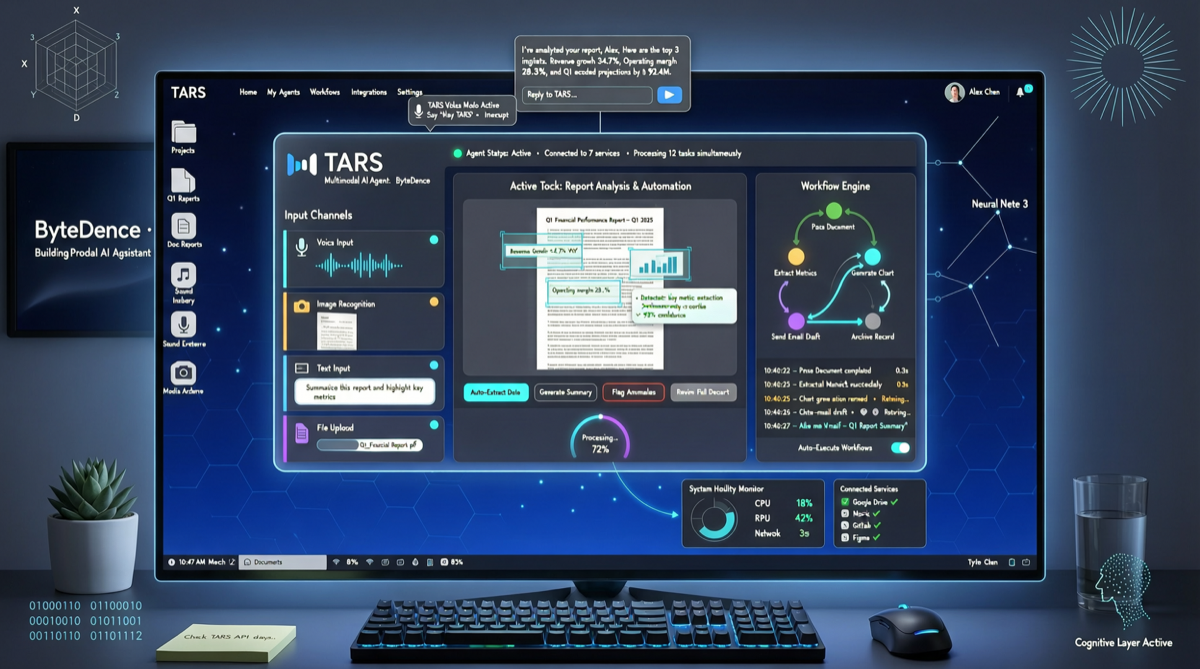
bytedance/UI-TARS-desktop gained another 850 stars today on GitHub Trending, reaching 31,110 total. Its tagline: "The Open-Source Multimodal AI Agent Stack" — an open-source multimodal agent solution connecting cutting-edge AI models with agent infrastructure.
What Is It
UI-TARS-desktop is a desktop agent framework that lets AI models "see" and "operate" your computer screen. Unlike pure API-based agents, it takes a GUI interaction route: the model visually understands screen content and then simulates mouse clicks and keyboard inputs to accomplish complex tasks.
This is the same direction as Anthropic's Computer Use and OpenAI's Operator, but UI-TARS-desktop is open-source and locally runnable.
What 1,108 Commits Tell You
The repo has 275 branches, 547 tags, and 1,108 commits. The latest commit was a security fix (CSRF protection + CORS whitelist) two months ago. This suggests the project has moved from an intensive development phase into stable maintenance.
316 open issues and 64 PRs for a 30K-star project is not bad — it means core features are mature and community feedback is concentrated on edge cases and integration adapters.
Compared to Similar Solutions
Compared to Anthropic Computer Use, UI-TARS-desktop's advantage is being open-source and customizable. You do not need to depend on Anthropic's API and can plug in your own models. Compared to pure CLI agents, its advantage is operating desktop applications that have no API.
But it faces the same challenges as all GUI agents: robustness when screen resolution changes, adaptation across different OS and desktop environments, and the balance between operation speed and API call latency.
When to Use It
If you are a developer wanting to introduce GUI automation into your desktop workflow, this project is worth looking at. Its monorepo structure (apps/ui-tars + packages/*) shows the architecture was designed for extensibility.
If you just want AI for document processing or data analysis, API-based agents are more stable and faster. GUI agents shine when dealing with scenarios without API interfaces — legacy systems, desktop software, complex web interface operations.
One Caveat
The last commit was two months ago, indicating the development pace has slowed. For a desktop agent that needs continuous adaptation to new models and operating systems, maintenance activity is a key metric. If you plan to rely on it for production deployment, keep an eye on issue response times.
Main sources: