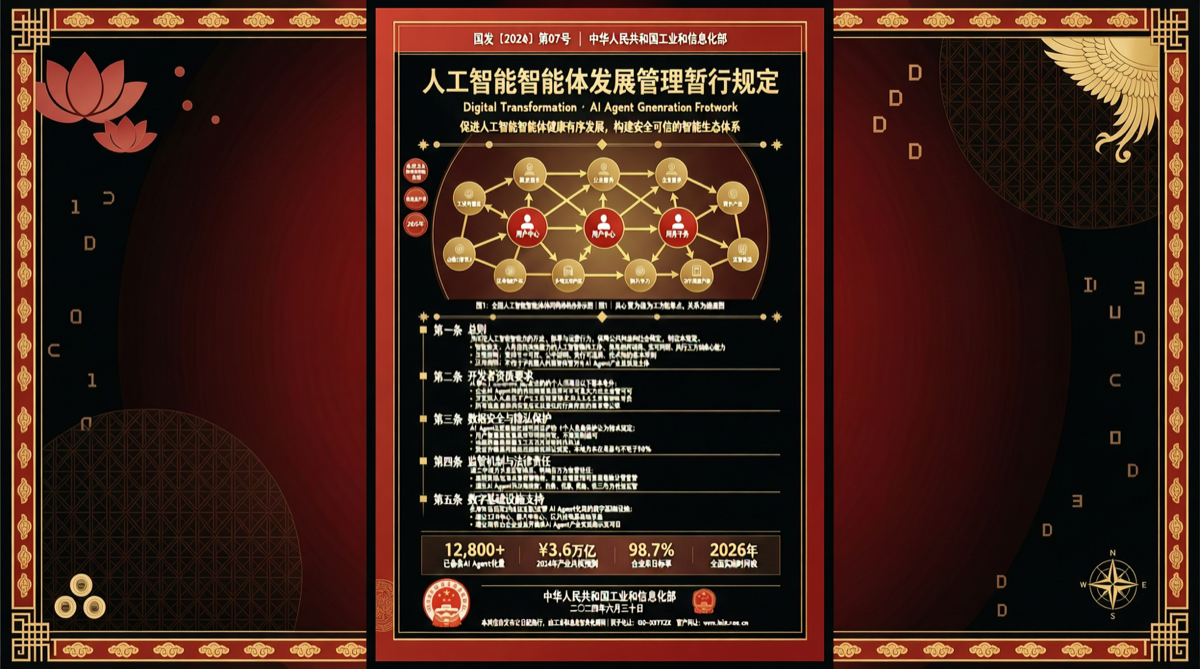
The 2026 government work report put the word "agent" in policy text for the first time. This week, the supporting implementation rules arrived.
The State Council released AI Agent Implementation Guidelines, aimed at promoting standardized application and orderly development of AI agents. This isn't vague "encourage innovation" language—it's an implementation guide with specific operational requirements. China's AI agent industry has officially moved from "wild growth" into "rule-based foundation" mode.
Why Now
The timing is revealing.
China's AI core industry exceeded 1.2 trillion yuan in 2025, with over 6,200 companies. Agents have exploded across office, manufacturing, finance, and healthcare sectors. But the faster the industry runs, the more risks are exposed—data security issues, agent loss-of-control risks, unclear responsibility attribution.
Set the rules now, or managing later gets much harder.
This guideline's background is the government work report's directive to "deepen and expand AI Plus, accelerate the promotion of next-generation intelligent terminals and agents." The guideline is the concrete implementation of that policy direction.
Key Points
Based on publicly available information, the guideline focuses on:
Standardized application. Agents in critical scenarios must be traceable and auditable. This means agent decision processes, data sources, and execution records must be logged. For high-risk scenarios like finance, healthcare, and industrial control, this is essentially mandatory.
Security and controllability. Agent behavior boundaries must be clearly defined, especially in scenarios involving user data, system permissions, and automated decisions. "What agents can and cannot do" needs to be established upfront—they shouldn't be exploring on their own.
Room for innovation. The guideline isn't a blanket restriction. It also emphasizes "innovative development," meaning companies and research institutions retain significant freedom to explore new agent forms and applications within the compliance framework.
What It Means for the Industry
For Chinese AI practitioners, this guideline sends several clear signals.
First, the agent race will no longer operate on "launch first, comply later." New products must consider compliance requirements from the design stage, especially around data security and decision transparency. Development cycles will get longer, but products will be more stable.
Second, the advantage of self-developed models expands further. If critical scenarios require traceable and auditable models, the compliance cost of calling external APIs becomes significantly higher than using in-house models. This reinforces the trend we're seeing with seven non-AI companies releasing models this week—major companies are building their own models, and compliance is a key driver.
Third, China is positioning itself to shape the global AI agent ecosystem. While the US and Europe are still debating "whether to regulate AI," China has published concrete implementation guidelines. This doesn't guarantee Chinese standards will become international standards, but it does give Chinese companies a first-mover advantage in rule-setting.
One Thing to Watch
The actual impact of this guideline depends on follow-up detailed rules and enforcement rigor. The direction is clear—"rule-based foundation, standard-first, security and controllability." But the specifics of whether a particular agent product is compliant, or whether a specific application scenario needs approval, will depend on more granular standards yet to come.
The next key milestone will likely be industry-specific standards (such as agent application standards for finance and healthcare). These vertical-sector rules will be more actionable than the general framework.
For teams building agent products, now is the time to audit which parts of your agent architecture involve data traceability and which decision processes need logging—these requirements will eventually land in concrete compliance reviews.
Primary sources:
- Chinese government official announcements
- X/Twitter industry analyst interpretations
- IDC enterprise AI model market report