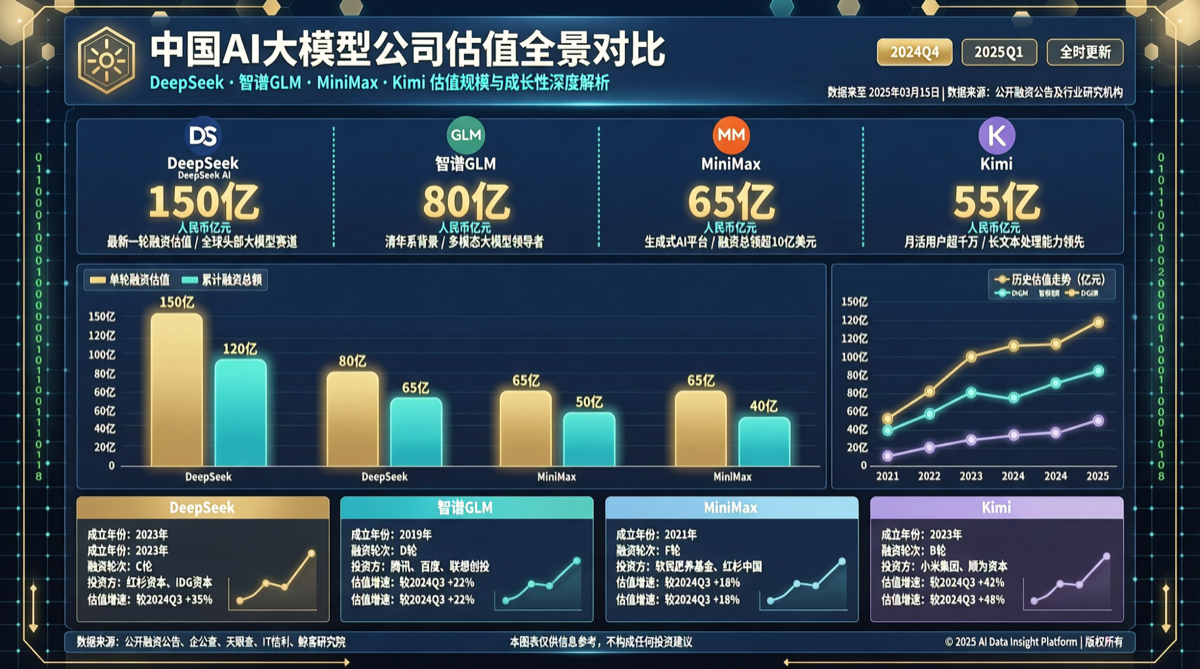
$40B or $10B? The DeepSeek Valuation Debate Reveals a New Pricing Logic
In late April, a piece of information about DeepSeek’s valuation spread rapidly in the Chinese tech community: DeepSeek’s latest valuation has exceeded $40 billion, not the previously rumored $10 billion.
This number may seem abrupt, but within the overall valuation system of Chinese AI foundation model companies, it is actually more reasonable.
| Company | Latest Valuation | Status |
|---|---|---|
| Zhipu GLM | ~$50B | IPO pending/listed |
| DeepSeek | ~$40B | Private funding |
| MiniMax | ~$30B | Multiple rounds |
| Moonshot AI (Kimi) | ~$20B | HK IPO preparation |
Restructuring the Valuation System
The market previously used $10 billion to estimate DeepSeek’s value—a figure from early funding rounds in late 2024. But industry changes in the first half of 2026 fundamentally altered this assumption:
The release of DeepSeek V4 was a key turning point. With 1.6 trillion parameters, a million-token context window, and fully open-source weights, the model caught up with or surpassed closed-source competitors in multiple benchmarks. More importantly, DeepSeek’s “open-source models, paid services” model demonstrated a sustainable commercial path—API prices are only 1/7 of GPT-5.5, yet scale effects still enable substantial revenue.
Zhipu’s GLM-5.1 iteration is equally strong, maintaining competitiveness in coding, multimodal, and Agent capabilities. As one of the earliest listed Chinese foundation model companies, Zhipu’s $50 billion valuation has received preliminary validation in public markets.
MiniMax reached $30 billion after receiving backing from Alibaba and state capital. Its commercialization path leans more toward B2B and industry solutions, with unique advantages in video generation, speech synthesis, and other vertical domains.
Moonshot AI’s (Kimi) HK IPO is the most标志性 event. A valuation of approximately $20 billion would make it one of the largest AI company IPOs in Hong Kong stock market history. On April 27, Binance’s He Yi revealed that CZ’s family office YZi Labs had invested in a Chinese AI foundation model company (highly likely pointing to Moonshot AI), further validating Kimi’s capital appeal.
Why the Valuation Surge Now?
Chinese AI foundation model companies experienced a concentrated wave of valuation reassessment from late 2025 to early 2026, driven by:
-
Technological leaps: New generation models like K2.6, V4, and GLM-5.1 have approached the international first tier in coding, reasoning, and multimodal capabilities—they are no longer “usable but not great.”
-
Commercial validation: API and subscription revenues at multiple companies have grown exponentially. After DeepSeek’s V4 series launched promotional pricing in May, user numbers surged.
-
Diversified capital sources: From pure VC funding to industrial capital (Alibaba, Tencent), state capital, and even crypto capital (YZi Labs) entering the field, the participants in valuation pricing are multiplying.
-
Improved policy environment: Increased national support for AI infrastructure, computing power subsidies, and data openness policies have reduced operational costs for startups.
Cross-Comparison: China vs. Silicon Valley
Comparing Chinese AI company valuations with their Silicon Valley counterparts reveals convergence in valuation systems:
| Chinese Company | Valuation | Silicon Valley Peer | SV Valuation |
|---|---|---|---|
| Zhipu GLM | $50B | Anthropic | $380B-$1T |
| DeepSeek | $40B | xAI (Grok) | Merged into SpaceX $1.75T |
| MiniMax | $30B | Cohere | ~$5.5B |
| Kimi | $20B | Mistral AI | ~$8B |
Chinese top model companies’ valuations remain significantly below Silicon Valley peers, but considering market size, commercialization stage, and capital environment, the gap is narrowing. A key observation: Chinese model companies generally demonstrate higher commercialization efficiency in their domestic market than Silicon Valley companies achieve outside their home market—meaning successful international expansion could drive further valuation upside.
The Significance of the HK IPO
If Kimi’s HK IPO plan succeeds, it will be a milestone for China’s AI industry:
- Return of pricing power: Chinese AI company valuations will be priced by public markets for the first time, rather than private rounds. This establishes a valuation benchmark for the entire industry.
- Liquidity release: Early investors and employees will gain exit channels, attracting more talent to AI startups.
- International window: Hong Kong’s international character helps Kimi build global investor relations, paving the way for future expansion abroad.
Action Recommendations
For developers: Valuation surges mean these companies have more resources for R&D. Tracking DeepSeek’s Agent Integrations community project, Kimi’s K3 roadmap, and GLM’s multimodal capability iterations is more valuable than watching valuation numbers.
For investors: The valuation system for Chinese AI companies is shifting from “Silicon Valley benchmark with a discount” to “independent pricing.” Focus on commercialization efficiency and international expansion progress, not just technical parameters.
For entrepreneurs: Valuation surges at top companies mean intensified funding competition, but also that the entire sector’s valuation ceiling is rising—mid-tier companies can also benefit from the rising tide.
Primary sources:
- DeepSeek valuation discussion - X/Twitter
- Chinese token plan discussion - X/Twitter
- Binance He Yi reveals investment in Chinese AI - X/Twitter
- China AI + Agent industry chain - Toutiao