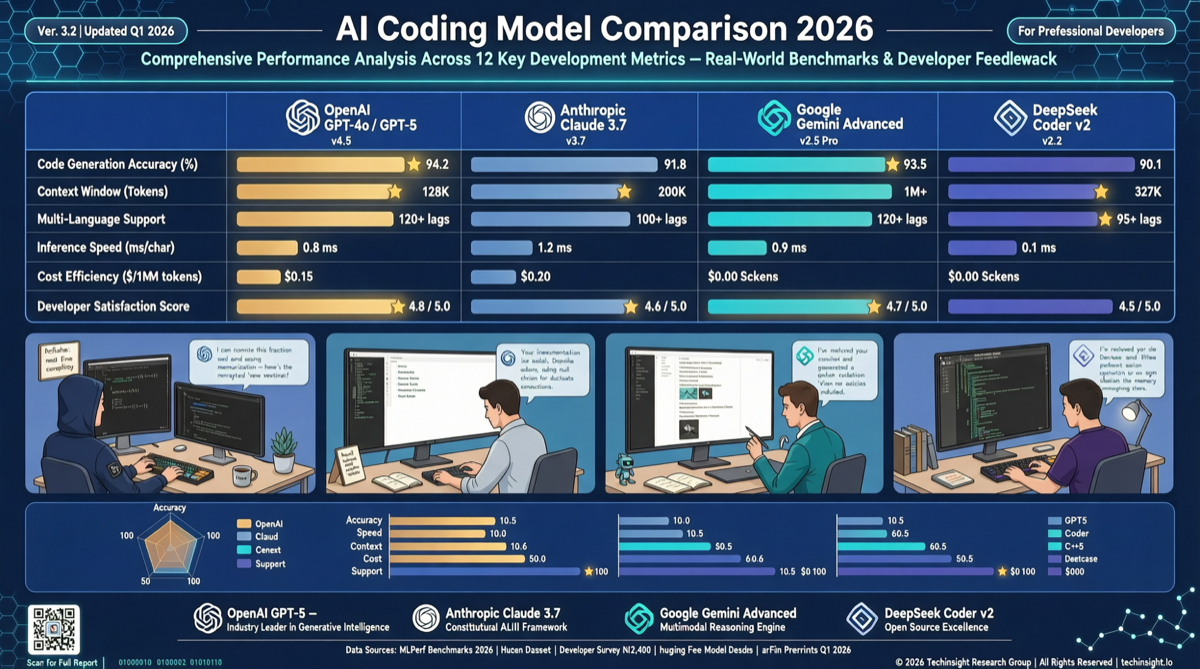
By late 2025, AI coding tool adoption jumped from 76% in 2024 to 84%. Claude Opus series first broke through the programming capability ceiling in November 2025, followed by rapid launches from GPT-5.5, Gemini 3.1 Pro, and DeepSeek V4. By April 2026, coding models have evolved beyond simple code completion to intelligent agents capable of completing complex software engineering tasks independently.
Benchmark Data
| Model | SWE-bench Pro | Terminal-Bench | Aider Ranking | Best For |
|---|---|---|---|---|
| Claude Opus 4.7 | 64.3% | 69.4% | Top 3 | Large codebases, refactoring |
| GPT-5.5 | 58.6% | 82.7% | Top 3 | Terminal operations, DevOps |
| Gemini 3.1 Pro | ~60% | ~65% | Top 5 | Multimodal code analysis |
| DeepSeek V4 | ~55% | ~58% | Top 10 | Cost-effective coding |
SWE-bench Pro is currently the closest evaluation to real-world software engineering, requiring models to understand large codebases, locate bugs, and generate mergeable fix patches. Claude Opus 4.7 leads at 64.3%, directly reflecting Anthropic’s continued investment in code and security.
Programming Scenario Breakdown
Code Generation and Completion
At the single-file level, the gap between the four models is narrow. Claude Sonnet (available at the $20 tier) already handles most daily development tasks — function writing and bug fixes. GPT-5.5’s advantage lies in terminal command generation — its 82.7% Terminal-Bench score means it’s more reliable when operating servers, debugging environments, and executing deployment commands.
Large Codebase Understanding
This is Claude Opus 4.7’s moat. In refactoring tasks involving multiple modules and thousands of lines of code, Opus 4.7’s long-context understanding and code structure analysis significantly outperforms peer models. Community tests show that on identical cross-module refactoring tasks, Opus 4.7 has higher patch merge rates and a lower probability of introducing new bugs.
Agent-Level Programming
When programming tasks expand to the full chain of “understand requirements → plan architecture → write code → test → fix,” GPT-5.5’s agentic browsing (84.4%) and terminal operation capabilities begin to shine. It can more autonomously browse documentation, search Stack Overflow, run tests, and iteratively fix issues.
Cost and Value
For coding-only needs, $20 Claude Pro (Sonnet model) already covers 80% of daily development tasks. For scenarios requiring Opus-level capabilities, $200 Claude Max is a must. GPT-5.5 via Plus plan ($20) offers better cost-effectiveness for terminal operation tasks.
DeepSeek V4, as an open-source alternative, achieves approximately 55% on SWE-bench — approaching the first tier of commercial models. For budget-conscious teams, it’s worth adding to the trial list.
Community Feedback
A community poll with 2,200+ likes sparked discussion on “which AI coding model is best.” The core consensus from 421 comments: no single model dominates all programming scenarios. Choice should be based on your daily work types:
- Frontend development: Claude Sonnet is sufficient — fast code generation, high-quality UI component suggestions
- Backend/system engineering: Claude Opus 4.7, strongest large codebase understanding
- DevOps/operations: GPT-5.5, leading terminal operation and automation script generation
- Budget priority: DeepSeek V4 or Gemini free tier
Recommendation
The coding model competition has entered a “scenario differentiation” phase. Don’t pursue the “best” coding model — instead, choose based on the 2-3 types of tasks you do most daily. For most developers, $20 Claude Pro or ChatGPT Plus is sufficient; if you’re doing systematic transformation of large projects, the $200 Opus 4.7 investment is worthwhile.