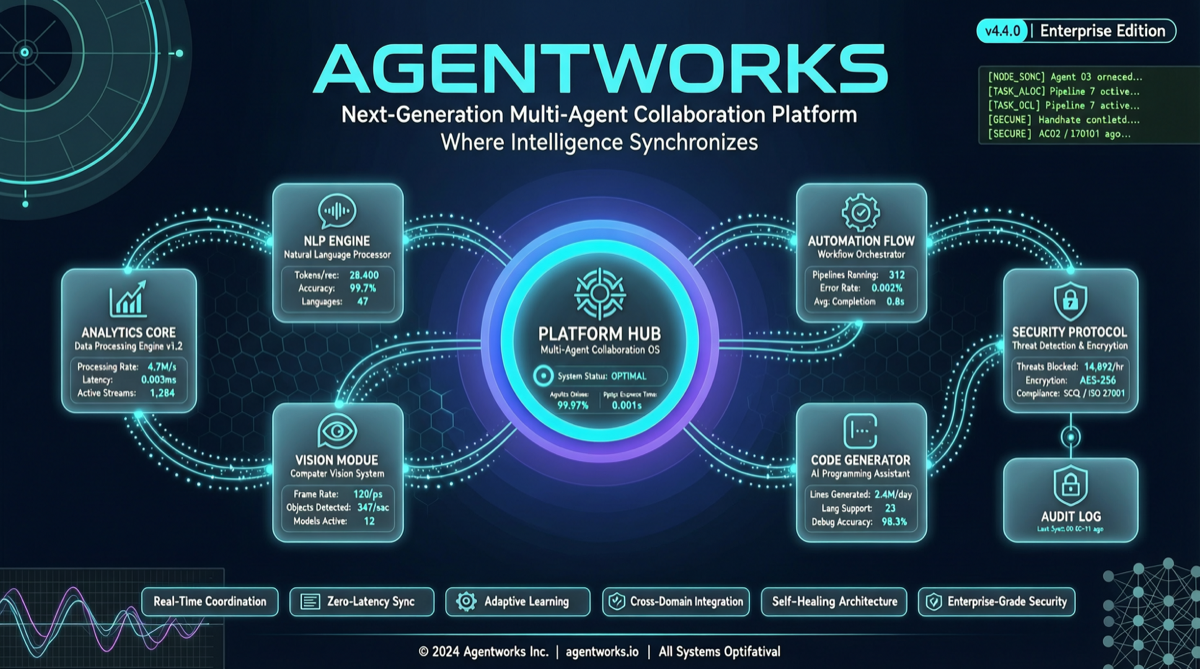
No Holiday Break: Coze 2.5 Arrives with "Agent World"
While most people are still digesting the releases of GPT-6 and Claude Mythos, ByteDance quietly launched Coze 2.5 during the May Day holiday, bringing a major feature called Agent World.
This isn't another chatbot shell — it's a multi-agent collaboration platform where users can build AI agents and have multiple agents work together to complete complex tasks. ByteDance's strategy is clear: don't compete on model parameters, go straight for the application layer.
What Exactly Is Agent World
In one sentence: from "one person using AI" to "a team using AI".
Traditional AI products follow this workflow: user asks a question → AI gives an answer → user executes it themselves. Coze 2.5's Agent World changes it to: user assigns a task → multiple agents collaborate and divide labor → automatically deliver results.
| Dimension | Traditional AI Assistant | Coze 2.5 Agent World |
|---|---|---|
| Interaction Mode | Q&A | Task assignment → auto-execution |
| Agent Count | Single model | Multi-agent collaboration |
| Output Format | Text response | Deliverable files/data |
| User Threshold | Requires prompt engineering | Drag-and-drop building |
| Core Capability | Information retrieval | Task decomposition + execution |
Why "Application Layer" Instead of "Model Layer"
ByteDance's strategic judgment is clear:
- Model layer competition is too crowded: The parameter gap between domestic and international large models is shrinking; competing on SOTA rankings alone offers no commercial moat.
- Application layer is where value is captured: Enterprises and individuals don't need smarter models — they need solutions that "get work done."
- Lowering the barrier to entry: Letting non-programmers "hire" AI digital employees.
This aligns with the same logic as Anthropic launching its enterprise AI service company and OpenAI integrating ChatGPT/Codex/Atlas into GPT-6's Symphony architecture — the endgame of AI is not conversation, but execution.
Comparison with Competitors
| Platform | Core Feature | Multi-Agent Support | Positioning |
|---|---|---|---|
| Coze 2.5 Agent World | Drag-and-drop + multi-agent collaboration | ✅ Core selling point | Mass-market AI workspace |
| Dify | Workflow orchestration | ✅ Basic support | Developer platform |
| LangChain | Code framework | ✅ Requires coding | Developer tool |
| CrewAI | Role assignment + task flow | ✅ Requires coding | Developer framework |
| OpenClaw | Autonomous agent execution | ✅ Built-in | Standalone agent platform |
Coze's differentiation: zero-code building + Chinese ecosystem + ByteDance traffic distribution.
Market Outlook: The AI Platform Battle of H2 2026
Coze 2.5's launch sends a signal: the focus of AI competition in 2026 is shifting from "whose model is smarter" to "whose platform is easier to use."
This means:
- For individual users: AI will transform from a "chat toy" to a "digital employee" — you'll need to learn how to manage a team, not how to write prompts.
- For enterprises: Multi-agent collaboration platforms may become new IT infrastructure, replacing some traditional SaaS.
- For developers: Pure model API value is declining; agent orchestration capability and tool ecosystems are the new moat.
Action Recommendations
- Current Coze users: Upgrade to 2.5 and try building your first multi-agent workflow. Experience the shift from single-point dialogue to task orchestration.
- Enterprise decision-makers: Evaluate whether to introduce multi-agent platforms to replace certain automation workflows, especially in customer service, data analysis, and content production.
- Developers: Watch the standardization progress of MCP and A2A protocols — these will be the infrastructure for multi-agent interoperability.
Coze 2.5 is just the beginning. As MCP (Model Context Protocol) and A2A (Agent-to-Agent) protocols mature, multi-agent collaboration will become standard across all AI platforms in the second half of 2026.