Conclusion First
The Cursor team conducted a simple yet profound experiment:
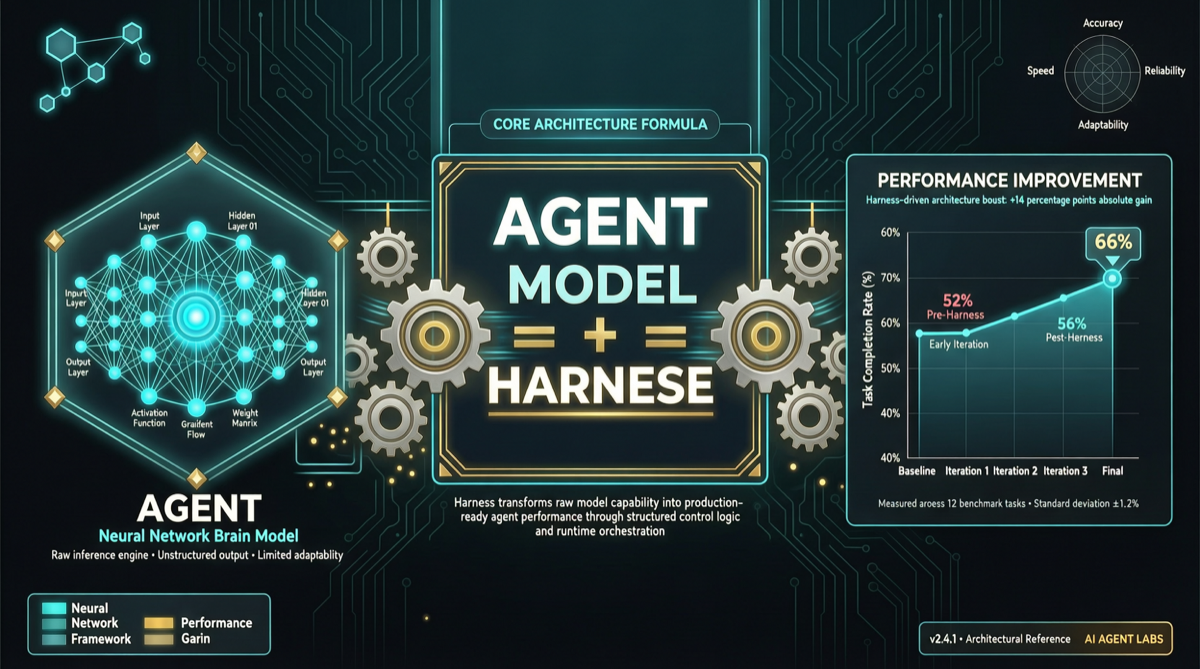
Same model (GPT-5.2-Codex), only changed the Agent Harness — Terminal-Bench 2.0 score jumped from 52.8% to 66.5%, ranking from outside Top 30 to Top 5.
This validates a critical judgment: In agent scenarios, the importance of architecture (Harness) rivals that of the model itself.
The Formula: Agent = Model + Harness
This is the core formula proposed by the Cursor team:
- Model: The language model, providing understanding and generation capabilities
- Harness: The agent framework layer, responsible for task decomposition, tool orchestration, context management, and error recovery
The model is necessary but not sufficient. The Harness is what transforms a language model into a useful agent.
Four Core Dimensions of Harness Optimization
1. Context Management Strategy
| Strategy | Before Optimization | After Optimization |
|---|---|---|
| Context Window Usage | Linear filling, frequent overflow | Layered management, critical info prioritized |
| History Retention | Keeps all conversation records | Intelligent compression, preserves decision nodes |
| File Context | Loads entire files | On-demand loading + summary caching |
2. Task Decomposition and Planning
- Before: Directly ask the model to execute complex tasks, high failure rate
- After: Model first creates an execution plan → Execute step by step → Verify each step → Auto-retry on failure with rollback
3. Tool Orchestration
- Serial vs Parallel: Identify steps that can be executed in parallel to reduce total execution time
- Tool Selection: Dynamically choose the most appropriate tool rather than using a fixed tool chain
- Result Verification: Validate output quality after each tool call; adjust parameters and retry if unsatisfactory
4. Error Recovery Mechanism
- Before: Stop immediately upon encountering an error
- After: Tiered error handling → Auto-diagnosis → Attempt repair → Report to user after exceeding retry threshold
Why This Matters
Impact on the Industry
The AI community’s attention is overly focused on model capabilities while neglecting the optimization space in the Harness layer. Cursor’s experiment proves:
- Harness optimization can unlock 10-15% additional performance (52.8% → 66.5%)
- Cost far lower than model upgrade: No need for more expensive API calls
- Portability: Harness optimization strategies can be applied across different models
Takeaways for Developers
- Don’t just stare at model switching: Before complaining the model isn’t good enough, check whether your Agent Harness is optimized
- Harness is a compounding competitive advantage: Models iterate rapidly, but good Harness design benefits long-term
- Open-source Harness projects deserve attention: Frameworks like OpenClaw and Hermes carry valuable architectural design insights
Action Recommendations
| Scenario | Recommendation |
|---|---|
| Existing agent applications | Audit Harness layer’s context management, error recovery, and tool orchestration logic |
| New agent projects | Design Harness architecture first, then choose the model |
| Cost-sensitive scenarios | Harness optimization has higher ROI than upgrading to more expensive models |
| Model is already optimal | Harness is the only direction left to optimize |
Summary
“The model is the engine, the Harness is the transmission.” A good engine with a poor transmission won’t deliver good performance. Cursor’s experiment proves with data that in the agent race, the importance of architecture optimization is being severely underestimated.