What Happened
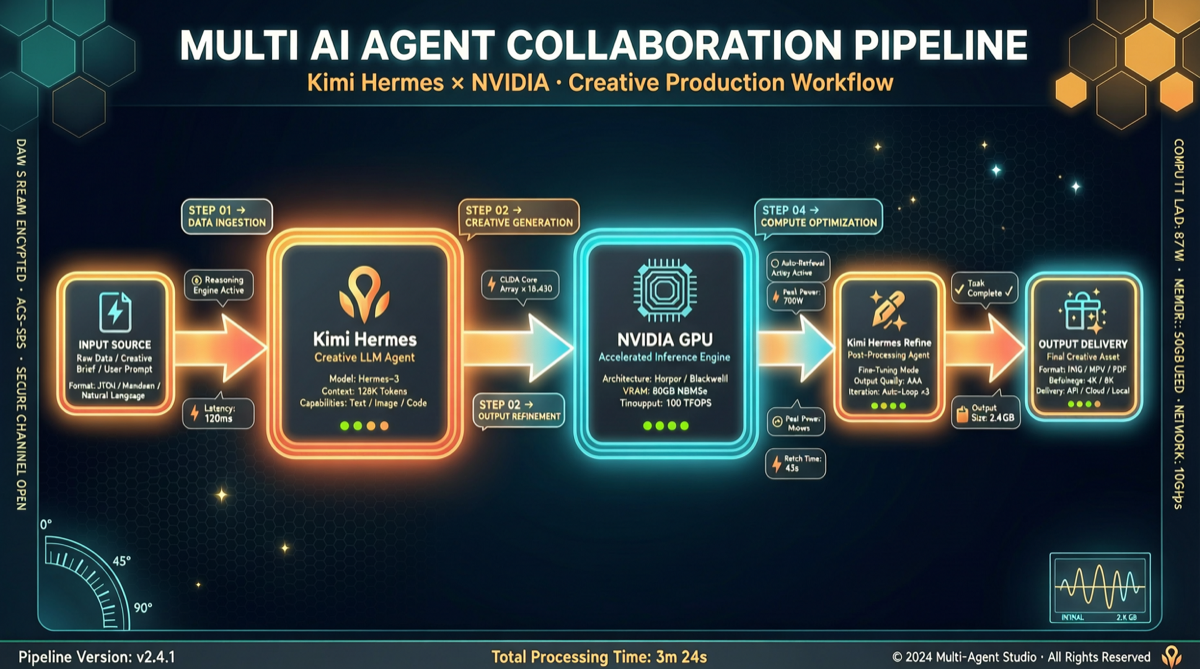
At the latest Hermes Agent Creative Hackathon, participants demonstrated a multi-model collaborative creative production pipeline that combines the strengths of different models and hardware into a complete creative workflow:
- Kimi (Moonshot AI): Responsible for creative planning and quality review
- Hermes Agent (Nous Research): Runs the full production pipeline orchestration locally
- NVIDIA DGX Spark: Handles final motion rendering and output
This is not a single model’s “all-around performance,” but rather different tools maximizing value in their respective areas of strength — a systems engineering approach.
Architecture Breakdown
Multi-Model Collaborative Workflow
[Kimi] Creative Planning → [Hermes Agent] Pipeline Execution → [DGX Spark] Rendered Output
   ↓                            ↓                                  ↓
 Understand requirements       Local orchestration               GPU-accelerated rendering
 Creative review               Tool scheduling                   Motion generation
 Quality gatekeeping           Cross-model calls                 Final output
Why Kimi for Planning?
Kimi has unique advantages in Chinese context understanding and creative planning:
| Capability | Kimi Performance | Suitable Scenario |
|---|---|---|
| Chinese creative understanding | Strong | Creative content for Chinese users |
| Long text processing | 200K+ context | Complete creative plan review |
| Multi-turn conversation | Natural and fluent | Creative iteration feedback |
Hermes Agent’s Pipeline Orchestration
Hermes Agent plays the role of local orchestrator in this architecture:
- Cross-model calling: Coordinates Kimi’s planning output to downstream rendering tools
- Local execution: All pipeline logic runs locally, data never leaves the local environment
- Skill learning: Autonomously creates and optimizes skills from execution experience
- Session memory: Maintains context across sessions, suitable for long-term creative projects
DGX Spark’s Rendering Acceleration
NVIDIA DGX Spark as an edge AI computing platform provides:
- Local GPU acceleration: No cloud rendering needed, reduced latency
- Motion rendering: Transforms static creativity into dynamic content
- Native integration with Hermes: Direct connection through local API
The Significance of This Architecture
1. The End of “Strongest Single Model” Thinking
Over the past year, the industry’s dominant thinking has been “find the best model and let it do everything.” This architecture demonstrates:
Using multiple models, each doing what they do best, may outperform a single strongest model.
This is a Best-of-Breed strategy, analogous to microservices architecture in software engineering.
2. Hybrid Paradigm of Local + Cloud
Hermes runs pipeline orchestration locally, Kimi is called via API, DGX Spark renders locally — this is a hybrid architecture where data stays local and computation is distributed on demand.
3. Creative Production from “Handcraft Workshop” to “Assembly Line”
Traditional AI creative workflow:
Human writes prompt → Wait for model output → Manual adjustment → Repeat N timesNew pipeline workflow:
Kimi plans creative solution → Hermes automatically executes multiple steps → DGX renders → Human reviews final resultEfficiency gains come from freeing humans from repetitive operations, focusing instead on creative direction and quality control.
Comparison with Competing Architectures
| Approach | Orchestration | Model Selection | Deployment | Use Case |
|---|---|---|---|---|
| This approach | Hermes local orchestration | Kimi + multi-tools | Hybrid | Creative production |
| OpenClaw | OpenClaw orchestration | Claude + tools | Cloud | Coding agent |
| LangChain | Framework-level orchestration | Any model | Flexible | General agent |
| Dify | Visual orchestration | Any model | Cloud/local | Enterprise workflow |
Action Recommendations
- Creative teams: Try using Hermes Agent as a creative pipeline orchestrator, combining the strengths of different models
- Developers: Reference this architecture for designing multi-model collaboration pipelines — the key is clearly defining each model’s role boundaries
- Enterprise decision-makers: Evaluate the ROI of a “Best-of-Breed” multi-model strategy vs. a single-model strategy
Sources
- Hermes Agent Creative Hackathon entry project (2026-05)
- X/Twitter community discussion
- Nous Research Hermes Agent documentation