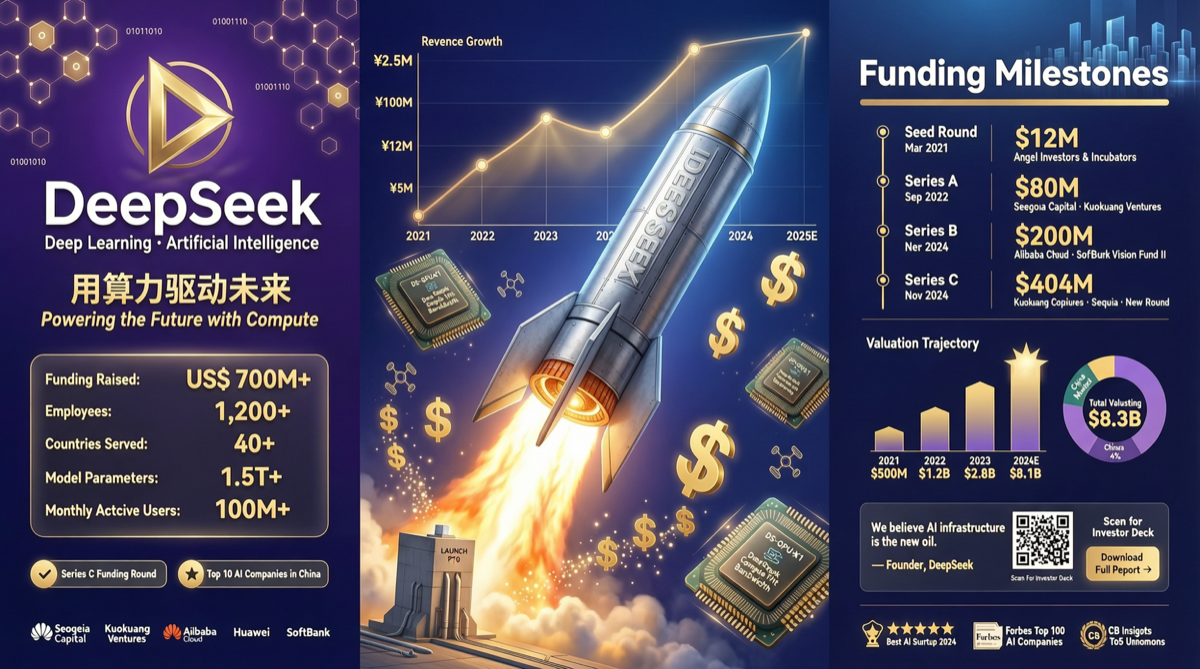
DeepSeek doesn't need money. But that didn't stop it from completing the largest AI funding round in Chinese history.
50 billion yuan. Founder Liang Wenfeng put in 40% himself. The National Integrated Circuit Industry Investment Fund led, with Tencent and Alibaba participating. Valuation jumped from $20 billion to $45 billion — doubled in two months.
The scale of this round means something: total AI sector funding in China for all of 2025 was about $9 billion. DeepSeek alone raised over $7 billion, eating a massive chunk of the pie.
Where the money goes
The company hasn't officially stated use of funds, but DeepSeek's recent moves point to a few directions:
Compute hoarding. After V4 launched in late April, usage surged and caused API backend outages. A significant portion of the 50 billion will go toward GPU procurement and compute cluster construction. Given tightening US export controls, domestic compute chip adaptation is also a focus — DeepSeek is already testing at least two model variants based on domestic chips.
V4.1 upgrade. According to Quick Technology, DeepSeek plans to release a major V4 update (expected to be named V4.1) in June, focused on improving third-party compatibility based on user feedback and fine-tuning coding capabilities to close the gap with Claude Opus 4.6/4.7 and GPT-5.5. Multimodal capabilities are also being optimized — DeepSeek previously ran grey-box testing for image recognition.
Talent reserves. DeepSeek currently has around 200 employees, lean for a top AI company. Post-funding, expansion is likely, especially in engineering and product teams.
An interesting signal
Liang Wenfeng's personal investment of 20 billion yuan (40%) is rare in AI funding history. Most founders raise with outside investors' money, putting little or nothing in themselves. This "all-in" gesture has two readings:
First, extreme confidence in DeepSeek's technical roadmap and commercial prospects. Second, it's a signal — personal capital buy-in for greater control and less dilution.
From Tencent and Alibaba's participation, domestic tech giants' positioning of DeepSeek is clear: it's not a startup that can be acquired, but an infrastructure-level player that needs to remain independent.
What it means for the industry
DeepSeek V4 has already launched a price war with "API pricing at one-tenth of frontier models." With 50 billion in funding, that strategy only gets more aggressive. For other domestic model companies, this means two things:
- The price war has no end. DeepSeek has the capital to keep cutting prices. Following is a math problem each company must solve.
- Compute is the moat. When model capability gaps narrow to the point users can't perceive them, whoever has cheaper compute and more stable service wins.
The V4.1 coding upgrade is a timing worth watching. If June's update truly brings coding capability to the same level as Claude Opus 4.6 — while maintaining a price advantage — the impact on the global AI coding tool market will be larger than V4's initial launch.
Risks
A $45 billion valuation means DeepSeek needs to prove its commercialization ability within a reasonable timeframe. Current revenue comes mainly from API calls and developer services — the ARPU in this track is far below enterprise SaaS.
Additionally, 50 billion in funding means higher expectations. If the next round doesn't show growth data matching the valuation, pressure will be intense.
Sources:
- Quick Technology: 50 Billion Yuan Funding, DeepSeek V4 June Major Upgrade
- Machine Heart: DeepSeek Raising 50 Billion Yuan
- The Information related reports