Key Takeaways
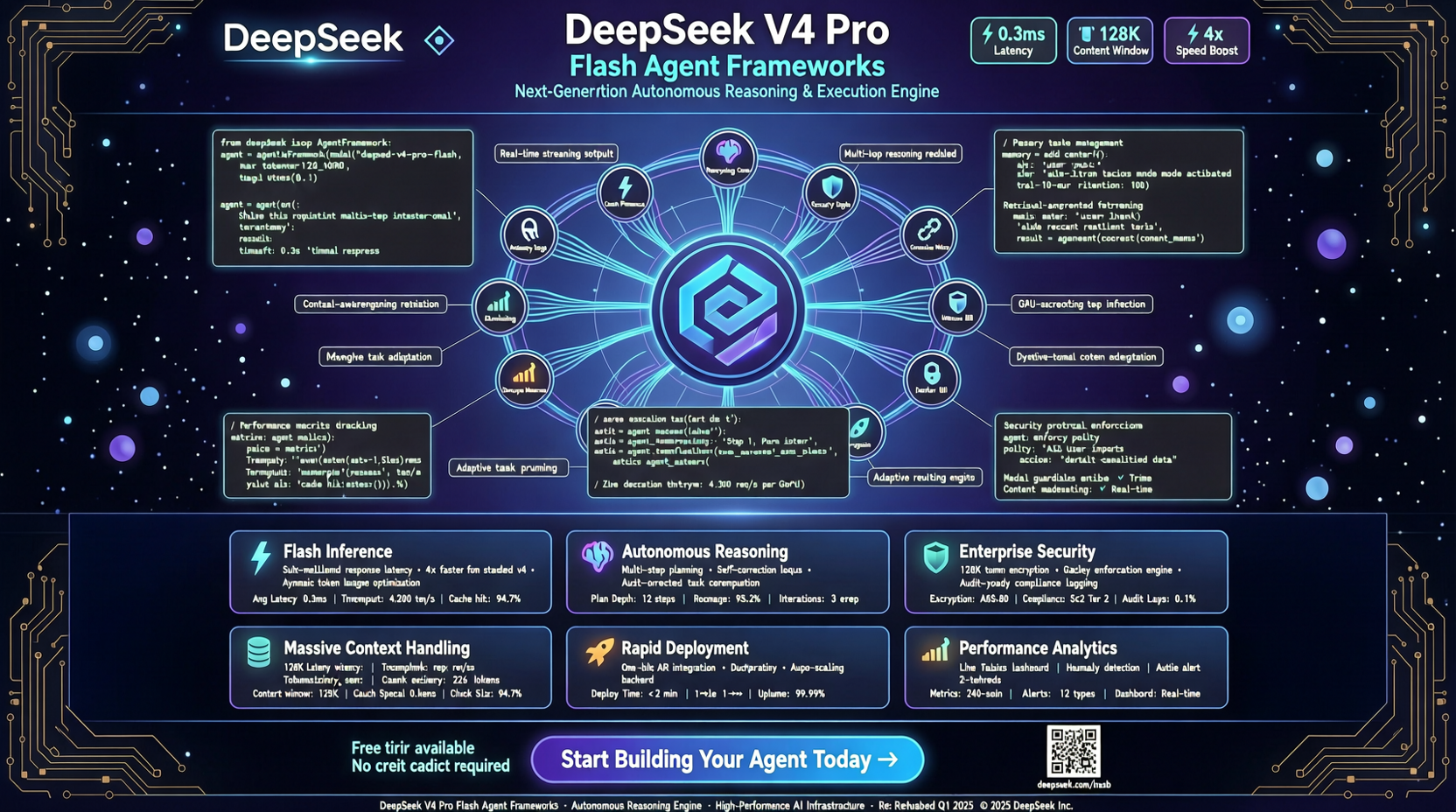
On May 6, 2026, DeepSeek officially confirmed that V4-Pro and V4-Flash variants are now integrated into mainstream Agent frameworks, with OpenCode Go added as a new Provider. This is a landmark moment: Chinese open-source models have achieved the leap from "callable via API" to "natively embedded in Agent workflows."
Why it matters: Until now, Agent frameworks' default model choices were almost monopolized by closed-source models like GPT-5.5 and Claude Opus 4.7. The integration of V4-Pro/Flash means developers can now directly orchestrate DeepSeek model nodes within LangChain, CrewAI, AutoGen, and other frameworks — without intermediate conversion layers.
V4-Pro vs V4-Flash: Positioning Differences
| Dimension | V4-Pro | V4-Flash |
|---|---|---|
| Positioning | Deep reasoning + complex Agent tasks | Low latency + high-frequency tool calls |
| Parameters | 1.6T MoE (49B active) | Lightweight distilled version |
| Use Cases | Multi-step planning, code generation, long-context analysis | Real-time chat, high-frequency API calls, streaming responses |
| Cost | ~2x V4 baseline | ~0.5x V4 baseline |
V4-Pro carries forward the V4 series' MoE architecture advantages, maintaining its position in the top tier of open-source models on AgentBench and SWE-bench. For Agent nodes requiring deep reasoning capabilities (code review, architecture design), this is currently the most cost-effective choice.
V4-Flash is the optimized version for high-frequency interaction scenarios. Within Agent frameworks, it serves as a "pre-filtering layer" — rapidly identifying user intent, routing to the correct tool or sub-Agent, and delegating complex tasks to the Pro version. This "Flash + Pro" layered architecture has been validated across multiple open-source communities.
OpenCode Go: The Significance of the New Provider
OpenCode Go's support as a new Provider bridges the Go language ecosystem with DeepSeek models. This means:
- Native Go Agent Framework Support: No longer requires a Python intermediate layer — Go-built Agents can directly call V4-Pro/Flash
- Microservice-Friendly: Go's microservice architecture is naturally suited for deploying Agent nodes, and direct Provider support reduces integration costs
- Edge Deployment Option: Combined with V4-Flash's lightweight characteristics, full Agent workflows can run in resource-constrained environments
Practical Recommendations for Agent Developers
Scenario 1: Multi-Agent Orchestration (CrewAI / AutoGen)
agents:
  - name: research_agent
    model: deepseek/v4-pro
    role: "Deep research analysis"
    tools: [web_search, file_read, code_execute]

  - name: routing_agent
    model: deepseek/v4-flash
    role: "Intent recognition and routing"
    tools: [intent_classifier]
Flash handles rapid classification and routing, while Pro processes sub-tasks requiring deep reasoning. This combination saves approximately 60% in costs compared to using Pro exclusively, while maintaining quality for core tasks.
Scenario 2: Code Review Agent in CI/CD
# LangChain integration example
from langchain_deepseek import ChatDeepSeek

reviewer = ChatDeepSeek(
    model="deepseek-v4-pro",
    temperature=0.1,
    max_tokens=4096
)

# Directly embed in CI pipeline
V4-Pro's advantage in code review scenarios lies in its superior understanding of Chinese code comments compared to same-price closed-source models, and its more standardized output formatting.
Scenario 3: High-Frequency Customer Service Agent
from langchain_deepseek import ChatDeepSeek

router = ChatDeepSeek(
    model="deepseek-v4-flash",
    temperature=0.3,
    streaming=True
)
The Flash version maintains Time-To-First-Token (TTFT) under 200ms, making it suitable for dialogue scenarios requiring real-time responses.
Industry Signals
DeepSeek's move releases three important signals:
- Open-source models are no longer just API alternatives — they are becoming first-class citizens in Agent workflows
- Chinese models' ecosystem building is accelerating — shifting from pure performance competition to framework-level integration
- "Model-as-Component" era arrives — developers can choose model nodes in Agents the same way they choose databases
With V4-Pro/Flash proliferating across Agent frameworks, we expect to see more open-source Agent projects built on DeepSeek models throughout Q2-Q3 2026. For enterprises and independent developers currently evaluating options, now is the optimal window to assess DeepSeek's actual performance in Agent scenarios.
Next Steps
- Agent Framework Users: Check whether your framework already supports
deepseek/v4-proanddeepseek/v4-flashproviders - Go Language Developers: Try OpenCode Go as a Provider to reduce intermediate layer dependencies
- Cost-Sensitive Scenarios: Use the V4-Flash + V4-Pro layered architecture as a replacement for single high-cost models