Core Conclusion
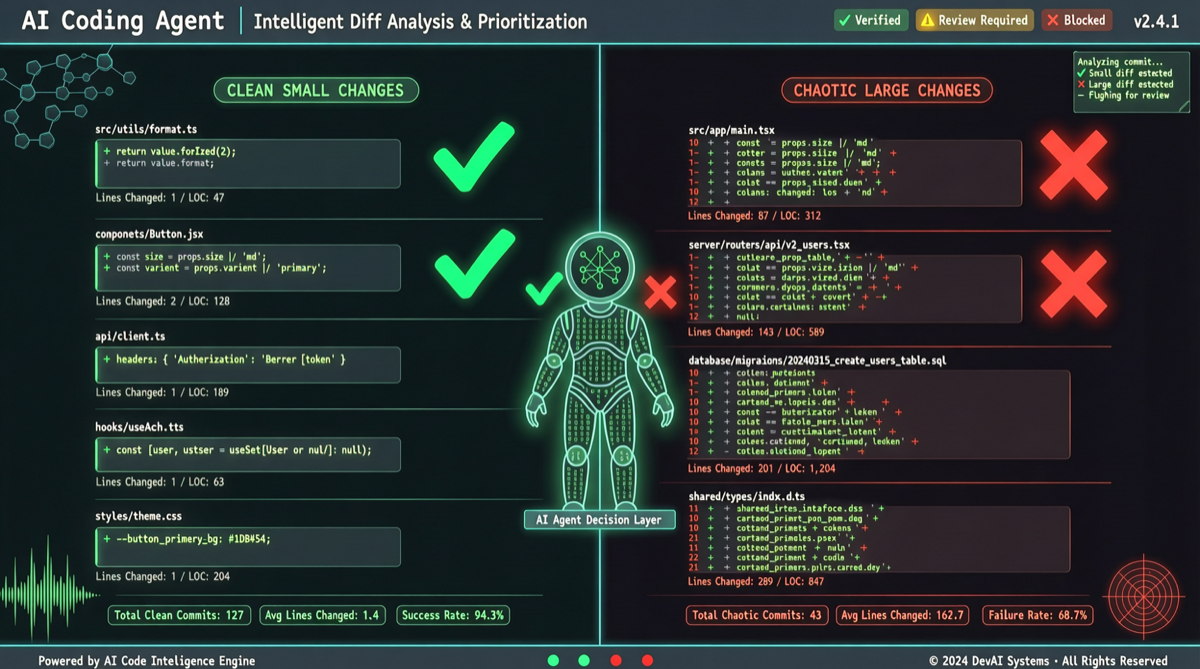
The biggest pain point for AI coding Agents isn’t an inability to write code, but rather writing unreviewable code—modifying dozens of files at once, producing diffs so long they have no end, leaving developers completely in the dark about what the AI actually did. dirac’s approach is straightforward: restrict the Agent’s editing scope so that each change is small enough and reviewable enough. This isn’t a performance optimization; it’s a paradigm shift in workflow.
Why Most Agents Fail on Diffs
The failure patterns of mainstream AI coding tools (Claude Code, Copilot, Cursor) are highly consistent:
- Over-editing: Models tend to “rewrite” rather than “modify”, causing a single feature change to ripple across a dozen files.
- Unreadable diffs: Diffs spanning thousands of lines mix logic changes, formatting adjustments, and irrelevant modifications.
- High rollback cost: When something breaks, it’s difficult to pinpoint which change caused it, forcing a complete rollback.
- Trust collapse: After reviewing a few massive diffs, developers either stop reviewing and just merge, or abandon the tool altogether.
dirac’s design philosophy is simple: The quality of the diff determines whether the Agent can be trusted.
dirac’s Core Design
| Design Principle | Implementation | Problem Solved |
|---|---|---|
| Small-step editing | Limit the number of files and lines modified per session | Prevents diffs from becoming too large to review |
| Incremental | Modify only one logical unit at a time | Reduces rollback and debugging costs |
| Review-friendly | Generates a standardized mini-diff format | Improves human review efficiency |
| Rollback-capable | Each change is independently reversible | Lowers the risk of trial-and-error |
Comparison with Mainstream Tools
| Tool | Modification Strategy | Diff Size | Review Experience | Failure Recovery |
|---|---|---|---|---|
| Claude Code | Unrestricted editing | Large (tens to hundreds of lines) | Moderate | Manual rollback |
| GitHub Copilot | Single-file suggestions | Small (a few lines) | Good | Ignore suggestion |
| Cursor | Multi-file editing | Medium to Large | Moderate | Partial undo |
| dirac | Constrained small-step editing | Small (a few to a dozen lines) | Good | Independent rollback |
Who It’s For
- Team Development: Scenarios requiring multi-person code review, where small diffs significantly boost review efficiency.
- Legacy Codebases: When modifying older projects, prevents the AI from making too many changes at once and spiraling out of control.
- Security-Sensitive Environments: Fields like finance and healthcare that require line-by-line code review.
- Agent Orchestration: Acts as an “execution layer” in multi-Agent collaboration, where smaller changes are easier to coordinate.
Who It’s Not For
- Rapid Prototyping: If you’re just quickly building a demo, small-step editing can actually slow you down.
- Large-Scale Refactoring: When comprehensive architectural changes are needed, constrained editing may fall short.
- Personal Projects: When developing solo, review requirements are lower, so the advantages of small diffs are less pronounced.
Getting Started
# Install
npm install -g dirac-agent

# Configure project
dirac init

# Execute small-step editing
dirac edit --scope "Only modify the login logic in the auth module"
Core principle: Give the Agent a sufficiently narrow task scope, and it will produce a sufficiently small diff. Breaking down large tasks into multiple small steps is the key to dirac’s workflow.
Industry Significance
dirac represents a new approach to Agent design: it’s not about making models increasingly powerful, but about making model outputs increasingly controllable. In 2026, as AI coding tools rapidly gain adoption, “controllability” may matter more than raw “capability”. With Claude Code already accounting for 4% of public commits on GitHub (projected to reach 20% by year-end), the challenge of reviewing AI-generated code is no longer a niche concern—it’s an engineering reality every team must face.