The biggest bottleneck for AI agents right now isn't that models aren't smart enough — it's that their arms are too short.
They can write code, analyze data, generate reports. But ask them to "check user A's order status" or "update a contact in the CRM via API" — sorry, they can't reach.
Executor wants to solve this. Its README is blunt: "The missing integration layer for AI agents."
What It Solves
Agents need to call external services. Current approaches are a mess: some hardcode it in prompts, some use MCP (Model Context Protocol), some build custom tool calling. Each approach has limitations, and they are incompatible with each other.
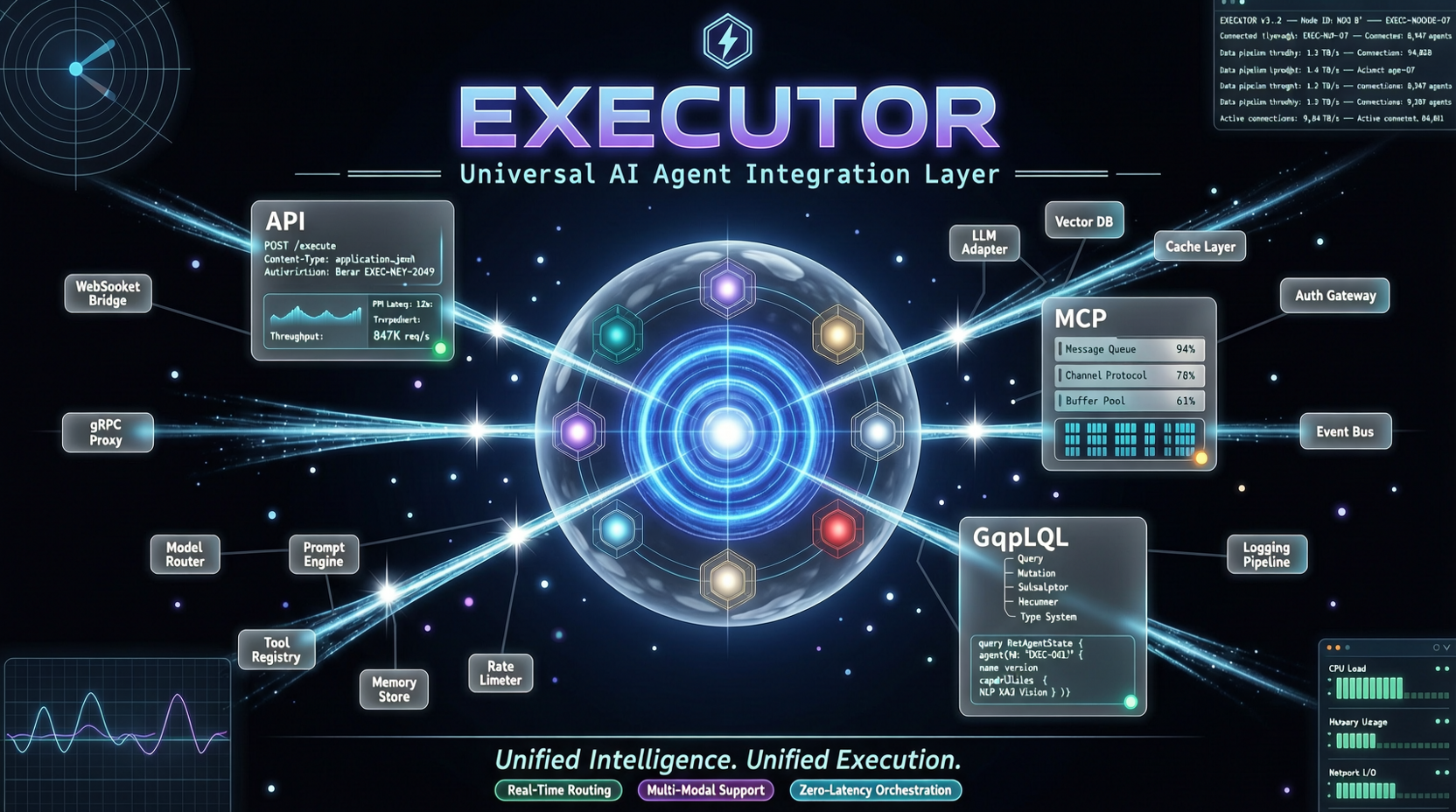
Executor's approach: a unified integration layer. Register your APIs — whether they are OpenAPI-spec REST endpoints, GraphQL endpoints, MCP servers, or custom JS functions — and agents can call them through a unified protocol.
Key features:
- Secure sandbox: Agent calls execute in an isolated environment, not directly exposing your internal systems
- Multi-protocol support: OpenAPI, MCP, GraphQL, custom JS
- Changeset version management: Using changesets for release management shows the project takes version compatibility seriously
- Desktop app: Recently updated the desktop release workflow (fix: publish as draft until desktop assets upload)
Activity Level
1,998 commits, latest update 6 hours ago. Recently doing Version Packages releases, suggesting the project is moving towards stability. Only 8 open issues, 14 pull requests — low issue count for a 1.7K star project, likely because it is still relatively new and users are观望.
Author RhysSullivan has a consistent contribution record in the AI Agent space — not a random repo chasing trends.
Relationship with MCP
Important clarification: Executor is not an MCP replacement, it is a layer on top of MCP. MCP defines the communication protocol between agents and tools. Executor does one thing on top of that — makes integration simpler.
If you have an existing OpenAPI service, you don't need to rewrite an MCP server — just register it with Executor. It handles protocol translation.
Real-World Scenario
Imagine this: you have an internal user management system (REST API), a data analytics service (GraphQL), and a custom data cleaning script (JS). Now you want Claude or GPT to "query user A's orders, analyze spending patterns, then write results to the database."
Without Executor: you write three separate tool definitions, handle auth, error retries, data format conversion...
With Executor: drop your service description files in, and the agent calls them directly.
Of course, this is the ideal case. Real-world effectiveness depends on Executor's protocol translation quality and error handling. From the code, it is strict about input schema boundaries (recent commit: "Tighten input schema boundaries") — which is good. Security trumps convenience.
Worth Following?
The project is still relatively early. 1.7K stars shows some attention but hasn't hit the explosion point yet. If you are building an agent system and need to integrate multiple external services, Executor is worth trying. If your agent only needs to call one or two APIs, there is no need to introduce this middleware layer yet.
Primary sources: