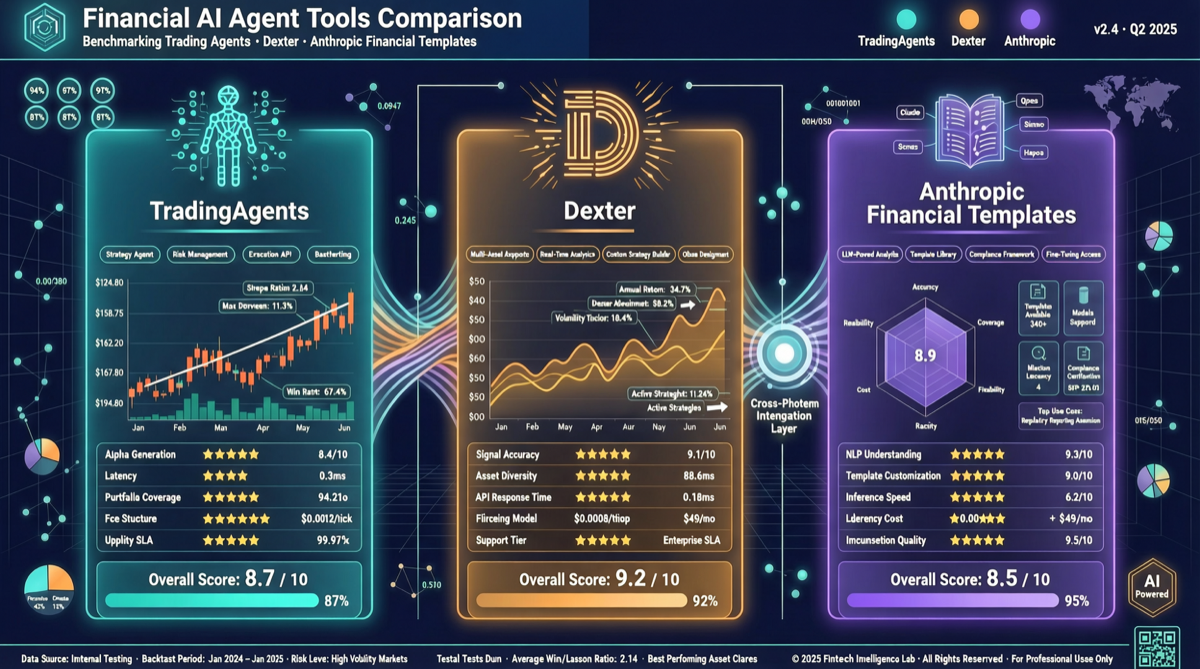
People working in finance may have noticed a cluster of financial AI Agent projects popping up on GitHub recently.
These aren't the same thing rebranded three times — they solve completely different problems. Understanding each tool's positioning matters far more than blindly chasing stars.
Conclusion First
- Quantitative trading strategy backtesting → TradingAgents
- Deep company research, earnings analysis → Dexter
- Financial industry workflow automation (Pitches, KYC, month-end close) → Anthropic Financial Services templates
Three directions, three paths. Don't expect one tool to do it all.
TradingAgents: Multi-Agent Trading Framework
72,741 stars, 14,155 forks, #3 on GitHub Trending this week.
TradingAgents' core selling point is a multi-agent collaborative trading decision framework. It doesn't give you a "auto-trade" button — it builds a research-decision-execution chain composed of multiple AI Agents.
What it does:
- Researcher Agents analyze market data
- Risk management Agents evaluate position risk
- Trading execution Agents generate trading signals
- Multiple agents reach consensus through debate mechanisms
Who should use it: Quantitative researchers, financial engineers, technical practitioners interested in multi-agent trading frameworks.
What to watch: 152 commits, decent activity but not exceptional. The iteration from v0.1.0 to v0.2.4 shows the project is still early-stage. DeepSeek V4 and Qwen model support were added recently, indicating multi-model compatibility is an active direction.
The critical point: this is not a "turn it on and make money" tool. It provides a framework — you need your own data sources, strategy logic, and risk controls. Treating the framework as a finished product will likely lose you money.
Dexter: Autonomous Financial Research Agent
25,096 stars, 3,058 forks.
Dexter's positioning is narrower and more focused: deep financial research. It's not a trading framework — it's an Agent that autonomously gathers information, analyzes data, and outputs research reports.
What it does:
- Autonomously searches financial data sources
- Integrates multi-source information to generate research reports
- Supports deep company fundamental analysis
Who should use it: Financial analysts, investment researchers, anyone who needs deep company/industry research.
What to watch: 442 commits, solid maintenance frequency. Latest version update was 2026.5.9, showing continuous iteration. The key difference from TradingAgents: Dexter doesn't do trading execution, only research.
If you need an AI assistant that "reads earnings reports, checks data, writes reports," Dexter is better than TradingAgents. If you need a trading decision framework, the reverse is true.
Anthropic Financial Services: Industry Template Library
17,955 stars, 2,309 forks, Apache-2.0 license.
Anthropic's financial-services repository takes a completely different approach. It's not a standalone framework — it's a set of out-of-the-box Claude Agent templates covering core financial industry workflows.
Scenarios covered:
- Investment banking pitch material generation
- Earnings review and cross-validation
- Model building
- Month-end close processes
- KYC screening
Who should use it: Financial industry practitioners — IB analysts, risk control staff, finance teams. No coding required, just apply the templates.
What to watch: This repository had 52 commits in the last 4 days — extremely fast iteration. Anthropic is clearly operating this project seriously, not just dumping it and walking away.
But it depends on the Claude ecosystem. If you don't use Claude, this template library has no direct value for you.
Comparison Summary
| Dimension | TradingAgents | Dexter | Anthropic Templates |
|---|---|---|---|
| Positioning | Multi-agent trading framework | Autonomous research Agent | Industry workflow templates |
| Technical barrier | High (strategy config needed) | Medium (data sources needed) | Low (out-of-box) |
| Ecosystem dependency | Standalone | Standalone | Claude-dependent |
| Target audience | Quant researchers | Financial analysts | Finance professionals |
| Stars | 72.7K | 25.1K | 18.0K |
| Activity | Medium | High | Very High |
My Take
The simultaneous rise of these three projects reflects a trend: the financial industry is becoming the first vertical domain for AI Agent adoption.
The reason isn't complex — financial tasks are naturally suited for Agent-ification: data-intensive, standardized processes, and relatively high error tolerance (research tasks aren't life-or-death like medical or autonomous driving).
But don't be fooled by star counts. 72K stars doesn't mean 72K people are using it. The number of people actually running these tools in live trading environments can probably be counted on one hand.
If you're selecting financial AI tools:
- First clarify what problem you need to solve
- Then map it to the tool's positioning
- Finally check ecosystem fit
Get the order wrong, and your selection is wasted.
Primary sources: