Key Takeaway
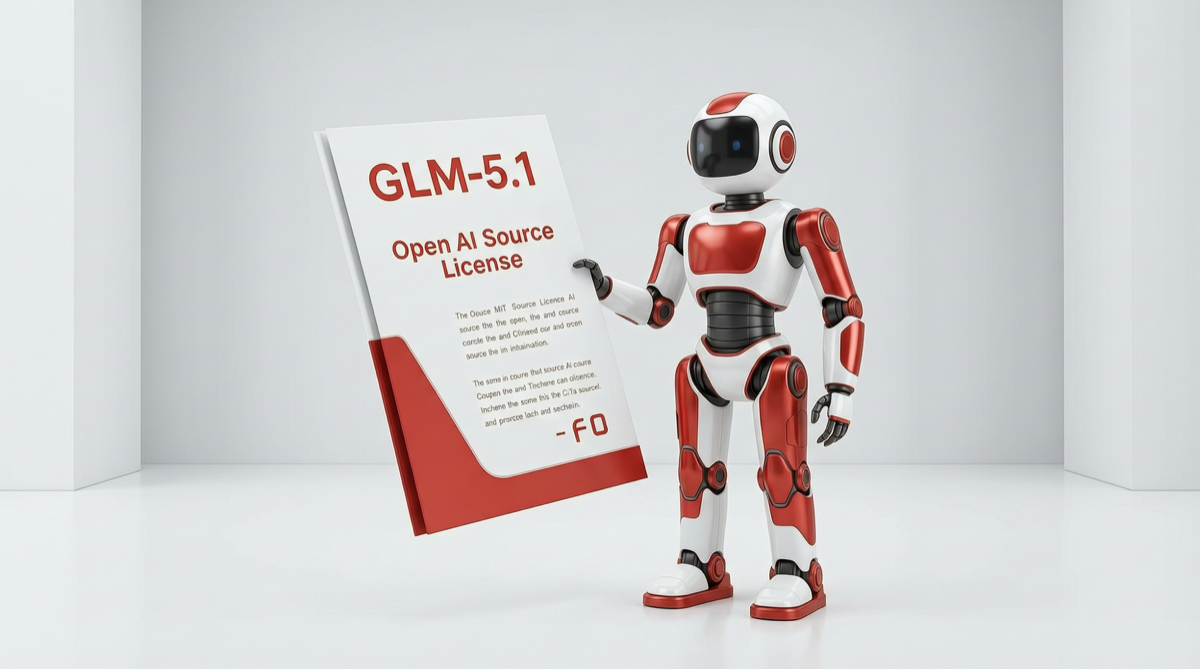
Zhipu AI released GLM-5.1 under MIT license, fully open-sourcing its weights. This is not just another domestic LLM release—the permissiveness of the MIT license and the clear Agent-first design direction reveal Zhipu differentiated strategy in the domestic model competition: trading the most open license for the largest ecosystem.
What Happened
GLM-5.1 Core Features:
- MIT License: Permits commercial use, modification, distribution with virtually no restrictions. This is among the most permissive license levels in domestic LLMs
- 754B MoE Architecture: Large parameter scale using Mixture of Experts (MoE) architecture, activating only partial parameters during inference
- Agent-first Design: Specifically optimized for sustained autonomous execution, long-horizon coding, agentic tool usage, and iterative engineering
Official Positioning: GLM-5.1 is not a "chat model" but an "Agent model"—designed for reliable performance across extended workflows and complex tasks.
License Comparison with Other Domestic Models
| Model | License Type | Commercial Use | Modification & Distribution | Agent Optimized |
|---|---|---|---|---|
| GLM-5.1 | MIT | ✅ Free | ✅ Free | ✅ Native |
| Qwen 3.6 | Custom open-source | ⚠️ Restricted | ⚠️ Restricted | Partial |
| DeepSeek V4 | Custom open-source | ⚠️ Restricted | ⚠️ Restricted | ✅ Native |
| Kimi K2.6 | Open weights | ⚠️ Restricted | ⚠️ Restricted | Partial |
The MIT license significance: enterprises can do anything with GLM-5.1 without reporting to Zhipu, paying additional fees, or worrying about license changes. This is a critical consideration for enterprise Agent application deployment.
Why Agent-first Design Matters
The competitive landscape of domestic models is undergoing a subtle shift:
Past: Competition focused on benchmark scores—MMLU, GSM8K, HumanEval. Higher scores meant leadership.
Now: Competition shifted to practical Agent capabilities—can it reliably execute multi-step tasks, maintain stability in long workflows, and seamlessly collaborate with external tools?
GLM-5.1 explicitly targets Agent capabilities as its core design goal, not as a post-hoc optimization. This is reflected in:
- State retention capability in long-range tasks
- Accuracy and fault tolerance in tool calling
- Self-correction ability in iterative engineering tasks
Landscape Assessment
Zhipu choosing the MIT license follows an "openness for ecosystem" path:
- Short term: Most permissive license → more developers and enterprises try it → community feedback accelerates iteration
- Mid term: Agent capability differentiation → build reputation in Agent scenarios → attract more use cases
- Long term: Ecosystem scale effect → become a default choice for Agent scenarios
The risk of this strategy: MIT license means Zhipu cannot build commercial barriers through license restrictions. The reward: if GLM-5.1 genuinely excels in Agent scenarios, natural ecosystem growth will bring greater market influence.
Action Recommendations
Developers and Enterprises:
- If evaluating domestic open-source models for Agent applications, GLM-5.1 MIT license + Agent-first design deserves priority testing
- Focus evaluation on stability in long-range tasks—the core metric for Agent scenarios
- When comparing with Qwen 3.6 and DeepSeek V4 Pro, include license terms as an important consideration
Metrics to Watch:
- GLM-5.1 performance on SWE-bench, AgentBench, and other Agent benchmarks
- Community response speed and adoption data for the MIT license
- Zhipu subsequent API pricing strategy (open-source free ≠ API free)