Key Takeaways
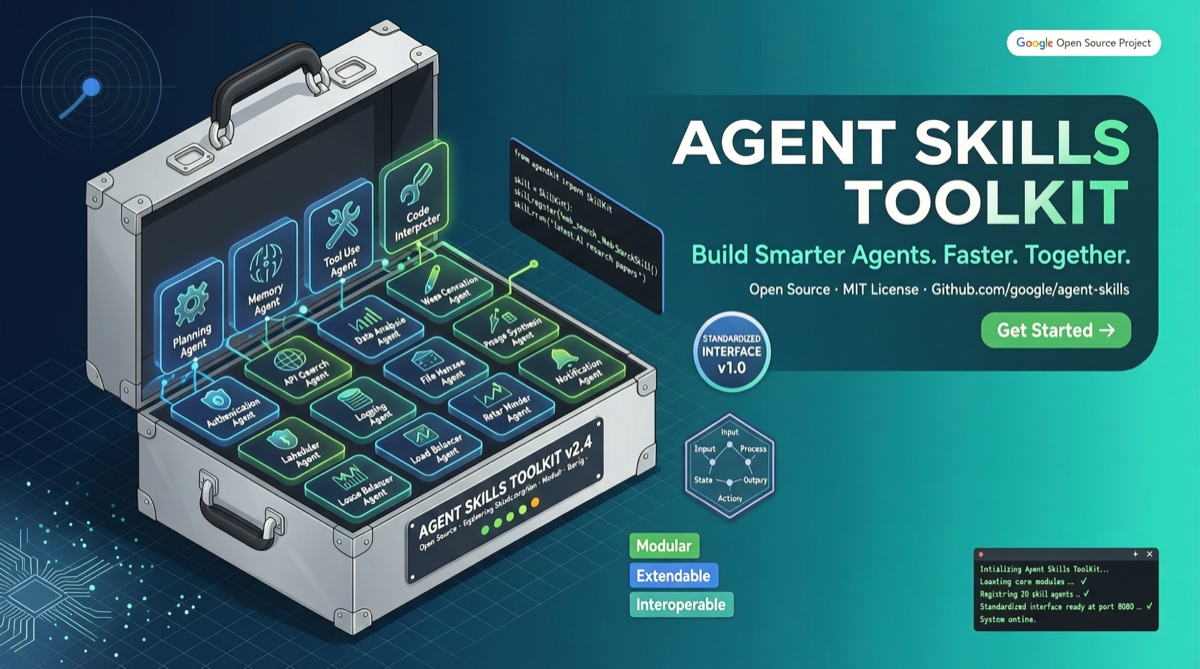
Google Cloud AI Director Addy Osmani previously open-sourced a library called Agent Skills on GitHub, focusing on engineering standards in the AI coding domain. This toolkit appeared almost simultaneously with the releases of OpenAI's GPT-5.5 and DeepSeek V4, revealing an overlooked trend: the competition among large models is shifting from "capability ceiling" to "engineering floor."
Why it matters: Agent development has long suffered from the "every team builds from scratch" dilemma. Agent Skills provides out-of-the-box best-practice templates, lowering the barrier to entry for Agent engineering while improving maintainability and reusability.
Core Problems Agent Skills Addresses
The past year of Agent development practices has exposed three major pain points:
1. Fragmented Skill Definitions
Different frameworks (Hermes Agent, OpenClaw, Claude Code) define "skills" completely differently:
- Hermes uses
.mdfiles for Skills - OpenClaw uses YAML configuration
- Claude uses
CLAUDE.mdcontext files
Agent Skills provides a unified abstraction layer, enabling skill definitions to migrate across frameworks.
2. Missing Engineering Standards
The inconsistent quality of Agent code stems from a lack of unified engineering standards:
- No standardized error handling patterns
- Missing observability instrumentation conventions
- No version management for inter-skill dependencies
Agent Skills introduces standardized templates similar to "design patterns."
3. Low Reusability
A code review Agent skill built by Team A cannot be directly reused by Team B because:
- Context dependencies are opaque
- Tool invocation formats are inconsistent
- There are no interface conventions between skills
Architecture Breakdown
agent-skills/
├── core/                    # Core abstraction layer
│   ├── skill-definition/    # Unified skill definition format
│   ├── interface-spec/      # Cross-framework interface specification
│   └── dependency-graph/    # Skill dependency management
├── templates/               # Pre-built templates
│   ├── code-review/         # Code review Agent template
│   ├── bug-triage/          # Bug classification and routing template
│   ├── doc-generator/       # Documentation generation template
│   └── test-automation/     # Test automation template
├── integrations/            # Framework adapters
│   ├── hermes-adapter/      # Hermes Agent adapter
│   ├── openclaw-adapter/    # OpenClaw adapter
│   └── langchain-adapter/   # LangChain adapter
└── examples/                # Practical examples
    ├── multi-agent-cicd/    # CI/CD multi-Agent orchestration
    └── skill-composition/   # Skill composition patterns
Key Innovation: Unified Skill Definition Format
Agent Skills proposes a framework-agnostic skill definition format:
skill:
  name: "code-review"
  version: "1.0.0"
  description: "Automated code review including security checks, performance suggestions, and style guidelines"

  inputs:
    - name: "diff"
      type: "string"
      description: "Git diff content"
    - name: "context"
      type: "object"
      description: "Related file context"

  outputs:
    - name: "review"
      type: "object"
      fields:
        - "issues"
        - "suggestions"
        - "severity"

  tools:
    - "git-diff"
    - "static-analysis"
    - "security-scanner"

  constraints:
    max_tokens: 8192
    timeout: 30s
    retry: 3
Advantages of this format:
- Highly readable: YAML format, understandable even by non-technical staff
- Framework-agnostic: Can be parsed by any Agent framework
- Version-controllable: Skill definitions enter Git version control
In Practice: Integrating Agent Skills into CI/CD
Step 1: Installation and Initialization
npm install @google-cloud/agent-skills
Step 2: Using Pre-built Templates
import { SkillRegistry } from '@google-cloud/agent-skills';
import { HermesAdapter } from '@google-cloud/agent-skills/integrations/hermes';

const registry = new SkillRegistry();

// Load code review template
const codeReview = registry.load('templates/code-review');

// Adapt to Hermes Agent
const hermesSkill = new HermesAdapter(codeReview);

// Register in CI/CD pipeline
hermesSkill.register({
  trigger: 'pull_request',
  branch: 'main'
});
Step 3: Skill Composition
// Compose multiple skills into a workflow
const pipeline = registry.compose([
  'code-review',      // Review code first
  'test-automation',  // Auto-generate tests
  'doc-generator'     // Update documentation
]);

pipeline.run({ diff: pr.diff });
Industry Significance
The open-sourcing of Agent Skills marks three trends:
1. The "Linux Moment" for Agent Engineering Just as Linux unified the operating system kernel, Agent Skills attempts to unify the definition and interaction of Agent skills. Once it becomes a de facto standard, it will significantly reduce development costs across the entire industry.
2. From "Model Competition" to "Engineering Competition" The capability gap between GPT-5.5 and Claude Opus 4.7 is narrowing, and the competitive focus is shifting to "who can better embed models into engineering workflows." Agent Skills is exactly the infrastructure for this shift.
3. Google's Cloud AI Strategy Agent Skills is not an isolated project — it's part of Google Cloud AI's overall strategy. By open-sourcing engineering standards, Google is attracting more developers to its Cloud AI platform.
Impact on Other Ecosystems
| Ecosystem | Impact |
|---|---|
| Hermes Agent | Can directly adopt Skills definition format, reducing skill migration costs |
| OpenClaw | Existing YAML configurations need adapter layer conversion |
| Claude Code | CLAUDE.md format and Agent Skills can be complementary |
| LangChain | Tool definitions and skill definitions need mapping relationships |
Next Steps
- Agent Framework Maintainers: Evaluate whether to add an Agent Skills adapter layer
- Enterprise Developers: Use pre-built templates to quickly set up internal Agent workflows
- Open-Source Contributors: Contribute new templates and framework adapters to Agent Skills