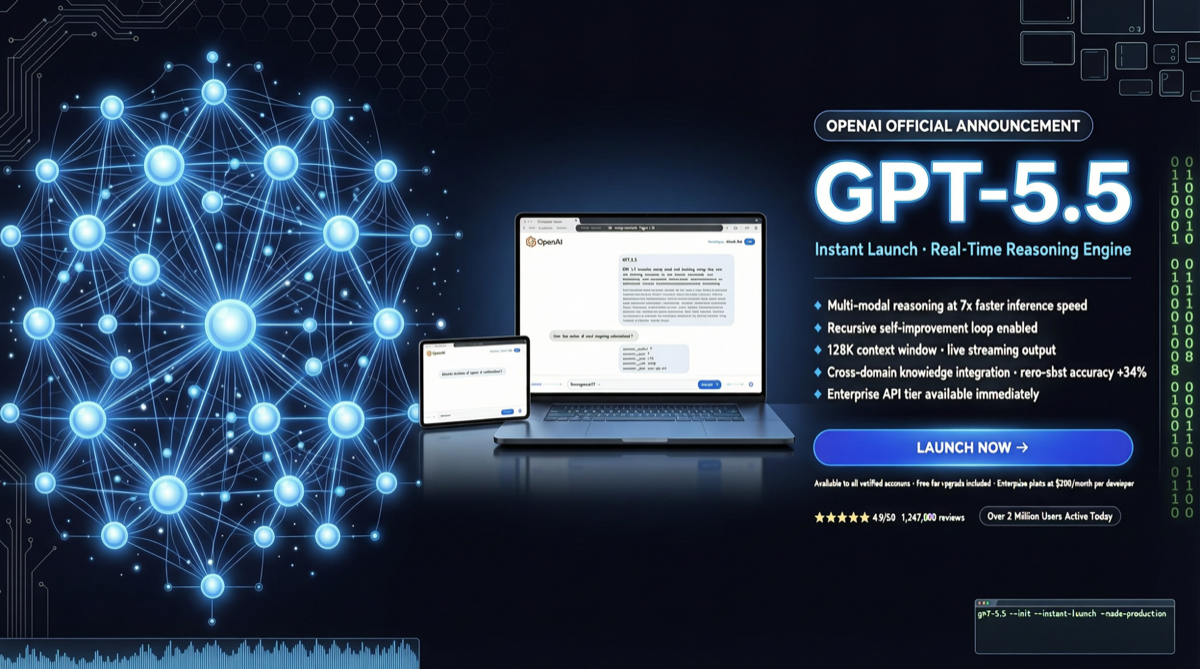
What Happened
Starting May 5, OpenAI began rolling out GPT-5.5 Instant to all ChatGPT users, officially replacing the previous GPT-5.3 as the default base model. Sam Altman personally announced the update.
This is not a minor upgrade — based on the data, GPT-5.5 Instant achieves significant breakthroughs across multiple dimensions.
Key Data Comparison
| Metric | GPT-5.3 | GPT-5.5 Instant | Change |
|---|---|---|---|
| Hallucination rate (medical/legal/finance) | Baseline | -52.5% | Massive drop |
| User-flagged error rate | Baseline | -37.3% | Significant improvement |
| Response word count (same query) | Baseline | -30.2% | More concise |
| Response line count (same query) | Baseline | -29.2% | Less verbose |
| STEM Q&A accuracy | Baseline | Improved | Specific numbers not disclosed |
Why It Matters
First, the significance of halving hallucination rates. In medicine, law, and finance — three domains where "getting it wrong has serious consequences" — a 52.5%+ reduction in hallucination rate means GPT-5.5 Instant is beginning to achieve the trustworthiness needed for direct production use. The biggest concern enterprises had about using ChatGPT was "will it fabricate information?" — that gap is rapidly closing.
Second, user feedback-driven error reduction. OpenAI specifically noted that "user-flagged incorrect conversations" saw a 37.3% error rate drop, indicating they've built an effective feedback loop: users correct → model learns → similar errors decrease. If this mechanism continues operating, the pace of quality improvement for the GPT series will only accelerate.
Third, a product philosophy shift toward "learning to shut up". A chronic issue with past GPT versions was overly verbose responses — frequently using 500 words when 100 would suffice. The ~30% reduction in both word and line count shows OpenAI has specifically optimized for "conciseness." For a conversational product handling hundreds of millions of daily queries, this directly means lower latency and better user experience.
Technical Speculation
According to community analysis, if GPT-5.5 Instant shares the same base model as GPT-5.5 Thinking, at least one of the following must be true:
- Model size is manageable: The base model is not at the multi-trillion parameter level (likely 1-3T range), otherwise the Instant path's inference cost would be unsustainable
- Routing optimization: The Instant path uses extensive routing, constraints, and caching strategies to avoid the full thinking chain
- Inference infrastructure expansion: OpenAI has significantly increased inference compute capacity over recent months
Given that the Instant path is set as "default" and free for all users, points 2 and 3 are most likely — OpenAI wouldn't deploy an unoptimized model directly to hundreds of millions of users.
Simultaneous Launch: ChatGPT Ads Manager
Alongside the model upgrade, OpenAI launched the ChatGPT Ads Manager beta for self-serve advertising in the US:
- Advertisers can create and manage search ads on their own
- New CPC (cost-per-click) bidding model added
- Integration with third-party ad tech platforms including Pacvue, Kargo, and StackAdapt
- Conversions API coming soon
This marks OpenAI's formal entry into the advertising market, with ChatGPT's search traffic beginning to monetize. For brands already running Google Ads and Bing Ads campaigns, there's a new channel to watch.
Action Recommendations
| Scenario | Recommendation |
|---|---|
| Daily ChatGPT use | Try GPT-5.5 Instant directly — responses are more precise and concise |
| Professional domains (medical/legal/finance) | Usable for initial research and draft generation, but critical decisions still require human review |
| Advertising | Monitor Ads Manager US beta progress, evaluate whether to integrate |
| Competitive comparison | Run side-by-side tests with Claude Sonnet 4.6, Gemini 2.5 Pro to choose the best option |