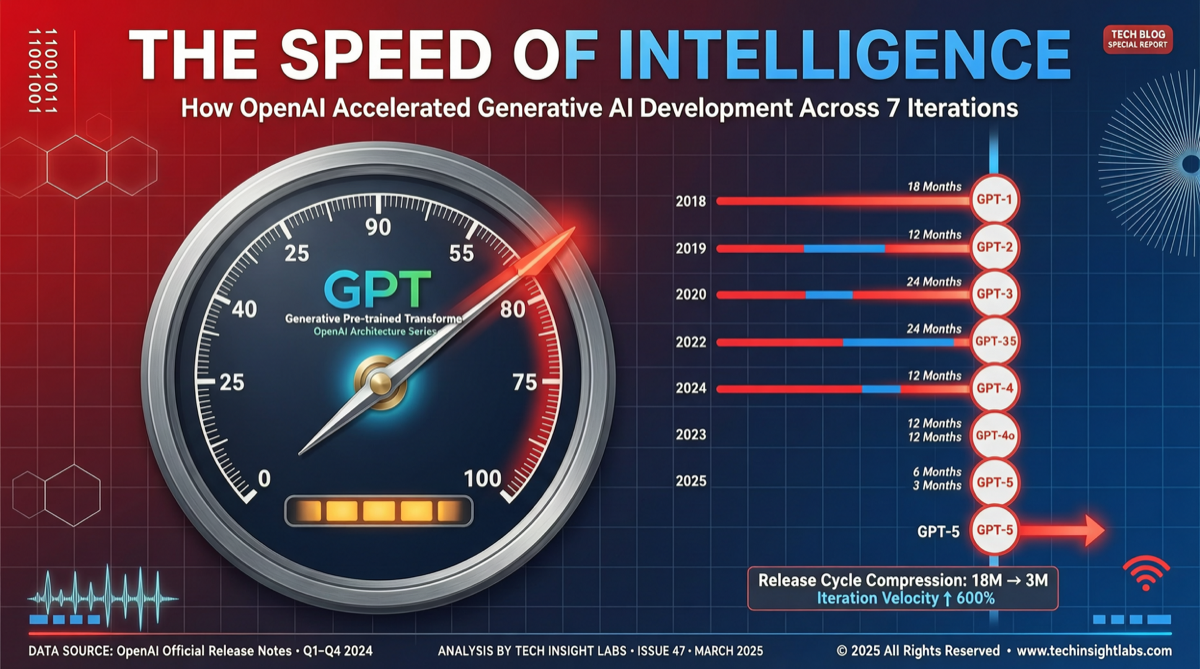
Bottom Line
OpenAI's GPT model release cadence is undergoing significant acceleration. The timeline from GPT-5 to GPT-5.5 shows release intervals compressed from 97 days down to 28-49 days. If the trend continues, GPT-5.6 could arrive as early as late May 2026.
Release Cycle Data
| Version | Release Date | Interval from Previous |
|---|---|---|
| GPT-5 | Aug 7, 2025 | — |
| GPT-5.1 | Nov 12, 2025 | 97 days |
| GPT-5.2 | Dec 11, 2025 | 29 days |
| GPT-5.3-Codex | Feb 5, 2026 | 56 days |
| GPT-5.4 | Mar 5, 2026 | 28 days |
| GPT-5.5 | Apr 23, 2026 | 49 days |
| GPT-5.6 (predicted) | Late May 2026 | Est. 28-40 days |
Pattern Analysis
1. Three Phases of Release Rhythm
- Phase 1 (97 days): GPT-5 → GPT-5.1, first iteration after major version, typically architectural improvements
- Phase 2 (28-56 days): GPT-5.1 → GPT-5.4, rapid iteration period, feature enhancements and optimization
- Phase 3 (49 days): GPT-5.4 → GPT-5.5, establishing regular monthly release rhythm
2. 28 Days as the Minimum Viable Cycle?
GPT-5.4's 28-day interval suggests a floor:
- Model training and data prep: at least 2-3 weeks
- Safety evaluation and red teaming: 1 week
- Release preparation: several days
This means future GPT iteration speed is unlikely to break the "monthly release" physical limit.
3. Numbering Strategy Changes
The naming reveals OpenAI's strategy:
- Decimal versions (5.1, 5.2, 5.4, 5.5): Incremental improvements
- Suffix versions (5.3-Codex): Specialized optimization for specific scenarios
- No GPT-6 yet — indicating room for iteration within GPT-5 architecture
Competitive Landscape
OpenAI's acceleration isn't isolated — it's part of industry-wide competition:
| Company | Latest Model | Recent Cadence |
|---|---|---|
| OpenAI | GPT-5.5 (Apr 23) | Accelerating to 28-49 days/version |
| Anthropic | Claude 5 Beta | From quarterly to monthly |
| Gemini 3.1 Flash | Continuous iteration | |
| Meta | Muse Spark | Delayed to May, slower pace |
| xAI | Grok 4.3 Beta | Active updates |
Notably, Meta's new model underperforms Google's, has been delayed to May, and internal researchers are leaving. Reports suggest Meta is discussing licensing Google's Gemini for its own products — a company that spent $14B building AI infrastructure may use a competitor's model.
Impact on Developers and Enterprises
1. Model Selection Dilemma
When major models update monthly:
- Integration cost increases: Each new version may require API call adjustments
- Benchmarks become stale: Today's eval results may be outdated next month
- Lock-in risk: Deep integration with one version increases migration cost
2. Cost Optimization Windows
Each new release typically brings pricing adjustments:
- Older version APIs may get discounted
- New versions may have initial promotions
- Cache and context optimization strategies need to keep pace
3. GPT-5.6 Expectations
If the 28-49 day rhythm continues:
- Release window: May 20 - June 5
- Likely improvements: Larger context window, better tool calling, lower latency
- Pricing: May continue GPT-5.5 pricing or differentiate via new tiers
Action Items
- API integrators: Build model version abstraction layers — avoid hardcoding specific versions
- Cost control: Monitor pricing changes after each new release; adjust accordingly
- Evaluation strategy: Don't over-rely on single-point benchmarks — build continuous eval pipelines
- Technical debt management: Do full upgrade assessments every 2-3 major versions, not every minor one
- Multi-model strategy: Don't put all eggs in one basket — integrate at least 2 providers as backup