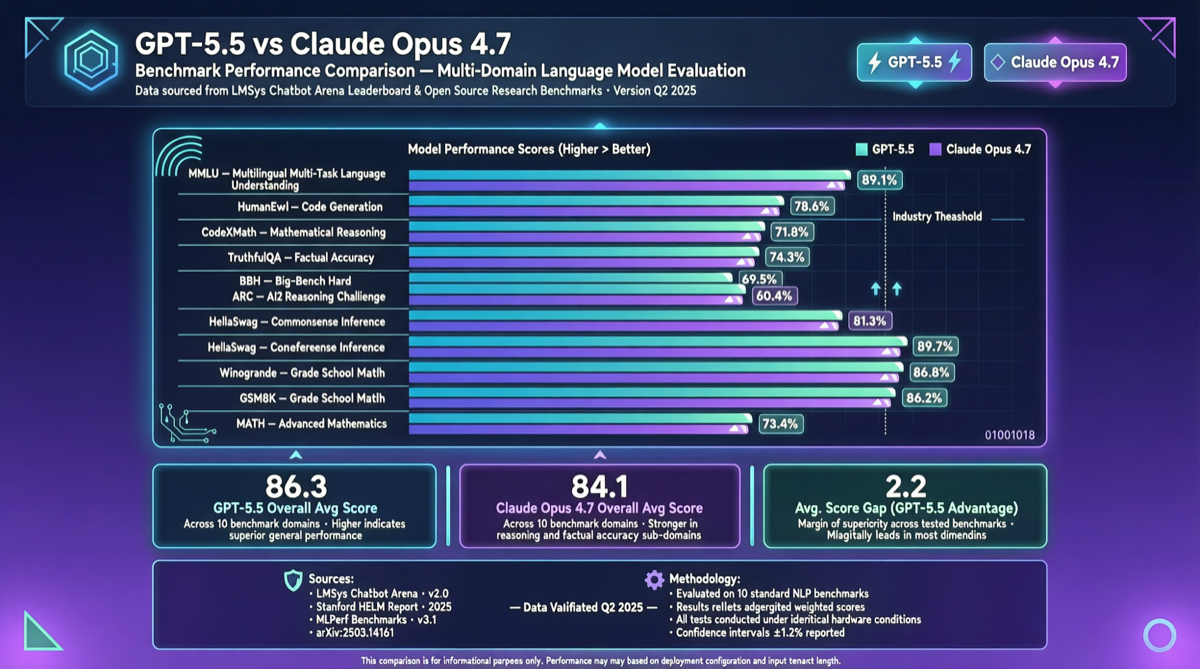
OpenAI released GPT-5.5 on April 23, marking the fourth major frontier model launch in Q1 2026. Just seven days earlier, Anthropic’s Claude Opus 4.7 (released April 16) had topped multiple evaluation leaderboards. The matchup between these two models reflects a clash of design philosophies: GPT-5.5 pursues peak efficiency in terminal operations and general reasoning, while Claude Opus 4.7 maintains its edge in software engineering and long-chain tasks.
Benchmark Comparison
Official GPT-5.5 benchmark results published by OpenAI (including categories where it lost):
| Benchmark | GPT-5.5 | Claude Opus 4.7 | Notes |
|---|---|---|---|
| Terminal-Bench 2.0 | 82.7% | 69.4% | Terminal operations and system-level tasks |
| GDPval | 84.9% | 80.3% | General data validation |
| CyberGym | 81.8% | 73.1% | Cybersecurity scenarios |
| SWE-bench Pro | 64.3% | 64.3% | Software engineering tasks (tie) |
| HLE | 41.4% | 46.9% | High-difficulty reasoning |
| MRCR @ 1M | 74% | 32.2% | Million-token context understanding |
GPT-5.5 leads by 13 points on Terminal-Bench, consistent with its “better at using tools” design direction. But Claude Opus 4.7 holds a clear advantage on HLE (Humanity’s Last Exam) and million-token context — the MRCR @ 1M gap (74% vs 32.2%) suggests a much larger practical difference in long-context usage.
Notably, OpenAI proactively listed the categories where GPT-5.5 lost (to Opus 4.7 and the restricted Claude Mythos Preview) — a level of transparency that was uncommon in previous launches.
Real-World Coding Comparison
Community tests (same prompts, same projects, three real builds) show:
- GPT-5.5: 73% solve rate on 20-hour software engineering tasks, higher efficiency in terminal command generation and debugging, fewer tokens per task
- Claude Opus 4.7: More stable on large codebase understanding, multi-step refactoring, and code review/security analysis
Both models support a 1 million token context window, but Claude maintains better information retention and citation accuracy at that length.
Pricing and Availability
GPT-5.5 is available to Plus, Pro, Business, and Enterprise users, with latency matching GPT-5.4. Claude Opus 4.7 is accessible via the Claude Max plan at $200/month. GPT-5.5 Pro API pricing is approximately $180 per million output tokens, while Gemini 3.1 Pro at the same tier costs about $12 per million tokens.
Which Should You Choose
- Terminal operations, DevOps automation, cybersecurity: GPT-5.5, with significant leads on Terminal-Bench and CyberGym
- Large-scale software engineering, code review, security analysis: Claude Opus 4.7, leading on SWE-bench Pro and HLE
- Million-token context analysis: GPT-5.5’s MRCR @ 1M score far exceeds Opus 4.7
- Budget-conscious developers: GPT-5.5 via Plus plan ($20/month) offers higher cost-effectiveness
The model landscape is shifting on a weekly basis. Today’s “best” may be surpassed in seven days, but the differentiated strengths of both models are now clear: GPT-5.5 excels at terminal operations and general reasoning efficiency; Claude Opus 4.7 leads in engineering depth and long-context quality.