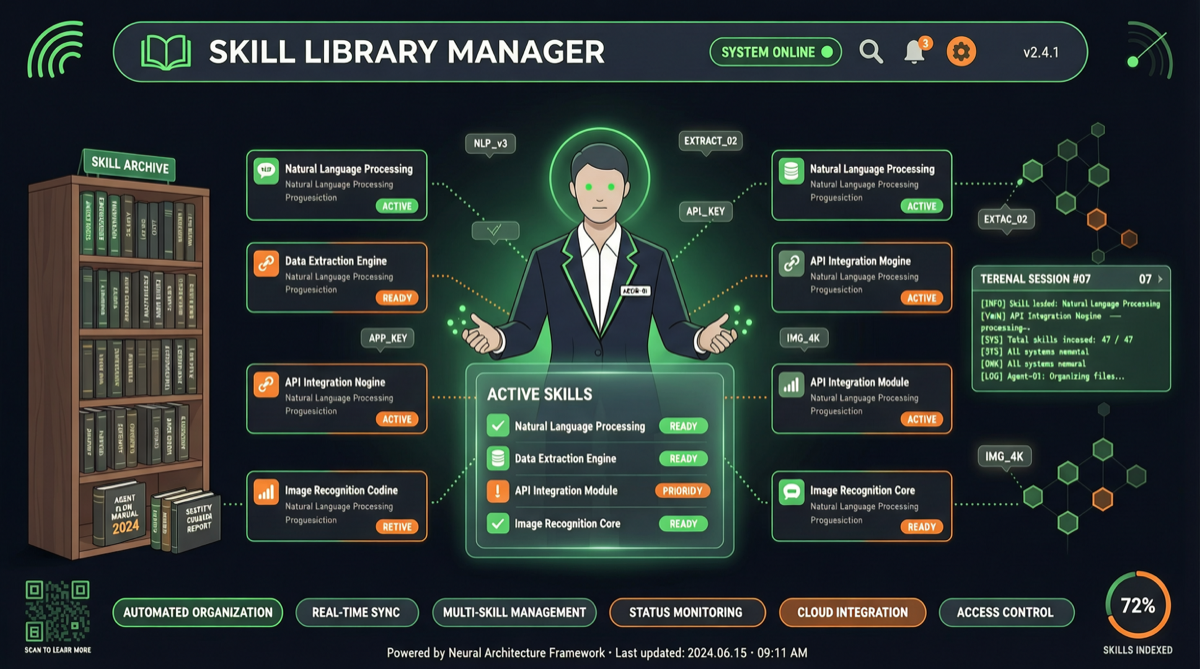
The Pain Point: The “Digital Junk Room” Problem
All Agent frameworks that support self-evolution face the same problem: skill files grow infinitely.
As an Agent learns and generates new skill files during use — skills for handling emails, checking weather, generating reports — few people clean them up. After three months, your skill library might have:
- 12 overlapping “file search” skills
- 3 different versions of “email summary” skills (v1, v2, v3)
- A pile of hyper-granular skills that triggered only once
This is the “digital junk room” effect — more and more stuff, less and less that’s actually useful, and search/match efficiency drops linearly.
What Curator Does
Hermes Agent’s Curator is an automated skill library governance tool that periodically performs:
| Action | Description | Effect |
|---|---|---|
| Merge overlapping skills | Identifies and merges functionally similar skill files | Reduces redundancy, improves match accuracy |
| Remove unused skills | Marks and removes skills not triggered for N days | Shrinks library volume, speeds up retrieval |
| Demote granular skills | Converts overly specific skills to template/script snippets | Maintains abstraction level of the library |
| Preserve core workflows | Keeps only high-frequency, valuable skills | Ensures Agent response quality |
Runs automatically weekly by default, also manually triggerable. The entire process requires no human intervention — Curator is an internal module of the Agent itself.
Comparison: How Other Frameworks Handle This
| Framework | Skill Management | Automation Level |
|---|---|---|
| Hermes Agent (Curator) | Auto merge/clean/demote, configurable schedule | Fully automatic |
| Claude Code (.claude/skills) | Manual management, no built-in cleanup | None |
| OpenClaw | Skill version management, no auto-merge | Semi-automatic |
| LangChain / CrewAI | Tool registry, manual maintenance required | None |
| Dify | Workflow version management | Semi-automatic |
Curator’s core differentiation is “automatic”. Most frameworks leave skill management to developers, but most developers never clean up — just like nobody regularly organizes their downloads folder.
Getting Started
If your Hermes Agent instance has self-evolution enabled (auto_evolve: true), Curator is automatically enabled:
# hermes-config.yaml
agent:
  auto_evolve: true
  curator:
    enabled: true          # Enabled by default
    schedule: weekly       # Frequency: weekly / daily / manual
    retention_days: 30     # Days to retain unused skills
    merge_threshold: 0.85  # Skill similarity threshold
View Curator execution logs:
hermes logs curator --last 7Manually trigger Curator:
hermes curator run --dry-run    # Preview what will happen
hermes curator run --apply      # Confirm and execute
Landscape Assessment
Curator’s launch marks the transition of Agent frameworks from “can self-evolve” to “can self-manage.” This is a critical step for Agents moving from lab to enterprise deployment — enterprises can’t accept an Agent whose skill library grows infinitely and whose response gets progressively slower.
Hermes Agent’s GitHub Star count has surpassed Claude Code (as of April 28 data). The addition of “operations-grade” features like Curator further reinforces its positioning as a production-grade Agent runtime — not just a coding assistant, but an autonomous system that runs stably long-term.
Sources
- Hermes Agent GitHub
- Hermes Agent Official Announcement (2026-04-30)
- Community discussion: Hermes vs Claude Code star comparison