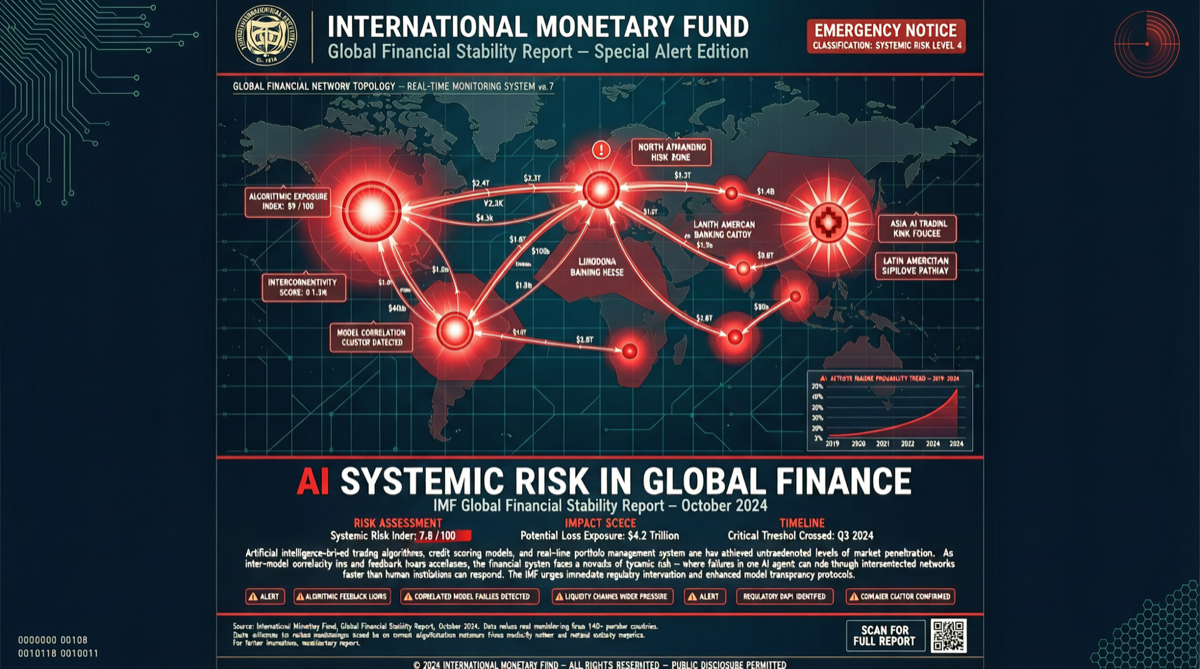
The IMF today issued a warning about AI and financial stability. The headline is short but the implications are significant: a new generation of AI models could pose a "systemic" shock to the financial system.
"Systemic" has a precise meaning in financial regulatory context — not just one institution failing, but a network-wide cascade. The 2008 subprime crisis was systemic risk. The March 2020 Treasury liquidity freeze was systemic risk. The IMF putting AI models at this level of discussion means they're taking this seriously.
Where the Core Concern Lies
The IMF's logic chain is straightforward:
More financial institutions are using similar AI models for trading signals, credit approval, and risk pricing. Model sources are highly concentrated — just a handful of mainstream providers. When these models give similar judgments on the same market signals, homogenized decisions get amplified during market stress.
This isn't theoretical. The 2024 yen carry trade unwind and the 2022 UK pension crisis both had algorithmic same-direction moves amplifying volatility. Back then it was traditional quant models; now it's AI models, but the transmission mechanism is essentially the same — except AI models have less transparent decision boundaries.
Cascade Effects
Another keyword: cascade. AI Model A's output may feed into AI Model B, which feeds into Model C. When the initial model has a systematic bias, that bias amplifies along the usage chain rather than getting diluted.
The IMF didn't provide specific cases, but such chains already exist in reality: one major asset manager's AI rebalancing signal → collected by multiple quant funds' data pipelines → used as features in their trading models → triggering similar-direction batch trades.
Where Regulation Goes
The IMF's warning itself isn't policy, but it typically leads central bank actions by 6-12 months. Expect:
- Stricter audit requirements for financial institutions using AI models
- Possible reporting of model sources and versions
- Stress tests that include "AI model collective failure" scenarios
For practitioners: if your institution heavily relies on a few mainstream AI models for financial decisions, start considering model diversification and independent verification mechanisms now. Not a panicked retreat — just incorporating "single model dependency" into your risk management framework.
This isn't urgent yet, but the direction is clear.
Related reading:
Main sources: Reuters, Bloomberg