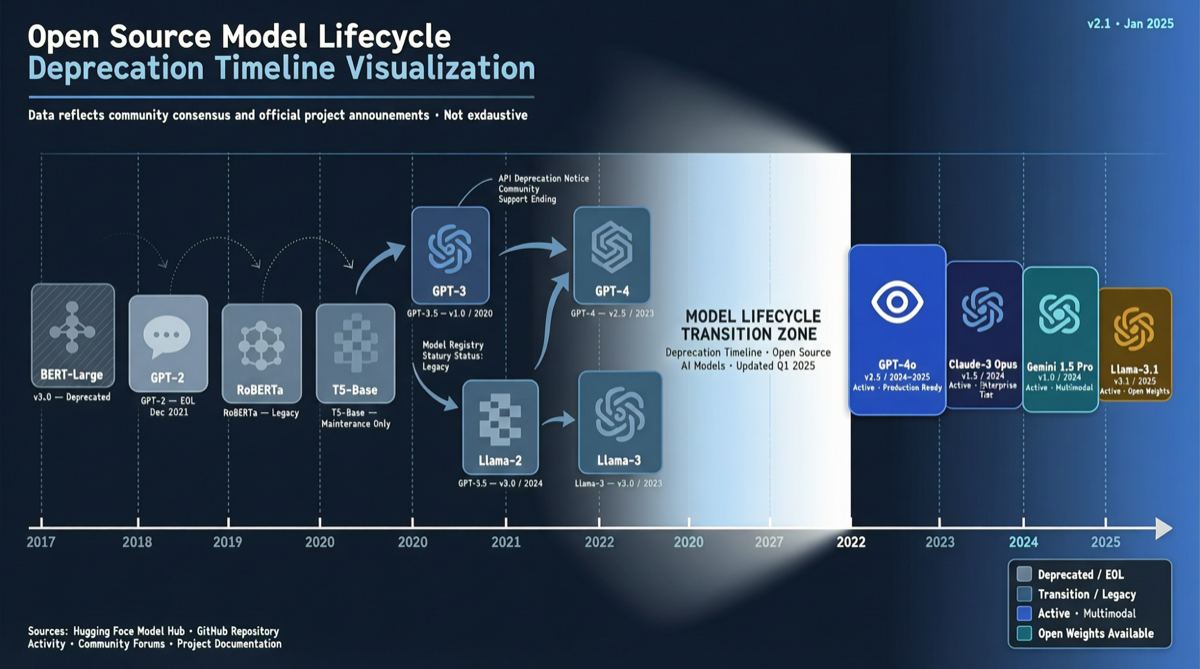
A signal worth more attention than a new model release.
Microsoft has explicitly listed in its AI model maintenance policy: Meta Llama 3.1 405B will retire on May 15, 2026. Recommended replacement model - OpenAI GPT-OSS 120B.
This isn't a minor adjustment by some cloud vendor. Llama 3.1 405B was the de facto flagship of the open source model community in 2024, and a cornerstone of the open source ecosystem over the past year. Its retirement means the replacement cycle for open source models is accelerating.
What Happened
Microsoft's maintenance policy document lists a clear retirement table:
| Model Series | Retirement Date | Recommended Replacement |
|---|---|---|
| Gemini 3 Pro | 2026-03-26 | Gemini 3.1 Pro |
| Meta Llama 3.1 405B | 2026-05-15 | OpenAI GPT-OSS 120B |
| Meta Llama 3 70B | 2026-02-27 | Llama 3.2/3.3/4 equivalent |
Focus on the last recommendation: replacing Meta's open source model with OpenAI's open source model.
This was almost unthinkable a year ago. At that time, Llama was the absolute hegemon in the open source model space, and OpenAI's open source strategy was still wavering. Now GPT-OSS 120B has become the Llama replacement in cloud vendors' eyes.
Why It Matters
Llama 3.1 405B isn't retiring because it's "broken" - it's because new models achieve better performance at equal or lower parameter counts. GPT-OSS 120B has less than a third of Llama 3.1 405B's parameters, but cloud vendors consider it an adequate replacement.
This reflects a trend: the capability density of open source models is improving rapidly. Parameter count is no longer a reliable indicator of open source model capability - new models do more with fewer parameters.
Direct impact on developers: if your project still depends on Llama 3.1 405B, you need to migrate after May 15. The migration itself isn't complex - change the model name, fine-tune prompts, verify output quality - but you need to leave time for testing.
The Bigger Signal
Llama 3.1 405B's retirement is a microcosm of shortening open source model lifecycles. A year ago, an open source flagship model could comfortably reign for two years. Now, the replacement cycle has compressed to 6-12 months.
This means:
- Deployment costs are increasing: Frequent model changes mean repeated adaptation, testing, and verification
- Technical debt is accumulating: Projects with hardcoded model names will suffer more and more
- Model abstraction layers become necessary: You need an intermediate layer that can smoothly switch underlying models
If you're deploying open source models in an enterprise environment, you should start considering a model abstraction layer now. Don't hardcode model names into business logic - use a configurable routing layer to manage model selection. When replacements come, you only change configuration, not code.
This isn't a "might need in the future" thing. Llama 3.1 405B's retirement is a "happening right now" thing.
Related reading:
Main sources: