Why Single Benchmarks Are No Longer Trustworthy
In 2026, AI model evaluation faces an awkward reality: almost any single benchmark can be "gamed" through targeted training.
- Score high on MMLU? Add similar multiple-choice questions to training data
- Rank high on SWE-Bench? Fine-tune on SWE-Bench issues
- Perfect on HumanEval? That was achievable back in 2024
When every benchmark can be optimized, single benchmark rankings lose their reference value. This is exactly why LLMStats launched TrueSkill composite scoring.
TrueSkill Composite Scoring: Cross-Benchmark Bayesian Consensus
LLMStats TrueSkill composite scoring uses a simple but effective methodology:
TrueSkill Score = μ − 3σ
- μ (mean): Average model performance across multiple benchmarks
- σ (standard deviation): Performance variability across different benchmarks
- −3σ: Conservative estimate, mean minus 3 standard deviations (covering 99.7% confidence interval)
Core logic: A model that performs well on only one benchmark but fluctuates wildly on others gets penalized by σ. Only models that perform consistently across all benchmarks earn high TrueSkill scores.
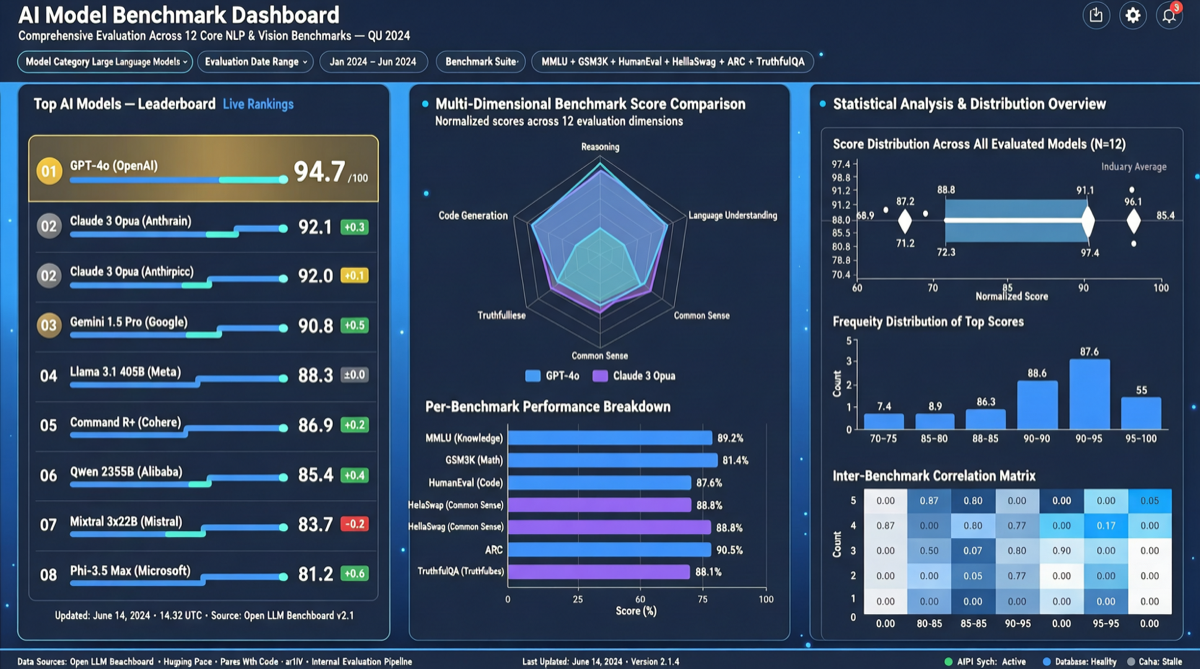
May 2026 TrueSkill Leaderboard Snapshot
| Rank | Model | TrueSkill Score | Key Strength | Key Weakness |
|---|---|---|---|---|
| 1 | Claude Opus 4.7 | 87.2 | SWE-Bench, GPQA | Inference speed |
| 2 | GPT-5.5 | 84.5 | Multi-benchmark balance, speed | SWE-Bench complex issues |
| 3 | Claude 5 "Mythos" (Beta) | 82.1 | Security vulnerability discovery | Not officially released |
| 4 | DeepSeek V4 Pro | 79.8 | SWE-Bench, cost efficiency | Chinese→English cross-language |
| 5 | Gemini 3.1 Pro | 78.3 | Multimodal, math reasoning | SWE-Bench |
| 6 | Grok 4.3 | 75.6 | Real-time information retrieval | GPQA |
| 7 | Qwen3.6-Max | 73.2 | Chinese tasks, long context | English science reasoning |
| 8 | ERNIE 5.1 Preview | 71.5 | Chinese reasoning, multimodal | English coding |
| 9 | Kimi K2.6 | 70.8 | Long context, Chinese | GPQA |
| 10 | Ling-2.6-1T | 68.4 | Chinese long documents | Code capability |
Action Items
For model selectors:
- Don't just look at one benchmark ranking, reference TrueSkill's cross-benchmark composite score
- Pay attention to both μ and σ: μ tells you average level, σ tells you stability
For model developers:
- TrueSkill's multi-benchmark design encourages "comprehensive development" rather than "single-point gaming"
Summary
AI model evaluation is shifting from "who scored highest on one benchmark" to "who performs most consistently across multiple dimensions." TrueSkill composite scoring is not a perfect evaluation method, but it is currently one of the most gaming-resistant and truth-revealing approaches available.
In an era where benchmarks can be optimized, cross-benchmark consensus is the closest thing to truth.