Core Finding
A story is spreading in the developer community:
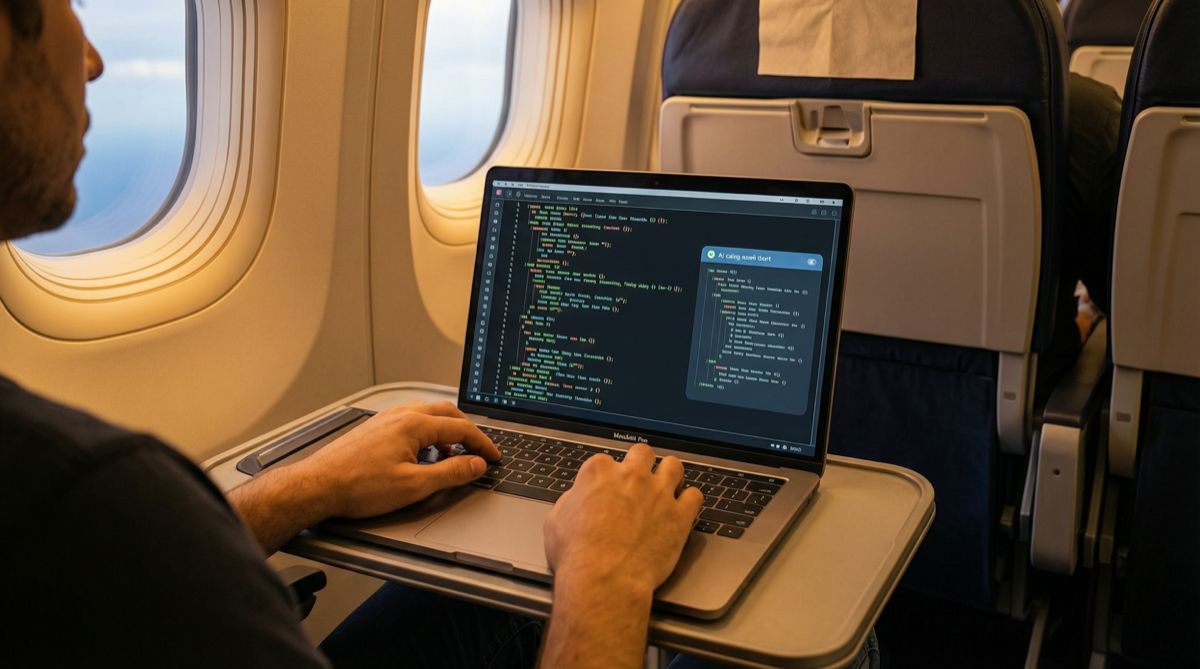
A Chinese engineer completed an entire client project during an 11-hour international flight. No WiFi. No cloud. No subscription fees. Just a MacBook Pro M4 (64GB RAM) and local AI he built himself.
This is not showing off—it is practical proof that local AI development has matured in 2026.
Toolchain Breakdown
Based on the post's description and the actual state of the local AI ecosystem in 2026, the engineer's toolchain likely looked like this:
Hardware Layer
| Component | Configuration | Significance |
|---|---|---|
| Device | MacBook Pro M4 | Apple Silicon's Neural Engine (NPU) provides hardware acceleration for local inference |
| Memory | 64GB unified memory | Sufficient to load 70B parameter quantized models (e.g., Llama 4 Scout / Meta open-source models) |
| Network | Zero connectivity | Completely offline work, no reliance on any cloud services |
Software Layer
| Layer | Tool | Purpose |
|---|---|---|
| Model Inference | MLX / llama.cpp | Efficiently run open-source models on Apple Silicon |
| Base Model | Meta Llama series (open-source) | Coding, reasoning, writing multi-task coverage |
| AI Coding Assistant | Local coding agent (e.g., OpenCode / Aider local mode) | Code generation, refactoring, debugging |
| IDE | VS Code / Cursor (offline mode) | Development environment |
| Version Control | Git (local repository) | Code management |
Cost Comparison
| Approach | Flight Scenario Cost | Estimated Annual Cost |
|---|---|---|
| Local AI (this approach) | ¥0 (no network fees) | Hardware depreciation approximately ¥15,000/year |
| Cloud AI + In-flight WiFi | $25 (in-flight WiFi) + API fees approximately $10-50 | $500-2,000/year (API subscription) |
| Pure manual | ¥0 | Human cost: engineer salary for project duration |
Key insight: The one-time hardware investment for local AI (MacBook Pro M4 approximately ¥20,000-30,000) can be recouped through saved API fees and subscriptions within 1-2 years.
Workflow Design
Actual Workflow During the Flight
[Before Takeoff] Preparation Phase
    │
    ├── Download model weights locally
    ├── Configure inference engine (MLX/llama.cpp)
    ├── Download project code and dependencies
    ├── Prepare prompt templates and context
    │
[During Flight] Execution Phase
    │
    ├── Requirements analysis: use local LLM to understand client requirement documents
    ├── Architecture design: let AI assist in designing system architecture
    ├── Coding implementation: AI coding assistant generates code framework
    ├── Testing and debugging: run tests locally, AI assists in troubleshooting
    ├── Documentation: AI assists in generating technical documentation
    │
[After Landing] Delivery Phase
    │
    ├── Push code to Git after connecting to network
    ├── Send delivery email
    └── Update project status
Key Success Factors
- Model Selection: 64GB memory can run 70B parameter 4-bit quantized models, with coding capabilities approaching GPT-4 level
- Inference Engine Optimization: MLX framework's performance optimization on Apple Silicon makes inference speed acceptable (estimated 5-15 tok/s)
- Context Management: Offline environment means no real-time retrieval of external materials—the engineer needed to prepare sufficient context materials before takeoff
- Task Decomposition: Break the project into small tasks that AI can complete independently, reducing steps requiring external verification
The Signal Significance of This Story
Signal One: Local AI Is Genuinely Usable
Local AI in 2025 was still in a "usable but not great" state—small models, slow inference, many hallucinations. By 2026, 70B parameter quantized models on consumer-grade hardware can already provide coding experiences close to cloud-based services.
Signal Two: AI Development Is No Longer Tied to the Cloud
Traditional AI coding tools (GitHub Copilot, Cursor, etc.) all rely on cloud APIs. This story proves that completely offline AI-assisted development has become a viable option.
Signal Three: Maturity of Open-Source Models
Meta's Llama series open-source models are the technical foundation of this story. If closed-source models did not allow local deployment, this story would not have been possible.
How to Replicate This Workflow?
Minimum Configuration Requirements
| Configuration | Minimum Requirement | Recommended Configuration |
|---|---|---|
| Memory | 32GB unified memory | 64GB+ |
| Storage | 50GB available space (model weights) | 200GB+ |
| Chip | M2 Pro and above | M4 Pro/Max |
| Operating System | macOS 14+ | macOS 15+ |
Recommended Toolchain
| Purpose | Recommended Tool | Notes |
|---|---|---|
| Model Inference | MLX (Apple native) | Best optimized for Apple Silicon |
| Model Selection | Llama 4 Scout / Qwen 2.5 72B | Open-source, strong coding ability |
| Coding Assistant | Aider (local mode) / OpenCode | Supports local models |
| IDE | VS Code + Continue plugin | Offline-friendly AI coding extension |
Preparation Checklist (2 hours before takeoff)
- ✅ Download model weights (approximately 30-40GB)
- ✅ Verify inference engine works correctly (test inference speed)
- ✅ Download all project dependencies
- ✅ Prepare requirement documents and reference materials locally
- ✅ Prepare common prompt templates
- ✅ Turn off all cloud sync functions
Landscape Judgment
The maturity of local AI development is reshaping how developers work. It is not just a "money-saving alternative," but rather:
- Privacy Protection: Client code never leaves the local device
- Reliability: Unaffected by network fluctuations and cloud service interruptions
- Controllable Cost: One-time investment, long-term use
- Autonomy: No reliance on any third-party service
For developers who travel frequently, enterprises sensitive to data security, and teams looking to reduce ongoing spending on AI tools, the local AI workflow is already a serious option.
Completing a client project on an 11-hour flight—in 2025 this sounded like science fiction, in 2026 it's just an engineer's daily work.