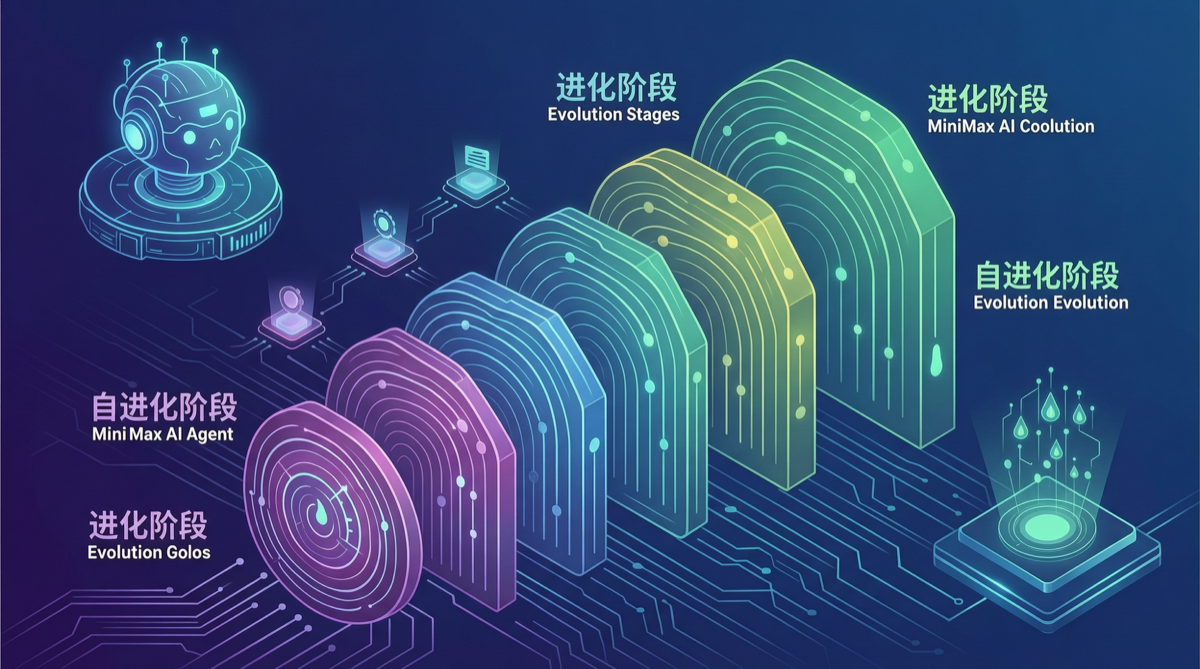
MiniMax's model update cadence is quiet, but M2.7's changes are worth a closer look.
On MiniMax's homepage carousel, M2.7's introduction has been upgraded from M2.5's "enhanced code and reasoning" to two new lines:
Enable Self-Improvement for Models, with Significant Improvement in Practical Capabilities Compared to M2.5
The keyword is "Self-Improvement" — model self-evolution. This isn't just a simple version number bump of +0.2, but a directional change in MiniMax's model training approach.
M2.7's four capability dimensions
From the official website, M2.7's capability upgrades cover four scenarios:
Agent Harness capability: Supports building self-evolving Agent harnesses. This means the model can self-adjust during operation based on feedback, rather than requiring manual retraining or fine-tuning each time.
Engineering coding ability: Officially described as "A model that truly understands production systems." This suggests M2.7's code understanding goes beyond "writing code snippets" to understanding project-level code structure, dependencies, and engineering practices.
Office scenarios: Explicit support for complex Excel/Word/PPT tasks and multi-round editing. This positioning is pragmatic — not everyone needs an Agent to write an OS kernel, but many people need an Agent to help fix a complex Excel formula.
M2.7 vs M2.5: The company directly benchmarks against M2.5, claiming "significant improvement in Practical Capabilities." Specific benchmark data has not yet been released.
Position in the Chinese model landscape
In the current Chinese code capability race, each player is finding differentiation:
- Qwen takes the open-source ecosystem and large-parameter route
- Kimi focuses on long context and deep thinking
- MiniMax's route appears to be Agent harness + practical engineering scenarios
If M2.7's "Self-Improvement" direction succeeds, it means model iteration speed can partially decouple from the cycle of manual annotation and fine-tuning — significant on both cost and time dimensions.
However, "self-evolution" is a term used too broadly in the AI industry. Some companies mean online learning, some mean RL fine-tuning based on feedback, some just mean a smarter prompt. MiniMax's specific technical approach hasn't been disclosed yet.
How to use
M2.7 is already available through the MiniMax API and can be experienced directly in the MiniMax Agent product. The API pricing page shows MiniMax offers both token packages and unlimited monthly plans.
For developers looking for a Chinese model with strong office scenario capabilities, M2.7 is worth a head-to-head comparison with Qwen and Kimi.
Main sources: