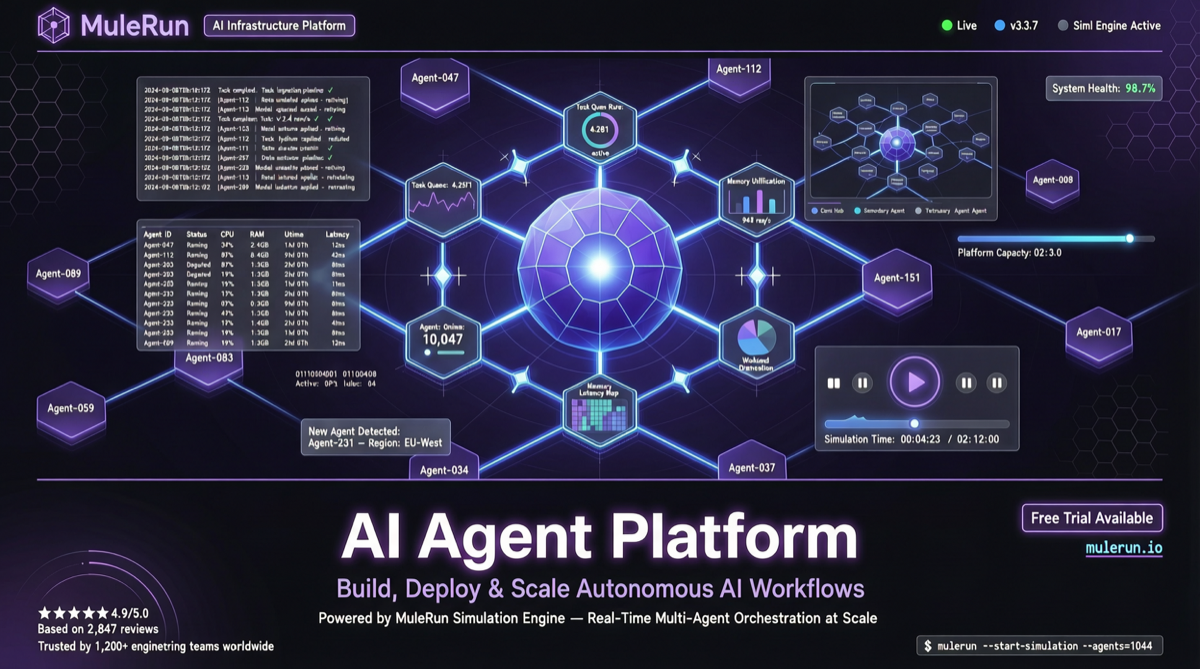
Recently, Future AGI announced the open-source release of its full technical stack for the MuleRun AI Agent platform. This is not a trimmed-down community version, but a complete stack including frontend UI, backend services, simulation engine, evaluation framework, optimization loop, and observability tools. Community response has been enthusiastic — the core tweet received 166K views and 746 bookmarks.
What Is MuleRun?
Simply put, MuleRun solves a pain point: AI agents silently hallucinating in production. Developers lack reliable ways to trace agent execution paths, evaluate their performance, simulate edge cases, set safety guardrails, or automatically optimize their behavior.
MuleRun integrates these capabilities into a unified platform. Once you connect your agent, the platform handles tracing, evaluation, simulation, guardrails, and optimization automatically.
Core Capabilities Breakdown
1. Simulation Engine + Auto-Optimization Loop
This is what sets MuleRun apart from other agent tools. Evaluations are not run as standalone steps — they are wired into a simulation engine with an auto-optimization loop. When the evaluation catches something, the system knows what to do about it — it autonomously attempts to improve the agent’s behavior, rather than just reporting the issue.
2. Full-Stack Observability
MuleRun provides complete agent execution path tracing. Every step’s input, output, decision logic, and tool calls are traceable. This is especially important for debugging complex multi-agent systems.
3. Creator Studio
Creator Studio integrates agent creation and commercialization into a single platform. Developers can:
- Build agents using any framework or tool
- Deploy agents to production
- Set pricing strategies and collect revenue
The design philosophy is clear: the shortest path from experiment to product.
4. Agents CLI
Agents CLI provides a fast track from idea to production-ready agents:
- Bundled skill injection
- Native evaluation harnesses
- Automated production deployment
5. Vibe Training
MuleRun introduces a new agent training method that could replace the traditional LLM-as-a-judge pattern. The conventional approach relies on large LLMs to evaluate and guard agents, but has two major drawbacks: slow and expensive inference, and limited ability to detect subtle behavioral deviations.
Vibe Training’s approach:
- Describe what you want to evaluate
- The platform generates a test set
- The platform trains a task-specific lightweight language model
- You get back a specialized API endpoint
Multi-Model Integration
MuleRun also serves as a multi-model integration platform, supporting access and benchmarking for various mainstream AI models. HappyHorse, GPT-Image-2, and other models are all available for online experience on MuleRun. The platform provides unified prompts and benchmarks browsing functionality.
Community & Ecosystem
Future AGI is actively building MuleRun’s community ecosystem:
- Ambassador Program: Already hosted Innovation & Entrepreneurship Night events in London, in partnership with the London PhD Club, Uniques Society, and Cambridge AI Lab
- Open-Source License: Full technical stack released, not a trimmed-down version
- Community Heat: Core tweet received 166K views and 746 bookmarks, with positive community response
Suitable Use Cases
MuleRun is particularly well-suited for:
- Agent Developers: Needing reliable tracing and evaluation tools
- Production Deployment Teams: Looking for a complete solution from experiment to product
- Multi-Agent Systems: Requiring simulation engines and automated optimization
- Commercialization Needs: Hoping to productize agents through Creator Studio
Weaknesses & Challenges
- Relatively Young Platform: While feature-rich, the open-source release is recent, and community documentation and best practices are still being built
- Learning Curve: Full-stack capabilities mean higher configuration complexity; newcomers may need time to get up to speed
- Evaluation Standards: The specific evaluation metrics and weight settings of the simulation engine are not yet fully transparent
Competitive Comparison
| Feature | MuleRun | LangSmith | LangGraph |
|---|---|---|---|
| Simulation Engine | ✅ Built-in | ❌ | ❌ |
| Auto-Optimization | ✅ | ❌ | ❌ |
| Full-Stack Open Source | ✅ Complete | ❌ Partial | ✅ |
| Creator Studio | ✅ | ❌ | ❌ |
| Commercial Deployment | ✅ | ✅ | Manual |
Verdict
MuleRun represents an important direction in current AI agent infrastructure: moving from a collection of tools to a complete platform. Its combination of simulation engine, auto-optimization loop, and Creator Studio enables developers to build, test, and deploy agents more reliably.
For teams looking for production-grade agent infrastructure, MuleRun deserves serious evaluation.
If you’re struggling with agent silent hallucination issues or need a complete solution from experiment to product, MuleRun may be the closest fit in the current open-source ecosystem.