Bottom Line First
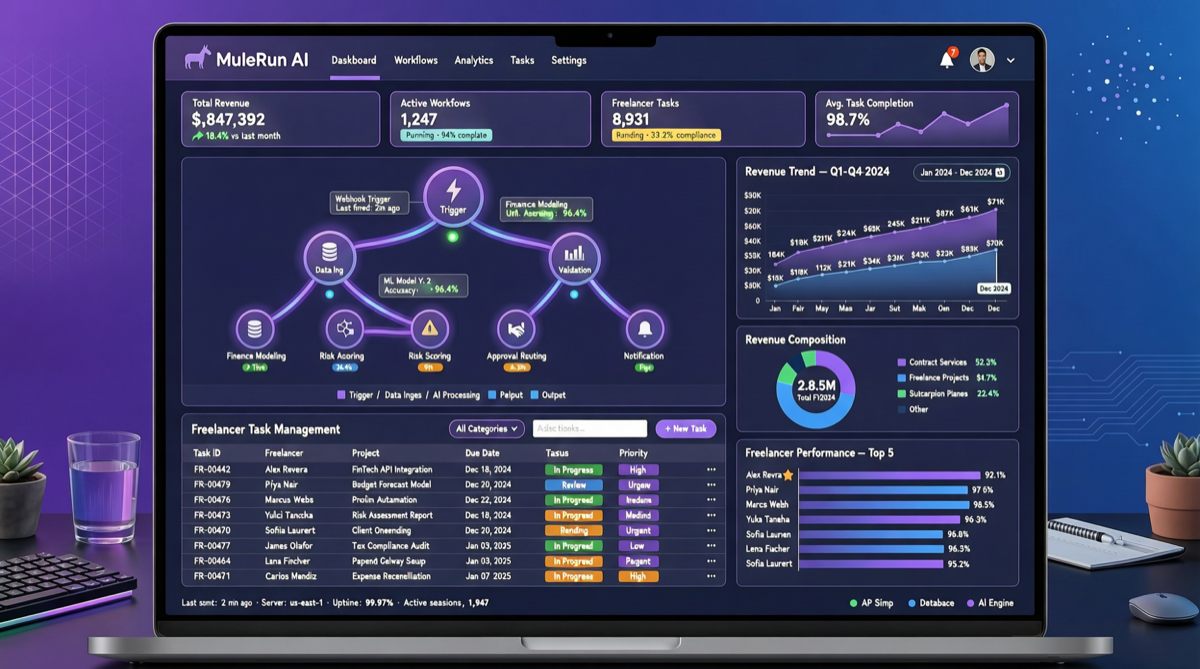
MuleRun is an AI workflow platform that lets non-technical users build complex AI Agent workflows. Two recent cases demonstrate its actual capabilities: one user built an earnings analysis dashboard covering the Magnificent 7 (revenue beats, margin trends, CapEx tracking, private AI company ARR estimates); another scenario shows freelancers using it to build automation workflows where "AI handles the repeatable parts, humans focus on judgment and creativity."
Pain Point: Too Many Agents, Too Hard to Manage
Jitterbit's latest data shows that enterprises already have an average of 28 AI Agents, expected to grow to 40 within a year. But problems follow:
- Fragmentation: Each agent solves one specific problem, but there is no unified management
- Invisibility: Bosses cannot see, control, or calculate which AI tools employees are using
- Redundant building: Different teams may build agents with overlapping functionality
MuleRun's approach: unify all workflows on one platform instead of letting each agent operate independently.
Solution: What MuleRun Can Do
Core capabilities:
- Visual workflow building: Drag-and-drop interface, no coding required
- Multi-model access: Supports connecting to multiple AI models, not locked to a single vendor
- Browser extension: Automates web content processing through browser extension
- Pre-built templates: Provides templates for common workflows, quick start
Real-world cases:
| Workflow | Function | User Group |
|---|---|---|
| Earnings Dashboard | Tracks Magnificent 7, semiconductors, cloud, AI infra revenue, margins, CapEx, and ARR | Investors, analysts |
| Freelancer Automation | AI handles repeatable tasks (data organization, draft generation, formatting), humans focus on judgment and creativity | Independent workers |
| Creative Challenge | Partnered with World Aquatics, uses MuleRun to generate posters, videos, data reports, and websites | Creators |
Comparison with Similar Tools
| Tool | Positioning | Technical Threshold | Best For |
|---|---|---|---|
| MuleRun | Visual AI workflow platform | Zero code | Diverse workflows for individuals/small teams |
| LangChain | Developer framework | Requires coding | Deeply customized Agent applications |
| Dify | Enterprise AI application platform | Low code | Internal enterprise AI application deployment |
| CrewAI | Multi-Agent orchestration framework | Requires coding | Multi-Agent collaboration scenarios |
| n8n/Zapier | General automation platform | Low code | Cross-application workflow automation |
MuleRun's uniqueness: It is not "yet another programming framework" but an AI workflow platform for non-technical users. Its target users are not engineers, but investors, analysts, creators, and freelancers — people who need AI capabilities but do not want to learn programming.
Getting Started: Three Steps to Build Your First Workflow
- Register and choose a template: MuleRun provides pre-built workflow templates such as "Earnings Analysis," "Content Creation," "Data Organization"
- Configure AI models: Select your preferred AI model (supports multiple model connections), set up API key
- Run and optimize: Execute the workflow, adjust parameters based on results, or build custom workflows from scratch
Browser extension: After installing the MuleRun browser extension, you can trigger AI workflows on any web page — such as automatically extracting key data while browsing earnings pages, or automatically collecting industry intelligence on social media.
Cost
MuleRun offers free quotas suitable for individual user trials. For users needing high token consumption or complex workflows, paid plans are available.
Landscape Assessment
The trend MuleRun represents: AI tools are moving from "developer-only" to "accessible to everyone".
When non-technical users can also build complex workflows, the AI adoption curve will accelerate steeply. This aligns perfectly with Goldman Sachs' prediction that "Agent AI drives exponential growth in token consumption" — platforms like MuleRun are lowering the barrier to Agent usage, thereby driving more token consumption.
Risks:
- Visual platforms still have a flexibility gap compared to programming frameworks
- If workflows become too complex, you may need to return to the code level
- Platform lock-in risk — workflows built on MuleRun have high migration costs