The Signal
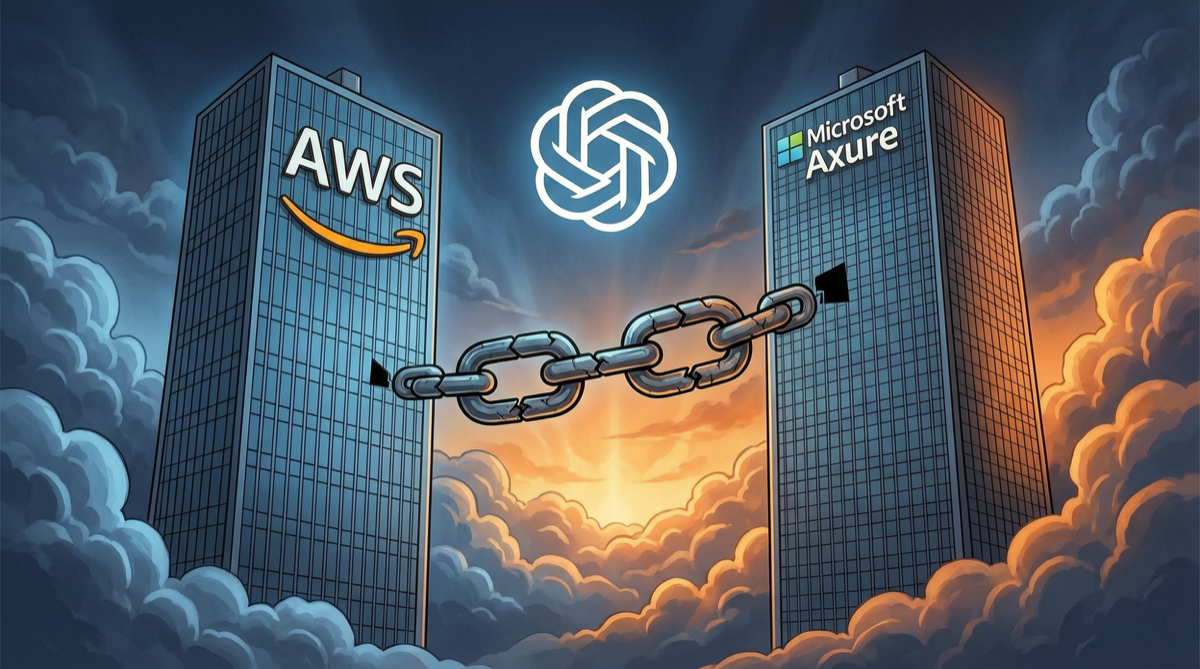
The biggest earthquake in the AI industry this week: OpenAI announces a comprehensive strategic partnership with AWS.
Core terms:
- Amazon provides $50 billion in financing to OpenAI
- OpenAI’s annual AWS cloud spending will exceed $16 billion
- OpenAI models officially land on AWS Bedrock, enterprise customers can directly access them
At the same time, OpenAI’s seven-year exclusive cooperation agreement with Microsoft officially terminates.
What This Means
1. Complete Reshuffling of the Compute Landscape
The breaking of the seven-year exclusivity agreement, on the surface, is an adjustment of commercial partnership. At its core, it reflects a fundamental change in AI compute supply and demand.
In the GPT-3 era, OpenAI needed Microsoft Azure’s exclusive compute support to train ultra-large-scale models. The exclusivity agreement was optimal for both: OpenAI got stable compute guarantees, Microsoft got exclusive access to OpenAI models.
But by 2026, things have changed:
- Compute is no longer scarce enough to require exclusivity — all major cloud providers are expanding aggressively, GPU cluster scale is no longer the decisive bottleneck.
- OpenAI needs a multi-cloud strategy — Azure alone cannot support its exponentially growing training and inference demands.
- AWS needs OpenAI’s model lineup — with Claude (Anthropic) and Gemini (Google Cloud) already present, AWS cannot afford to miss out on the GPT series.
2. Microsoft’s Awkward Position
This is a double blow for Microsoft:
- Loss of exclusivity: Azure is no longer the only cloud platform for OpenAI models. Customers can directly access GPT on AWS.
- Copilot competitive pressure: After the OpenAI-AWS partnership, AWS can build its own AI office suite based on GPT models, directly threatening Microsoft 365 Copilot’s market position.
However, Microsoft isn’t entirely without options. Azure remains one of OpenAI’s primary compute partners, and Microsoft’s own Phi series small models and self-developed chips are accelerating. But strategically, the halo of “OpenAI’s exclusive partner” has disappeared.
3. Enterprise Customers: Finally Able to Pick the Best
For end users, this is almost pure upside.
In the past, if you wanted to use GPT models on AWS, you needed complex integration solutions. Now with GPT natively integrated into Bedrock, enterprises can compare Claude, Gemini, GPT, and other models on the same platform, selecting the optimal solution for specific tasks.
This “multi-model selection” paradigm is exactly the necessary path for AI to move from “toy” to “production tool.” When customers are no longer locked into a single model or single cloud platform, the entire market’s competition returns to the essentials: model capability, cost, and stability.
Industry Impact
The Cloud Giants’ “Fine-Tuning” Era
The era of “grabbing models” is over. Major cloud providers now need to compete on:
- Model tuning capability: How to maximize model performance on their own hardware.
- Integration experience: Whether enterprise customers can manage calls, monitoring, and billing for multiple models on one platform.
- Vertical industry solutions: Customized AI services for finance, healthcare, manufacturing, and other sectors.
Lessons for Domestic Cloud Providers
Alibaba Cloud, Tencent Cloud, and Huawei Cloud face the same multi-model integration challenge. The OpenAI-AWS partnership model demonstrates: openness is the best strategy for cloud platforms to attract AI customers. No binding, no exclusivity, letting customers choose freely — this actually builds a larger ecosystem moat.
Actionable Advice
- Enterprise IT decision-makers: Reassess multi-cloud AI strategies. You can now use GPT models on both Azure and AWS, dynamically allocating load based on cost and performance.
- AI application developers: Watch AWS Bedrock’s GPT model API compatibility and pricing — this could be a new opportunity for cost optimization.
- Investors: The $50 billion financing scale means OpenAI is stockpiling ammunition for the next phase of model training (possibly GPT-6). Compute infrastructure and chip companies may benefit indirectly.