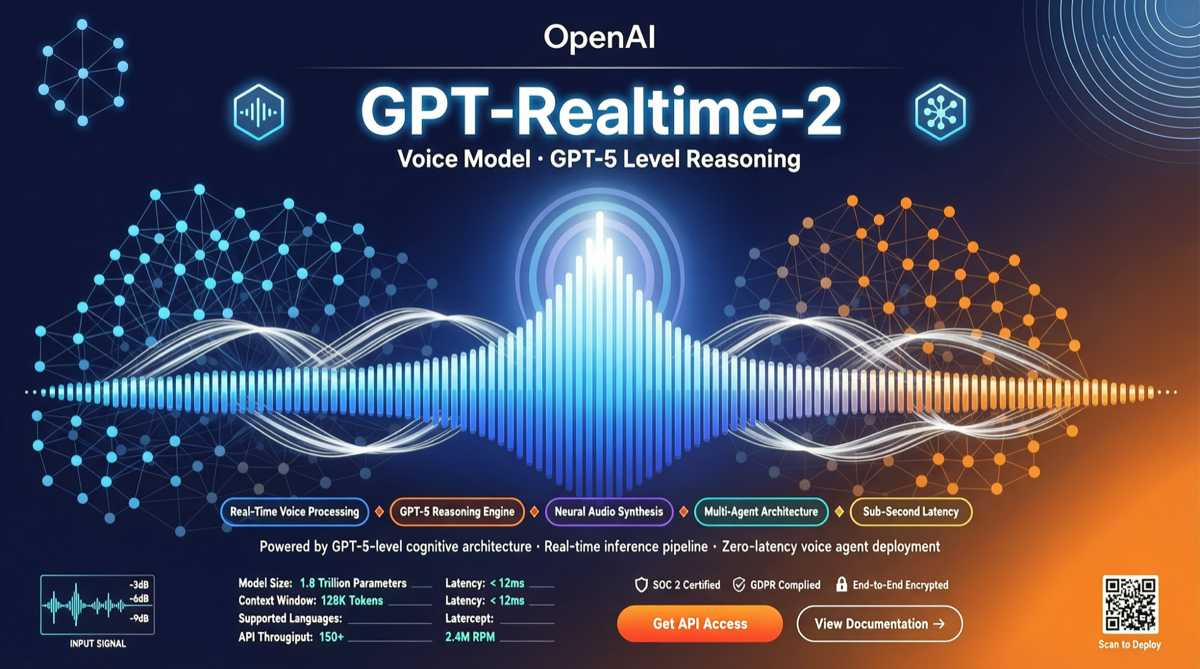
OpenAI didn't hold a press event today. It just dropped three new models directly into the API. This "silent launch, API first" approach has become the norm this year.
The three models are GPT-Realtime-2, GPT-Realtime-Translate, and GPT-Realtime-Whisper. The first is the star, but the supporting cast isn't trivial either.
GPT-Realtime-2: Voice Agents Can Finally "Think"
The problem with previous voice models was clear—they could listen and speak, but the reasoning wasn't strong enough. Users spoke, the model transcribed to text, ran inference, and converted back to speech. The reasoning step determined conversation quality, and the previous generation was merely adequate.
GPT-Realtime-2's core change is embedding GPT-5-level reasoning directly into the voice agent. Instead of the "transcribe → think → speak" pipeline, the model now reasons directly within the audio stream.
On benchmarks, Big Bench Audio jumped from 81.4% to 96.6%, and Audio-MMLU from 68.3% to 88.2%. These numbers alone don't tell the full story, but a 15-point leap means voice models are finally approaching text-model performance on complex reasoning tasks.
More importantly: interruption handling and context retention. Previous voice agents lost state when interrupted. Realtime-2 supports real-time interruption with context recovery—more useful for actual use cases than benchmark scores.
Translation and Transcription: 70 In, 13 Out
GPT-Realtime-Translate supports real-time streaming translation from 70 input languages into 13 output languages. The combination looks somewhat arbitrary but covers the main commercial language scenarios.
GPT-Realtime-Whisper is an accelerated version of transcription. Whisper was already strong; this iteration optimizes latency and long-audio handling.
Real-World Impact
The voice agent space previously felt like a demo-level capability—the technology worked, but practical utility was limited. Realtime-2 pulling reasoning up to GPT-5 level while solving interruption and context issues means voice agents are starting to meet the basic requirements of "real-time collaborators."
But pricing hasn't been announced. GPT-5-level reasoning in voice agents will consume significantly more tokens than pure text. Wait for the pricing page update before judging cost-effectiveness.
Also, ChatGPT's Voice Mode upgrade should follow. If Voice Mode gets Realtime-2 directly, the everyday conversation experience will change qualitatively—not just "smarter," but able to genuinely keep pace with you.
I wouldn't rebuild my workflow for voice agent scenarios right now. Wait for technical docs, pricing, and actual latency data before deciding which scenarios are worth migrating to.
Related reading:
Main sources: OpenAI Blog, @OpenAIDevs