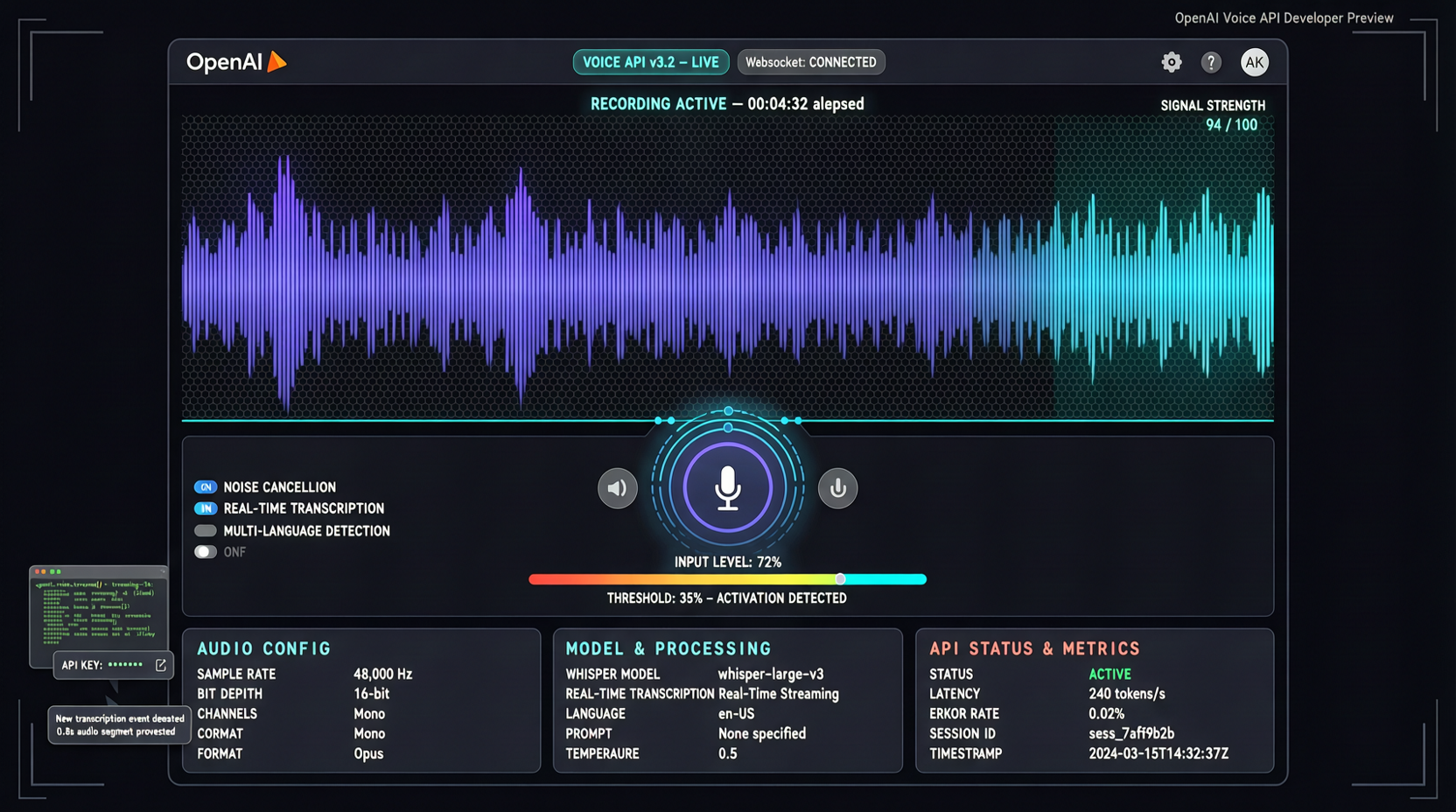
OpenAI quietly dropped three new real-time voice models into its API in early May. The volume was low, but the signal is worth listening to.
On May 7, OpenAI's official blog published a brief announcement: new models support reasoning, translation, and speech transcription, aiming to make voice-based software agents more natural and capable of completing tasks in real time.
VentureBeat's coverage gave a key piece of information: these models have GPT-5-class reasoning capabilities, at real-time voice latency.
What Changed
Previous voice models — like GPT-4o's real-time voice mode — could already hold fluent conversations. But "fluent" doesn't mean "smart." The bottleneck for voice agents wasn't understanding what you said; it was whether they had the capacity to do complex reasoning on top of that understanding.
Example: you ask a voice agent to check flights, compare prices, consider your schedule, and book. This chain involves multiple steps of reasoning and decision-making. Previous voice models' performance on such tasks — in VentureBeat's words — "changes what voice agents can actually orchestrate."
These three new models aren't meant to replace GPT-5's text API; they're about bringing near-text-model reasoning quality to the voice channel.
The Three Models' Roles
OpenAI didn't detail each model's specifications, but from the description, the three models focus on:
- Reasoning voice model: handles multi-step reasoning voice tasks, like problem diagnosis in customer service
- Translation voice model: real-time voice translation, where latency is the key metric
- Transcription voice model: high-accuracy speech-to-text, likely for meeting recordings and voice search
This split shows OpenAI's understanding of voice scenarios is maturing — no longer a "one universal voice model fits all," but differentiated by use case.
What It Means for Developers
For teams building voice products, this reduces the need to build a custom voice reasoning stack. Previously, you'd need to convert speech to text, send it to GPT for reasoning, then convert the result back to speech — long chain, high latency, accumulated errors. Now OpenAI bundles all three steps into a single API call.
Latency figures weren't published officially. But since they emphasize "real-time," response times should be sub-second — otherwise "real-time" is just marketing speak.
One Caveat
The actual effectiveness of voice reasoning models depends on their performance in noisy environments, dialects, and multi-person conversation scenarios. The gap between lab-condition demos and real-world voice interaction is typically wide. That gap will become clear once developers get API keys and run them for a couple of days.
Primary sources: OpenAI official blog, Reuters, VentureBeat. Specific model names and pricing pending OpenAI API documentation updates.