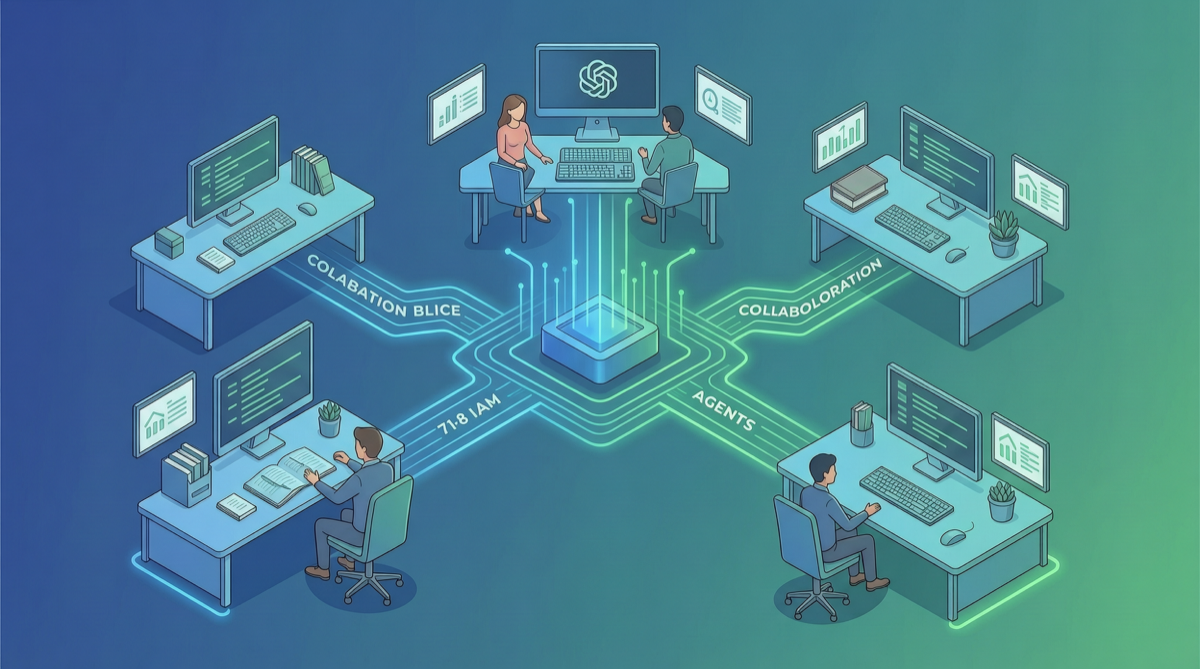
On April 22, OpenAI quietly released a feature that may have deeper implications than GPT-5.5 itself: Workspace Agents.
This is not another ChatGPT feature update — it is a product paradigm shift — from "you ask, I answer" chat tool to an automation system capable of executing long-cycle tasks on behalf of entire teams.
What Happened
Workspace Agents core positioning: shared AI agents, serving teams rather than individuals.
Key capabilities:
- Team sharing: Agents belong to the workspace, not individuals
- Long-cycle tasks: Handle complex workflows spanning hours or days
- Slack integration: Call directly in Slack without opening ChatGPT
- Codex powered: Code execution capability based on GPT-5.5
- Autonomous operation: Set goals and execute autonomously
Essential Differences from GPTs
| Dimension | GPTs (2023) | Workspace Agents (2026) |
|---|---|---|
| Scope | Individual | Team |
| Task type | Instant Q&A | Long-cycle automation |
| Access method | Manually open ChatGPT | Direct Slack call |
| Execution | Limited tool calling | Full Codex code execution |
| State management | Stateless | Persistent workflow state |
| Collaboration | Single user | Multi-user shared/collaborative |
GPTs are like "customized chatbots," while Workspace Agents are more like "digital employees for the team."
Typical Use Cases
Scenario 1: Automated Data Reporting Set Agent to pull data from database daily → Generate analysis report → Send to Slack channel → Flag anomalous metrics. Entire process requires no human intervention.
Scenario 2: Code Review Pipeline Agent monitors PR submissions → Automatically runs tests → Reviews code quality → Gives review opinions in Slack → Flags parts needing human intervention.
Scenario 3: Customer Ticket Classification Agent reads customer support tickets → Classifies priority → Assigns to appropriate team → Tracks processing progress → Auto-escalates on timeout.
April OpenAI Updates Overview
Workspace Agents is not an isolated update but part of OpenAI's April product matrix:
| Product/Feature | Status | Relationship to Workspace |
|---|---|---|
| GPT-5.5 | ✅ Released | Underlying model driver |
| Workspace Agents | 🔄 Research Preview | Team automation layer |
| ChatGPT Agents | ✅ Released | Personal Agent layer |
| GPT Image Gen 2 | ✅ Released | Multimodal capability |
| Sora | ✅ Released | Video generation |
OpenAI is building a complete Agent ecosystem: Personal Agent + Team Agent + Multimodal capabilities, all driven by GPT-5.5.
Industry Impact
Pressure on Anthropic/Claude: Claude previously led in programming agents (Claude Code), but Workspace Agents shows OpenAI is making moves in enterprise-level team automation.
Impact on traditional SaaS: If Slack + ChatGPT Agents can handle data reporting, code review, and ticket classification, traditional automation tools (Zapier, Make, etc.) face direct competition.
Opportunities for developers: Workspace Agents is currently in research preview. Early adopters can establish usage norms and best practices, forming competitive barriers.
Action Recommendations
Try immediately:
- Apply for Workspace Agents research preview (OpenAI website)
- Start with simple scheduled tasks: daily report generation, data monitoring
- Test Agent integration experience in Slack
Teams suited for early adoption:
- Medium-large teams already using Slack workflows
- Business teams with repetitive data processing needs
- Engineering teams needing automated code review
Scenarios not yet recommended:
- Sensitive data scenarios (limited security review in research preview)
- Critical business requiring precise SLA guarantees (research preview does not guarantee stability)
Bottom line: Workspace Agents is ChatGPT's key step from "toy" to "tool" to "colleague." When AI agents start "working" alongside your team members in Slack, the rules of the game have changed.