Core Conclusion
OpenClaw released version 2026.5.2 on May 3, 2026, marking the third significant update in a row after versions 4.25 and 4.26. This release doesn’t feature flashy new capabilities but focuses on three practical directions: model support expansion, infrastructure stability, and communication platform reliability.
For users building multimodal agents with OpenClaw, the Grok 4.3 integration is the biggest addition — it’s currently the leading model in agentic tool calling, with 100 tokens/s inference speed and a 1M context window, fully privacy-runnable through platforms like Venice.
Update Details
Model Layer: Grok 4.3 Officially Integrated
xAI’s Grok 4.3 is now a first-class citizen in OpenClaw:
| Feature | Specification |
|---|---|
| Inference Speed | 100 tokens/second |
| Context Window | 1M tokens |
| Function Calling | ✅ Native support, leading in agentic tool calling benchmarks |
| Multimodal Input | ✅ Text + Image |
| X Search Integration | ✅ Native |
| Privacy Deployment | ✅ Fully runnable via Venice.ai |
Grok 4.3 ranks highly in agentic tool calling benchmarks, which means for OpenClaw users: more reliable tool call success rates — significantly lower error rates when agents execute code, file operations, and API calls.
Infrastructure: Plugin + Hot Path Optimization
- More stable plugin installation/updates: Resolved issues in previous versions where plugin downloads failed or installations were interrupted. This is a direct experience improvement for users relying on many third-party plugins.
- Gateway and agent hot path streamlined: The core execution paths for gateway and agent underwent code-level slimming, reducing intermediate layer overhead. This means lower agent response latency on the same hardware.
Communication Layer: Four Platform Fixes
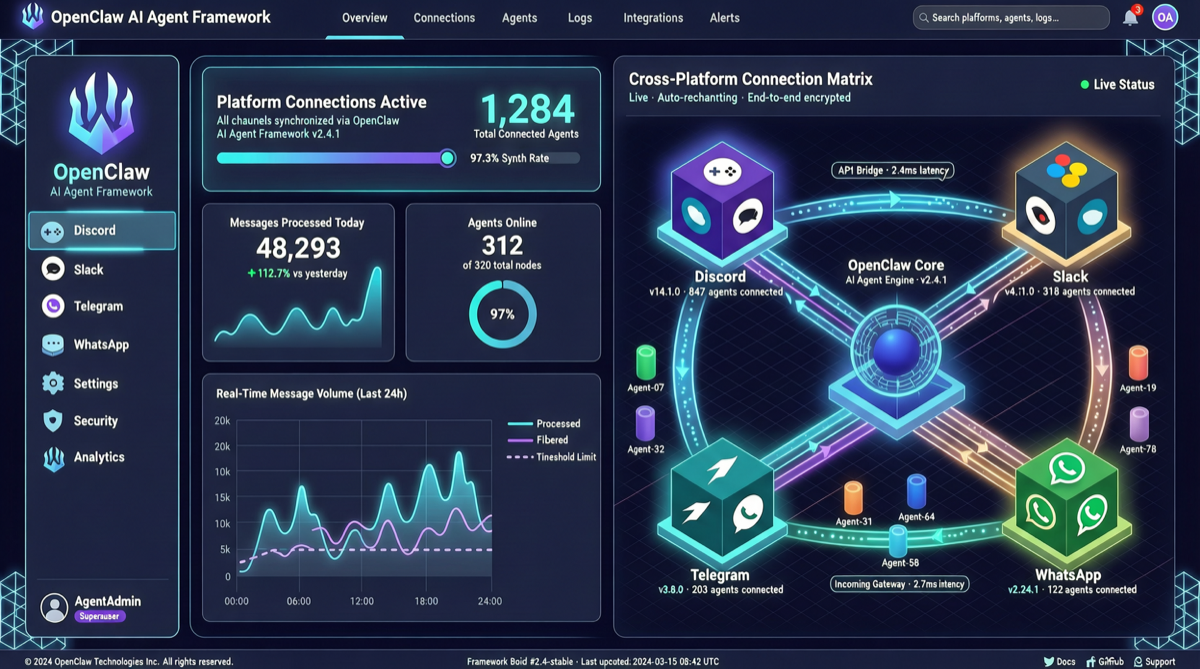
All four integrated communication channels — Discord, Slack, Telegram, and WhatsApp — received fixes. While the official announcement didn’t detail specific bugs, community feedback suggests these issues centered on:
- Message loss or duplicate sending
- Long conversation context loss
- Connection interruptions caused by specific platform API changes
TTS and Voice Calling
Voice functionality is a continuous investment area for OpenClaw. This update “polished” TTS (Text-to-Speech) and real-time voice calling, including:
- Latency optimization for voice generation
- Improved call interruption recovery mechanisms
- Voice quality tuning
Combined with the “TTS got serious” update from version 4.25, OpenClaw is building a complete voice agent capability stack.
Competitive Comparison
| Dimension | OpenClaw 2026.5.2 | Codex (OpenAI) | Claude Code (Anthropic) |
|---|---|---|---|
| Multi-Model Support | ✅ Dozens (including local models) | ❌ GPT series only | ❌ Claude series only |
| Grok 4.3 | ✅ Native integration | ❌ | ❌ |
| Local Deployment | ✅ Full support | ❌ | Partial support |
| Voice Agent | ✅ TTS + Real-time calling | Limited | Limited |
| Multi-Platform Communication | ✅ Discord/Slack/TG/WA | ❌ | ❌ |
| Open Source | ✅ MIT | ❌ | ❌ |
OpenClaw’s core differentiation lies in model agnosticism — not tied to any single vendor, users can switch backend models at any time. With Grok 4.3 becoming the leader in agentic tool calling, this advantage becomes even more pronounced.
Action Recommendations
- Existing users: Update to v2026.5.2 immediately — the improved tool calling success rate with Grok 4.3 integration is worth the upgrade.
- New users: If you need multi-platform communication agents (especially Discord/Slack), OpenClaw is currently the most mature open-source solution.
- Local deployment users: Combined with Ollama, OpenClaw supports fully offline agent operation, suitable for data privacy-sensitive scenarios.
- Watch out: OpenClaw’s update cadence is very fast (three releases in one week). Stay tuned to its release channels for timely feature updates and security fixes.