Core Conclusion
In the “Learn to Build AI Agents in 90 Days” GitHub trending list, Pipecat is listed as the first recommended project — “powering most production voice agents you’ve actually used.”
Core selling points:
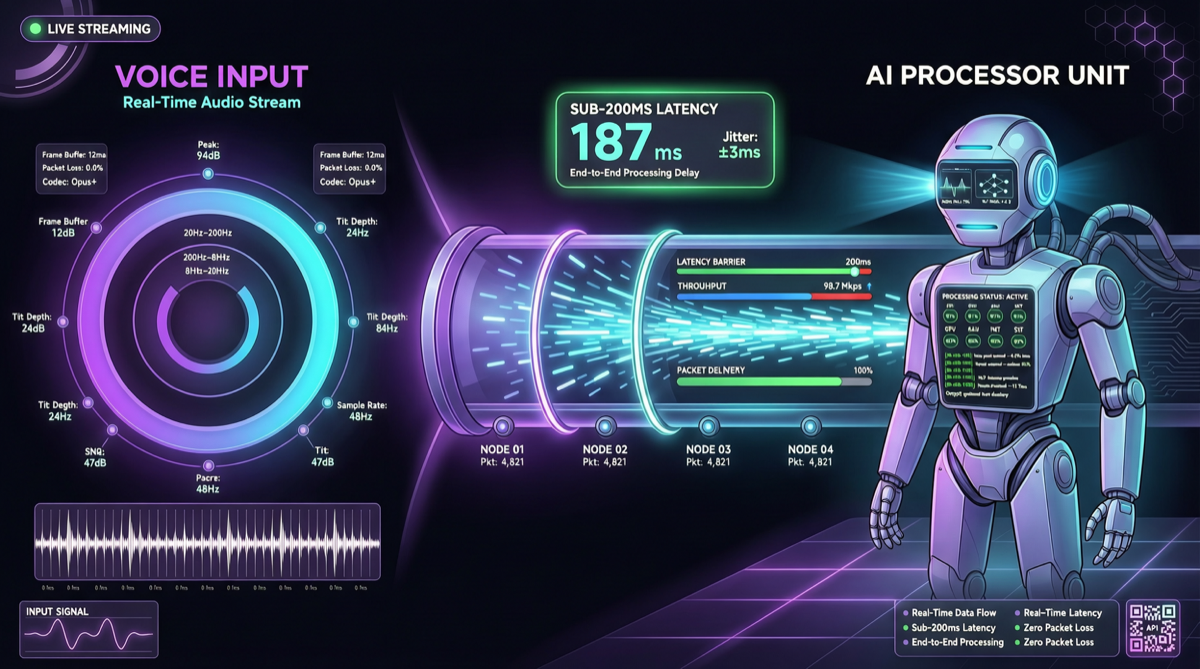
- <200ms end-to-end latency: The complete chain from user speech to AI response controlled within 200ms
- Production-grade: Not a demo, but a framework designed for actual deployment
- Python native: Developer-friendly for Python developers
- Multimodal pipeline: Supports streaming processing pipelines for voice, text, and images
What Is Pipecat
Pipecat is a real-time voice AI framework, focused on building low-latency voice conversation agents. Its core architecture is a “pipeline” system that chains speech input → speech recognition → LLM inference → speech synthesis → speech output into a single streaming processing chain.
Architecture Overview
User Speech → VAD (Voice Activity Detection) → STT (Speech-to-Text) → LLM → TTS (Text-to-Speech) → User Hears
                ↑                                                                                ↓
                └──────────────────── Streaming Processing ─────────────────────────────────────┘
Key design decisions:
- Full-chain streaming: Each stage processes in real-time, no need to wait for the previous stage to fully complete
- VAD-driven: Only activates downstream processing when user speech is detected, saving compute resources
- Model agnostic: STT, LLM, and TTS stages can independently choose different providers
Core Components
| Component | Function | Supported Providers |
|---|---|---|
| VAD | Detects when the user is speaking | Silero, WebRTC |
| STT | Speech-to-text | Whisper, Deepgram, Google STT |
| LLM | Conversation reasoning | OpenAI, Anthropic, Groq, local models |
| TTS | Text-to-speech | ElevenLabs, Cartesia, OpenAI TTS, Coqui |
| Transport | Transport protocol | WebSocket, Daily.co, LiveKit |
Competitor Comparison
| Framework | Language | Latency | Real-Time Voice | Production Ready | Learning Curve |
|---|---|---|---|---|---|
| Pipecat | Python | <200ms | ✅ Core focus | ✅ | Medium |
| LiveKit Agents | Python/JS | <300ms | ✅ | ✅ | Low |
| Vocode | Python | <400ms | ✅ | ✅ | Low |
| Twilio Autopilot | - | >500ms | Limited | ✅ | Low |
| LangChain Voice | Python | >500ms | ✅ (plugin) | Experimental | High |
Pipecat’s advantage lies in latency control and pipeline flexibility. <200ms latency means the conversation experience approaches real human conversation (average human conversation response latency is about 200-300ms).
Quick Start
Installation
pip install pipecat-aiMinimal Example
from pipecat.pipeline.pipeline import Pipeline
from pipecat.pipeline.runner import PipelineRunner
from pipecat.services.openai import OpenAILLMService
from pipecat.transports.services.daily import DailyTransport

# Configure transport layer (using Daily.co)
transport = DailyTransport(
    room_url="https://your-room.daily.co",
    token="your-token",
    bot_name="Pipecat Bot"
)

# Configure LLM
llm = OpenAILLMService(model="gpt-5.4", api_key="your-key")

# Build pipeline
pipeline = Pipeline([
    transport.input(),   # Receive audio
    llm,                  # LLM inference
    transport.output()    # Send audio reply
])

# Run
runner = PipelineRunner()
await runner.run(pipeline)
Custom STT + TTS
from pipecat.services.deepgram import DeepgramSTTService
from pipecat.services.elevenlabs import ElevenLabsTTSService

stt = DeepgramSTTService(api_key="dg-key")
tts = ElevenLabsTTSService(api_key="11labs-key", voice_id="Rachel")

pipeline = Pipeline([
    transport.input(),
    stt,                  # Speech-to-text
    llm,                   # Conversation reasoning
    tts,                   # Text-to-speech
    transport.output()
])
Typical Use Cases
| Scenario | Configuration Suggestion | Estimated Latency |
|---|---|---|
| Customer service bot | GPT-5.4 + ElevenLabs | ~150ms |
| Language companion | Local model + Coqui TTS | ~180ms |
| Voice assistant | Groq + Cartesia TTS | ~120ms |
| Meeting summary | Deepgram STT + Claude | N/A (non-real-time) |
Cost Estimation
For a voice agent with 1,000 calls/day averaging 5 minutes each:
| Component | Provider | Monthly Cost (estimated) |
|---|---|---|
| STT | Deepgram | ~$150 |
| LLM | GPT-5.4 | ~$500 |
| TTS | ElevenLabs | ~$200 |
| Transport | Daily.co | ~$100 |
| Total | ~$950/month |
If using DeepSeek V4 Pro (discounted price) instead of GPT-5.4, LLM costs can be reduced by approximately 90%, bringing total cost down to ~$500/month.
Action Recommendations
- Voice Agent developers: If you’re building real-time voice conversation applications, Pipecat is currently the most mature option in the Python ecosystem.
- Existing LangChain users: Pipecat’s pipeline concept differs from LangChain — it’s designed for streaming real-time scenarios. If your application needs low-latency voice interaction, consider migration.
- Cost control: STT and TTS costs are often underestimated. Plan usage estimates early in the project. Deepgram and Cartesia offer good cost-performance ratios worth attention.
- Local deployment: Combined with Whisper.cpp (STT) and Coqui TTS (speech synthesis), Pipecat can run completely locally, suitable for scenarios with high data privacy requirements.