What Happened
OpenClaw released two version updates within May 6-7, taking a path entirely different from the current Agent framework landscape — not competing on new features, but on stability.
v2026.5.3 Key Changes
| Update | Description |
|---|---|
| File Transfer Plugin | New bundled file-transfer plugin with binary file operation support |
| Hardened Plugin Management | Strengthened plugin management mechanism for improved security |
| Gateway Performance Optimization | Gateway layer performance tuning, reduced response latency |
| Channel Streaming Improvements | Enhanced streaming output across communication channels |
| New Agent Commands | Multiple new Agent operation commands added |
v2026.5.5 Key Changes
According to the developer's own description, this version is "not flashy — it's all about stability, polish, and making daily agent workflows less annoying":
- Cross-channel reliability fixes (Discord, Slack, Telegram, etc.)
- Annoying bug fixes in daily interactions
- Extensive polish-level experience improvements
Why It Matters
A "Maturity Signal" for Agent Frameworks
The current Agent framework landscape (LangChain, CrewAI, Dify, OpenClaw, etc.) is at a critical turning point:
- 2024-2025: Feature competition — who supports more models, more tools, more orchestration patterns
- 2026: Stability competition — who provides reliable, predictable, crash-free Agent runtime environments
OpenClaw's choice to focus on "fixing bugs, improving stability" after features are already relatively complete sends an important signal: Agent frameworks are moving from early exploration toward production readiness.
Strategic Significance of the File Transfer Plugin
Adding binary file transfer capability means OpenClaw is moving toward becoming a "full-featured Agent runtime." Not just text and code — images, PDFs, audio, and video binary files can all be reliably transferred between Agents, directly expanding Agent use cases:
- File exchange in multi-Agent collaboration
- Binary data interaction between Agents and external systems
- Rich media content processing and delivery
Value of Gateway Performance Optimization
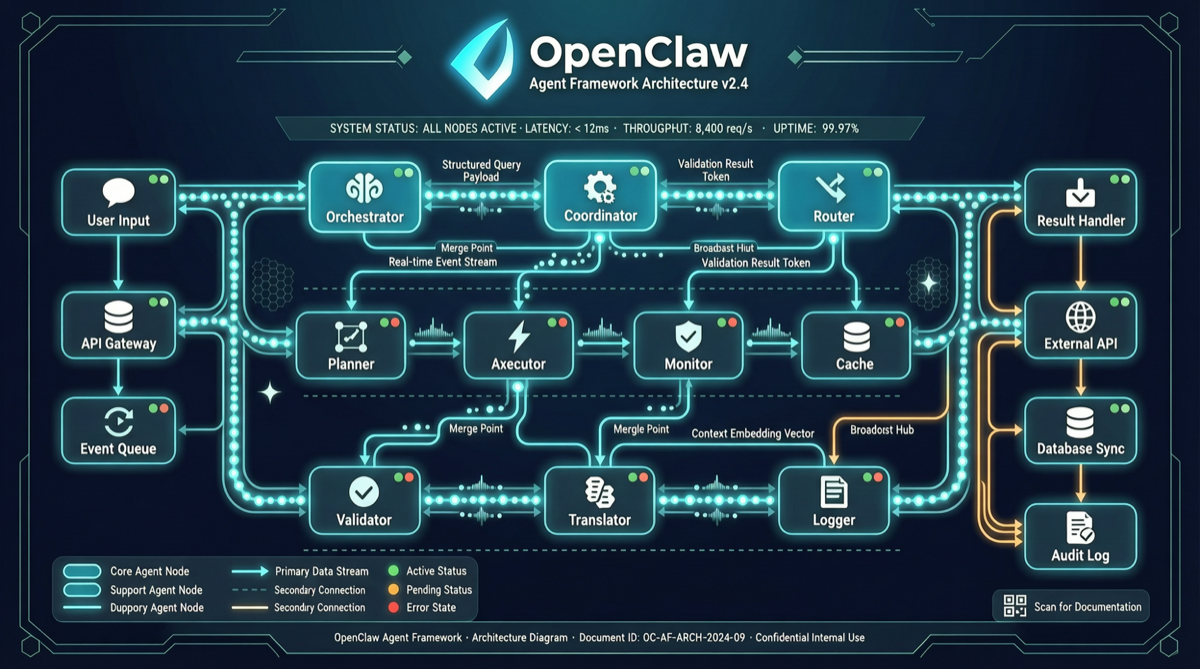
The Gateway is the core hub in OpenClaw's architecture connecting multiple Agent instances. Performance optimization directly impacts:
- Response speed of multi-Agent orchestration
- Processing capacity for large-scale concurrent tasks
- Overall system resource utilization
Comparison with Other Frameworks
| Dimension | OpenClaw | LangChain | CrewAI | Dify |
|---|---|---|---|---|
| Current Phase | Stability polishing | Ecosystem expansion | Agent orchestration enhancement | Platformization |
| Deployment | Self-hosted/cloud | SDK/self-hosted | SDK | SaaS/self-hosted |
| Best For | Multi-Agent collaboration | Flexible customization | Team Agents | Visual orchestration |
| Latest Version Strategy | Stability-first | Feature-first | Orchestration-first | Platform-first |
How to Use It
If you are evaluating Agent frameworks for production use:
Reasons to choose OpenClaw:
- Need multi-Agent collaborative workflows (Swarm mode)
- Value system stability and reliability over flashy features
- Require self-hosting with full data control
- File transfer and multi-channel communication are core requirements
Quick Experience:
# Install latest version
npm install -g openclaw

# Check version
openclaw --version  # Should show 2026.5.5

# Start Gateway
openclaw gateway start
Landscape Assessment
OpenClaw's "stability battle" strategy reflects the maturation trend of the Agent framework landscape. As feature gaps narrow, reliability and developer experience will become the core of differentiated competition. This means:
- For enterprise users: Now is a better time to build production systems with Agent frameworks
- For framework developers: Stability investments are starting to pay off (user retention, word-of-mouth)
- For the entire industry: Agent frameworks are transitioning from "toys" to "tools"