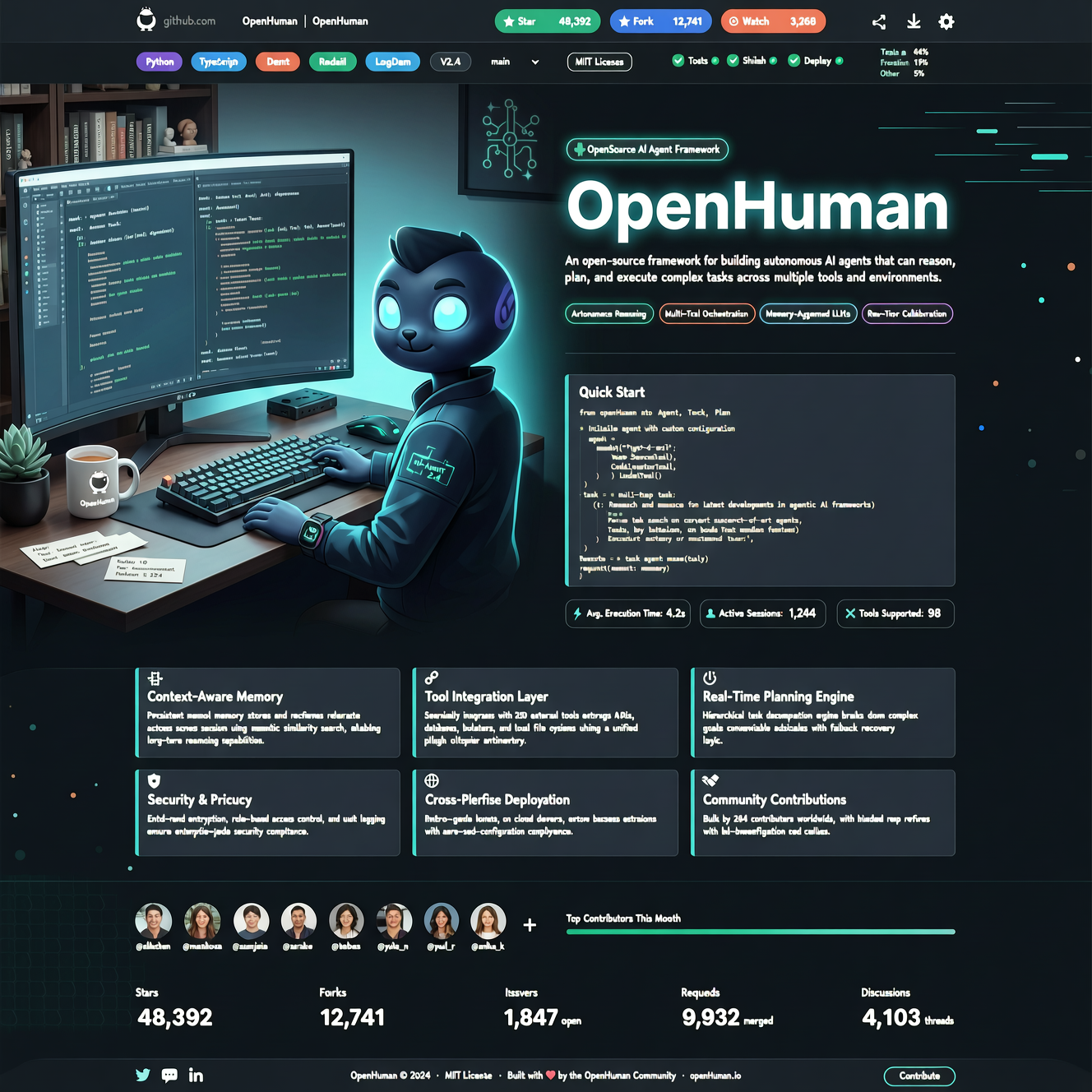
The top spot on GitHub Trending has a new owner.
A project called OpenHuman gained 1,271 stars within 24 hours, bringing its total to over 9,200. Its tagline is "Your Personal AI super intelligence."
Slogans like this aren't uncommon in the AI community. But OpenHuman's rapid star growth suggests it has truly tapped into a specific need.
What is OpenHuman
In the developers' own words: an open-source agentic assistant designed to integrate seamlessly into your daily life.
It's not just a simple chatbot, but rather a "Personal AI Operating System" that attempts to connect all your digital life. Its core features have several highlights:
118+ Third-party integrations with automatic data fetching. Gmail, Notion, GitHub, Slack, Stripe, Calendar, Google Drive, Linear, Jira—connect once via OAuth, and OpenHuman automatically fetches the latest data from each active connection every 20 minutes, injecting it into the memory system. No need to write polling loops or set up cron jobs; the agent just knows "what context you'll need tomorrow morning."
Memory Tree + Obsidian Knowledge Base. This is OpenHuman's most unique design. All connected data is normalized into Markdown blocks of no more than 3,000 tokens, scored, and folded into a hierarchical summary tree stored in a local SQLite database. The same data is also exported as .md files into an Obsidian-compatible vault—you can open, browse, and edit them. Inspired by Karpathy's obsidian-wiki workflow.
TokenJuice Compression Technology. Every tool call, scraping result, email body, and search payload passes through a token compression layer before being fed to the LLM. It converts HTML to Markdown, shortens long URLs, and removes non-ASCII characters. The official claim is a reduction of up to 80% in token consumption and latency.
Model Routing. Different tasks are automatically routed to the most suitable LLM (reasoning model, fast model, or vision model), all handled with a single subscription. It also supports running local models via Ollama.
Desktop Mascot. OpenHuman features a desktop pet avatar that can talk, react to its surroundings, join Google Meet calls as a real participant, remember you across weeks, and even continue thinking in the background after you stop typing.
Why Did It Suddenly Go Viral?
OpenHuman isn't a project that just appeared today. It already has 1,902 commits, 8 branches, and 61 tags, indicating development has been ongoing for a while. However, the gain of 1,271 stars in 24 hours shows it has landed at exactly the right moment.
Several possible reasons explain this:
The local-first AI trend. As cloud-based AI services like Claude and GPT become mainstream, more users are growing concerned about privacy and data security. OpenHuman's "local SQLite storage" and "local model support" directly address this anxiety.
Practical demands for AI Agents. Users have evolved from "chatting with AI" to "having AI do things for me." OpenHuman's 118+ integrations and automatic data fetching give agents true "memory" and "context," so they no longer start from scratch with every conversation.
The appeal of open-source alternatives. While Anthropic pushes Claude for Business and OpenAI rolls out Codex integrations, an open-source, self-hostable personal AI assistant holds greater appeal for many technical users.
Details Worth Noticing
OpenHuman is currently marked as "Early Beta," which means:
- Features may be unstable
- Documentation may be incomplete
- It has rough edges
However, its commit frequency is very high (the latest commit was 9 minutes ago), indicating a highly active development team. The project supports macOS, Linux x64, and Windows, with installation options including a one-click script and desktop app downloads.
My Take
The viral success of OpenHuman reflects a clear trend: users are no longer satisfied with just "talking to AI"; they want a true AI assistant that understands them and can work autonomously.
But the "Personal AI Superintelligence" slogan might be a bit grandiose. OpenHuman's current core value lies in integration and memory management—it connects numerous services and organizes data into formats usable by agents. That's highly useful, but still a long way from "superintelligence."
What will truly determine whether it sustains this momentum comes down to two things:
- Stability. A beta product can have plenty of bugs, but they must not break core functionality. If connections to those 118 services drop frequently, the user experience will quickly collapse.
- Model quality. No matter how polished the wrapper is, an agent's underlying capabilities depend entirely on the LLM's quality. If the routed model isn't smart enough, all those integrations are for nothing.
Reaching 9,200 stars on GitHub is a great start. However, "star bubbles" are all too common in AI projects—users star a repo and never use it, leading the project to eventually fade into obscurity. OpenHuman needs to convert those stars into genuine active users to prove it's more than just another flash-in-the-pan trending project.
Primary Source: GitHub tinyhumansai/openhuman